
The Data Layer Advantage: How P&C Insurers Can Modernize in 6–9 Months
Why mid-market carriers don’t need to replace their core systems to win the AI race — they just need to build smarter around them.
The property and casualty insurance industry is facing a moment of reckoning. According to a 2025 BriteCore report, while 67% of carriers acknowledge that modernization is essential to their competitiveness, a staggering 86% remain dissatisfied with their analytics capabilities. Even more alarming: over 60% of carriers are piloting AI, yet fewer than 15% have successfully scaled it across core operations.
The gap between AI ambition and data reality is not a technology problem. It’s an architecture problem — and it’s one that Perceptive Analytics has spent years helping mid-market carriers solve.
The Margin Math Demands Action
The financial pressure is concrete. In the United States, the combined ratio — a key measure of underwriting profitability — was at its strongest in over a decade in 2024, sitting at 97.2%. But Swiss Re projects it will worsen to 98.5% in 2025 and 99% in 2026. At a 99% combined ratio, there is virtually no margin left for operational inefficiency, manual processes, or delayed decisions.
Add to this the growing volatility from natural catastrophes, with global insured losses trending toward $145 billion in 2025, and the case for real-time data infrastructure becomes undeniable. Carriers need dynamic portfolio steering and instant catastrophe response — capabilities that simply cannot be delivered by batch-processed data and siloed legacy systems.
This is exactly where Perceptive Analytics’ AI consulting practice comes in — helping carriers move from reactive reporting to real-time, intelligence-driven operations.
Why “Bolting On” AI Doesn’t Work
Many carriers have tried the obvious shortcut: layering AI tools on top of existing systems. Chatbots on policy platforms. Fraud detection on claims databases. Pricing models on rating engines. The result is what the ebook calls “patchwork AI” — point solutions that appear to solve immediate problems but compound technical debt with every deployment.
Each new AI initiative requires custom integrations, manual data extracts, and complex reconciliation processes. The architecture becomes more fragile with each addition, and the carriers end up with more complexity, not less intelligence.
The hard truth is simple: AI cannot deliver value if the underlying platforms cannot provide clean, contextual, real-time data. You can’t build a smart house on a crumbling foundation.
Visualization tools like Power BI and Tableau are powerful — but only when the data flowing into them is unified, clean, and real-time. Without a modern data layer underneath, even the best dashboards are just a polished view of a broken foundation.
The 6–9 Month Alternative
The ebook from Perceptive Analytics presents a different path — one validated across multiple carrier deployments. Instead of a 3–5 year core system overhaul, mid-market carriers can achieve AI-ready infrastructure, unified analytics, and operational intelligence in just 6 to 9 months. The critical distinction: these transformations are scoped as data layer modernization, not core system replacement.
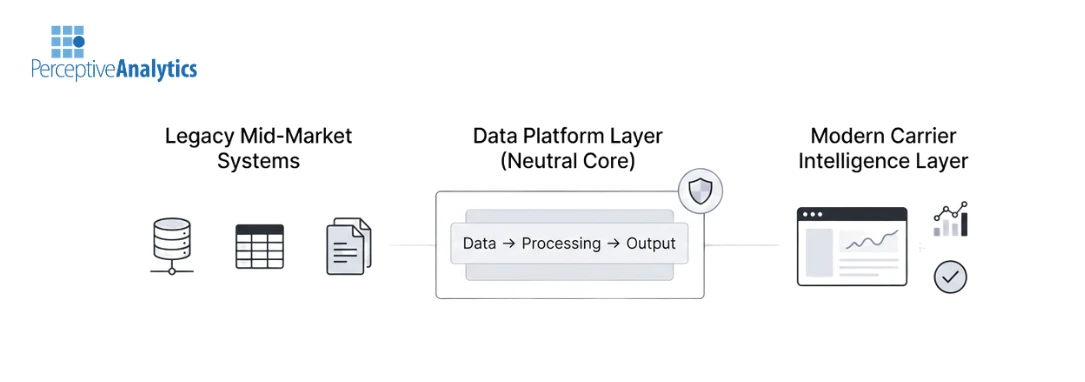
The approach involves building an intelligence fabric alongside existing systems, rather than ripping them out. This means deploying a unified cloud-native lakehouse architecture — using platforms like Snowflake, Databricks, or Microsoft Fabric — that sits beside the legacy core and draws from it, rather than replacing it.
The transformation follows three phases:
The 90-Day Foundation Sprint focuses on establishing the data infrastructure — cloud environment setup, core integrations, and identifying three to five high-value business use cases to anchor the work. This is where Perceptive Analytics’ data engineering and Talend consulting expertise proves critical for building reliable, scalable data pipelines from day one.
The 6-Month Operational Scale expands that foundation into working analytics: underwriting command centers where submissions arrive pre-analyzed, claims orchestration with automatic routing and reserve adjustment, and dynamic pricing that responds to real-time risk signals. At this stage, Power BI development services and Tableau implementation bring these insights to life for business users — turning raw pipeline data into decision-ready dashboards.
The 9-Month AI-Ready State is where intelligence becomes operational — not a pilot project, but a functioning layer that drives daily decisions across underwriting, claims, and portfolio management. Chatbot and AI-powered interfaces can then be layered in confidently, backed by a data infrastructure that can actually support them.
Leveling the Playing Field for Mid-Market Carriers
Large carriers like State Farm, Allstate, and Progressive have invested billions in data infrastructure, creating what seems like an insurmountable gap. But mid-market carriers hold structural advantages that are often overlooked: less organizational inertia, deeper specialization in niche lines, and closer broker and customer relationships that generate unique data assets.
Cloud-native platforms have fundamentally changed the economics. A $500 million premium carrier can now deploy the same class of infrastructure as a $50 billion carrier — just at appropriate scale. The key differentiator is no longer budget size. It’s architectural pattern and execution speed.
Perceptive Analytics specializes in precisely this: delivering enterprise-grade analytics capabilities to mid-market organizations — without the enterprise-scale price tag. From Looker to Power BI to Tableau, the team brings the right tool to the right problem — integrated into a coherent, scalable data strategy.
The Seven Traps to Avoid
The ebook is candid about why 70% of data transformations fail to deliver business value. The most common mistakes include building infrastructure without clear use cases (“if we build a data lake, value will come”), attempting big-bang core replacements that stall and overrun budgets, waiting for perfect data quality before delivering any value, and running AI pilots in silos that can never be integrated or scaled.
The antidote to each is the same underlying principle: start with specific business outcomes, build incrementally, and modernize the data layer before deploying advanced AI on top of it. Engaging experienced advanced analytics consultants from the outset dramatically reduces the risk of falling into these traps — by grounding every technology decision in business value rather than architecture for its own sake.
The Window Is Closing
The embedded insurance market is projected to grow from $210.9 billion in 2025 to $950.59 billion by 2030 — a 35% compound annual growth rate. Carriers with modern data architecture will be positioned to capture that growth. Those still operating on batch-processed, siloed data will watch it pass them by.
As Perceptive Analytics frames it in their ebook: “The companies that lead aren’t the ones that score risk the best — they’re the ones that operationalize intelligence fastest.”
In 2026, speed is strategy. The 6–9 month transformation is not just possible. For mid-market P&C carriers, it’s necessary.
Ready to Build Your Data Layer Advantage?
Whether you’re looking to unify fragmented data, unlock real-time analytics, or make your infrastructure AI-ready — Perceptive Analytics has the expertise to get you there in months, not years.
Talk with our consultants today. Book a session with our experts now.
Our Work
Industry
- Industry
Function
- Function
-
Increasing Conversions with Adwords Spend Optimizer
How To Optimize Adwords Budget in Real Time
Free Download


-
Markdown Optimization for Retailers
A Methodology to Track Performance and Maximize Value
Free Download
-
Optimizing Marketing Spend with Marketing Mix Modeling
Using Statistical Modeling and Empirical Methods
Free Download
-
Leveraging Web Analytics for Customer Acquisition
Leveraging Web Analytics for Customer Acquisition
Free Download

*Subscribe to be the first one to know our latest updates
Contact us

You have crafted a powerful analytical tool for us. Thank you.
Alan Benjamin
Principal, Benjamin Realty Advisors

I have been working with Chaitanya and Perceptive Analytics for about 20 months now. They did BI / reporting and excel tool development. Their work helped us in channeling our periodic reports to the senior and operational management. The team exceeded my expectations. Chaitanya would ask thought provoking questions that trigger a new line of thinking. They created good dashboards so our senior team can quickly interpret reports. We were able to make progress because the team knew finance and tools they created were easy to implement.
Samir Lavani
CFO at Pearl Hospitality

Chaitanya and the Perceptive Analytics team worked on multiple strategic projects that involved Tableau data visualizations. Perceptive's work (~ 1 year) led to successful launch of our portal - this was an important milestone for us. Visualizations created were insightful, easy to understand and visually attractive. The team often suggested ways to show data in more intuitive way so our audience can understand it. They also knew Tableau well that helped in customizing it for our purposes. The team worked hard to finish the project on time managing expectations. I look forward to working with Perceptive on other projects.
Haroon Yaqoob
Principal at Nomenclature Inc.