


Executive Summary
Can you confidently identify the authoritative version of your customer data? For many organizations, that seemingly simple question becomes difficult to answer once data begins moving across business units, platforms, and external partners. This article examines how secure sharing frameworks help enterprises scale collaboration without sacrificing governance, traceability, or trust.
As data becomes a shared enterprise asset, organizations face a growing challenge: enabling broad access without creating uncontrolled copies, governance blind spots, and compliance risks. Traditional data sharing methods often duplicate data across teams, making lineage difficult to track and increasing security exposure. Modern sharing architectures such as Snowflake Shares, Delta Sharing, and Iceberg-based data products allow organizations to share data securely without replication. The organizations extracting the most value from data today are treating secure sharing as a governed platform capability rather than an access management exercise.
The Hidden Cost of Data Sharing Is Rarely the Data Itself
A Perceptive Analytics POV
Many organizations believe they have a data access problem when they actually have a data distribution problem. As business units, analytics teams, AI initiatives, and external partners consume more data, copies begin multiplying faster than governance teams can track them. The result is fragmented lineage, inconsistent definitions, duplicated storage costs, and growing compliance exposure.
At Perceptive Analytics, we increasingly see leading organizations shifting from “data movement” to “data access.” Instead of sending data to every consumer, they expose governed datasets through secure sharing frameworks that preserve a single source of truth. This approach improves trust, simplifies compliance, and creates a scalable foundation for future AI and data monetization initiatives.
Every New Copy Creates a Governance Problem That Gets Harder to See
Most governance programs focus heavily on access control. Yet many of the largest governance failures originate after access has already been granted.
A marketing team exports customer data into a separate workspace. A regional business unit creates its own reporting layer. An external partner receives periodic extracts through batch transfers. Each action appears reasonable in isolation. Collectively, they create a network of disconnected copies that governance teams can no longer fully monitor.
This challenge is becoming increasingly significant as organizations scale AI and advanced analytics initiatives. IBM reports that 35% of data breaches involve data residing in unmanaged or “shadow data” environments, highlighting the risks associated with uncontrolled copies and disconnected governance processes.
The issue extends beyond security. When multiple copies exist, organizations struggle to answer fundamental governance questions:
- Which version is authoritative?
- Who owns the data?
- Which downstream reports consume it?
- Has sensitive information been shared externally?
- What happens when retention policies change?
Once these questions become difficult to answer, trust in enterprise data begins to erode.
The Secure Sharing Architecture That Preserves Both Access and Control
The most successful organizations are adopting architectures that separate data access from data replication.This architecture enables teams to consume data directly from governed sources without generating additional physical copies. Instead of distributing datasets, organizations distribute permissions, metadata, and governed access paths.
Architecture Layer | Primary Objective | Recommended Approach |
Data Storage Layer | Maintain single source of truth | Centralized lakehouse or warehouse |
Sharing Layer | Enable secure consumption | Snowflake Shares, Delta Sharing, Iceberg Catalog Service |
Governance Layer | Enforce policy consistency | Catalogs, policy engines, metadata services |
Lineage Layer | Preserve traceability | Automated lineage tracking and active metadata |
Monitoring Layer | Audit and cost visibility | Usage analytics and access monitoring |
Monetization Layer | External commercialization | Metered consumption and pricing models |
The strategic value is significant. Storage growth slows, compliance visibility improves, and business teams gain faster access to trusted information.
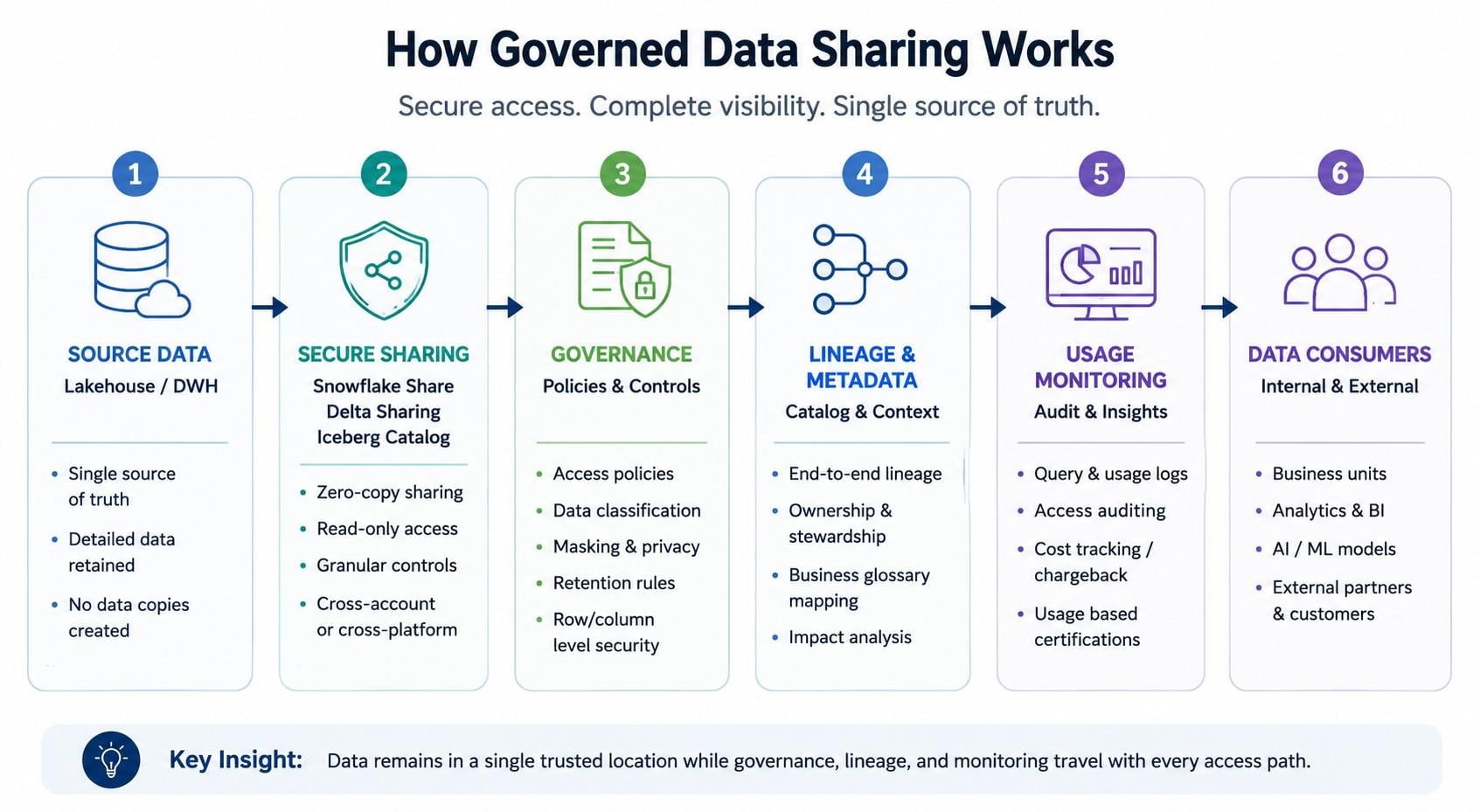
Lineage Breaks When Sharing Becomes Invisible
One of the most overlooked risks in modern data platforms is the loss of lineage visibility during data sharing. Many organizations successfully document lineage within their internal pipelines but lose visibility once data is shared externally or consumed across business domains.
Shared datasets frequently become disconnected from enterprise catalogs, preventing governance teams from understanding downstream impact. Gartner identifies lineage, metadata orchestration, and policy enforcement as core governance capabilities because governance effectiveness increasingly depends on visibility rather than manual oversight.
To prevent lineage fragmentation, organizations should ensure that every shared asset includes:
- Registered ownership metadata
- Business glossary mappings
- Source-to-consumer lineage relationships
- Data classification tags
- Consumption tracking
- Automated impact analysis
When lineage remains connected, governance teams can quickly identify which reports, AI models, dashboards, or partners are affected by schema changes, quality issues, or policy updates.
High-Maturity Organizations Govern Shares Like Products
The biggest difference between average and high-performing data organizations is how they manage shared datasets. Less mature organizations treat sharing requests as operational tickets. Mature organizations treat shared datasets as governed products with ownership, lifecycle management, service levels, and usage monitoring. A practical operating model includes:
Data Product Ownership
Each shared dataset has a designated business and technical owner accountable for quality, access approvals, and compliance.
Automated Certification
Shared assets must undergo quarterly recertification. Access that is no longer required should expire automatically.
Consumption Monitoring
Track which business units, applications, and external partners actively consume data. Dormant shares often become governance liabilities.
Policy Enforcement
Classification, retention, masking, and privacy controls should travel with the data rather than being recreated by consumers.
Cost Allocation
Usage metrics should support chargeback or showback models, particularly when sharing expands across multiple domains.
This product-oriented approach creates accountability while reducing governance overhead.
Data Monetization Becomes Practical Only After Sharing Is Governed
Many organizations view data monetization as a future initiative. In practice, secure sharing infrastructure often determines whether monetization is possible at all. Without governed sharing, organizations struggle to measure consumption, enforce licensing restrictions, or demonstrate compliance obligations to customers and regulators.
Modern sharing platforms increasingly allow organizations to:
- Publish governed data products externally
- Meter consumer usage
- Track contractual compliance
- Monitor query patterns
- Enforce data retention policies
- Support subscription-based revenue models
This is becoming strategically important as enterprises seek new revenue opportunities from proprietary data assets. The same governance capabilities that enable internal collaboration often become the foundation for external monetization programs.
A Five-Step Roadmap for Eliminating Shadow Copies
Step 1: Inventory Existing Sharing Mechanisms
Identify exports, replicated datasets, partner feeds, and unmanaged copies across the organization.
Step 2: Standardize on a Native Sharing Platform
Align sharing architecture with the primary data platform based on the table in the earlier sections to select the right platform.
Step 3: Connect Sharing to Metadata
Every shared dataset should automatically register ownership, lineage, classification, and usage information.
Step 4: Implement Continuous Monitoring
Track access patterns, dormant shares, query volumes, and policy violations.
Step 5: Introduce Recertification
Require quarterly approval renewals for all shared assets to eliminate governance drift and zombie shares. Organizations that operationalize these controls create a sustainable model for growth without proportional governance complexity.
Conclusion
Secure data sharing has become a foundational capability for modern enterprises. As organizations expand AI initiatives, partner ecosystems, and cross-functional analytics programs, unmanaged copies introduce risks that scale faster than governance teams can respond. The most effective strategy is to keep data centralized, make access governed, and ensure lineage remains visible throughout the entire consumption lifecycle.
Perceptive Analytics is here to help organizations design secure sharing architectures that preserve trust, accelerate collaboration, and create a foundation for future data monetization opportunities. The organizations that master governed sharing today will be significantly better positioned to scale data-driven growth tomorrow.