


Executive Summary
The highest-performing data platforms are no longer built on a single database. They combine specialized technologies to serve different workloads, from real-time transactions and analytical reporting to AI and vector search. While this improves performance, scalability, and cost efficiency, it also increases the risk of fragmented data, inconsistent business definitions, and governance blind spots. Organizations that succeed with polyglot storage treat governance as a shared enterprise capability rather than a database-specific responsibility. This article explores the architectural principles, governance framework, and operating model required to build a high-performance polyglot data platform without compromising trust.
Performance Should Be Specialized. Governance Should Be Universal.
A Perceptive Analytics POV
The conversation around enterprise data platforms has shifted. The question is no longer whether organizations should adopt multiple database technologies. The reality is that modern workloads demand them. Analytical warehouses, operational databases, vector stores, caching engines, and local analytical databases each solve a distinct business problem more efficiently than a single generalized platform ever could.
What differentiates mature organizations is not the number of technologies they deploy but how consistently they govern them. At Perceptive Analytics, we have seen organizations achieve significantly better scalability by separating data ownership from data consumption. Specialized databases continue to evolve with business requirements, while metadata, business definitions, lineage, security policies, and ownership remain centralized. This architectural discipline enables innovation without creating disconnected data estates that become increasingly expensive to govern.
Every New Database Should Solve a Performance Problem, Not Create a Governance Problem
Polyglot storage has become a natural outcome of digital transformation. As organizations introduce AI, real-time analytics, personalization engines, and operational intelligence, different workloads begin demanding fundamentally different storage capabilities.
Attempting to satisfy every requirement with a single database often results in unnecessary compromise.
Business Requirement | Preferred Technology Characteristic |
High-volume transactions | ACID compliance and low-latency writes |
Enterprise reporting | Massively parallel analytical processing |
Recommendation engines | Vector similarity search |
Application acceleration | In-memory caching |
Data science exploration | Lightweight local analytical execution |
This explains why modern enterprise architectures increasingly combine PostgreSQL, Snowflake, Redis, Pinecone, DuckDB, and streaming platforms within the same ecosystem. The technology strategy itself is rarely the problem. The challenge begins when each specialized database gradually evolves into another version of enterprise truth.
According to IBM’s Cost of a Data Breach Report 2024, 35% of data breaches involve shadow data, where organizations have lost visibility into duplicated or unmanaged datasets. As polyglot environments grow, every uncontrolled replica increases the difficulty of understanding which dataset is authoritative, who owns it, and whether governance policies remain consistent.
Without an enterprise-wide governance strategy, fragmentation begins appearing in multiple forms.
Business fragmentation
- Different KPI definitions across reporting platforms.
- Multiple customer records with inconsistent ownership.
- Conflicting business glossaries maintained by different teams.
Technical fragmentation
- Independent schema changes across storage engines.
- Replication pipelines operating without centralized monitoring.
- Broken lineage between operational and analytical environments.
Operational fragmentation
- Duplicate storage costs.
- Longer audit cycles.
- Increasing manual reconciliation between systems.
- Reduced confidence in enterprise reporting.
Research from Gartner consistently identifies active metadata management as a foundational capability for modern data governance because organizations are no longer governing one platform. They are governing an ecosystem of interconnected storage technologies. The strategic question for CXOs therefore changes.
It is no longer: “Which database should we standardize on?” Instead, it becomes:
“How do we allow every workload to use the best database while ensuring every database follows the same governance model?”
Optimize Workloads, Not Ownership
One of the most common mistakes in polyglot architectures is allowing every storage platform to become responsible for its own version of enterprise data. Mature organizations separate where data is created from where data is consumed. The principle is simple:
Data should be written once, governed once, and optimized many times.
Workload | Recommended Database | Business Benefit | Governance Principle |
Enterprise Analytics | Snowflake | High-performance analytical queries | Analytical copy only. Business ownership remains with the source system. |
Operational Applications | PostgreSQL | Reliable transactional processing | Authoritative operational record. |
Real-Time Applications | Redis | Millisecond response times | Cache is regenerated automatically and never becomes a permanent record. |
AI & Semantic Search | Pinecone | Vector search for LLMs and recommendations | Embeddings originate from governed enterprise datasets. |
Analyst Exploration | DuckDB | Fast local analytics | Temporary datasets governed through lifecycle policies. |
Notice that the storage technologies are different, but ownership never changes. Every customer record, financial transaction, supplier profile, or product master should have one authoritative source, regardless of how many optimized copies exist across downstream platforms. Replication should also follow clearly defined business rules rather than technical convenience.
For example:
- CDC (Change Data Capture) should synchronize operational systems requiring near real-time consistency.
- Event-driven streaming should distribute information immediately to AI and operational services.
- Batch replication remains appropriate for many analytical and financial reporting workloads where minute-level freshness provides little additional business value.
Choosing the appropriate synchronization strategy allows organizations to balance performance, infrastructure cost, and governance complexity simultaneously.
Most importantly, introducing a new database should never require redefining ownership, security classifications, or business terminology. Those responsibilities belong to the enterprise governance layer, not the storage engine. When this principle is followed consistently, organizations gain the flexibility to adopt future technologies without repeatedly rebuilding governance from scratch.
The Strongest Polyglot Architectures Are Governed by Metadata, Not by Databases
Adding more databases does not have to increase governance complexity. What increases complexity is allowing each database to develop its own understanding of enterprise data.
High-performing organizations therefore build what many Gartner reports refer to as an active metadata layer. Rather than embedding governance inside every storage engine, they centralize metadata and allow governance policies to flow consistently across every platform. Think of metadata as the control plane of a polyglot architecture. While databases optimize storage and query execution, the metadata layer governs meaning, ownership, security, quality, and lineage.
A mature metadata control plane should answer five questions for every enterprise dataset:
- Who owns this data?
- Which system is the authoritative source?
- Where has this data been replicated?
- Which dashboards, AI models, or applications consume it?
- What is the impact if the schema changes today?
When these questions can be answered instantly, adding another database becomes an infrastructure decision rather than a governance challenge. Instead of managing governance independently within Snowflake, PostgreSQL, Redis, or Pinecone, leading enterprises centralize capabilities such as:
- Business glossary for standardized KPI definitions.
- Enterprise data catalog covering every storage platform.
- Schema registry to govern structural changes.
- Automated lineage from source systems to downstream consumers.
- Policy engine for masking, retention, and access control.
- Data quality rules enforced consistently across replicated environments.
According to Gartner, organizations that invest in active metadata management significantly improve governance automation because metadata continuously drives lineage analysis, impact assessment, and policy enforcement instead of relying on manual documentation.
This architectural separation also accelerates change. When a source application modifies a customer attribute or introduces a new product hierarchy, the metadata layer identifies every downstream dependency before deployment. Development teams understand which dashboards, APIs, machine learning models, and reporting environments require updates, reducing the operational risk of schema evolution.
At Perceptive Analytics, we increasingly recommend treating metadata as a shared enterprise service rather than another platform feature. Storage technologies will continue evolving, but the principles governing enterprise data should remain stable.
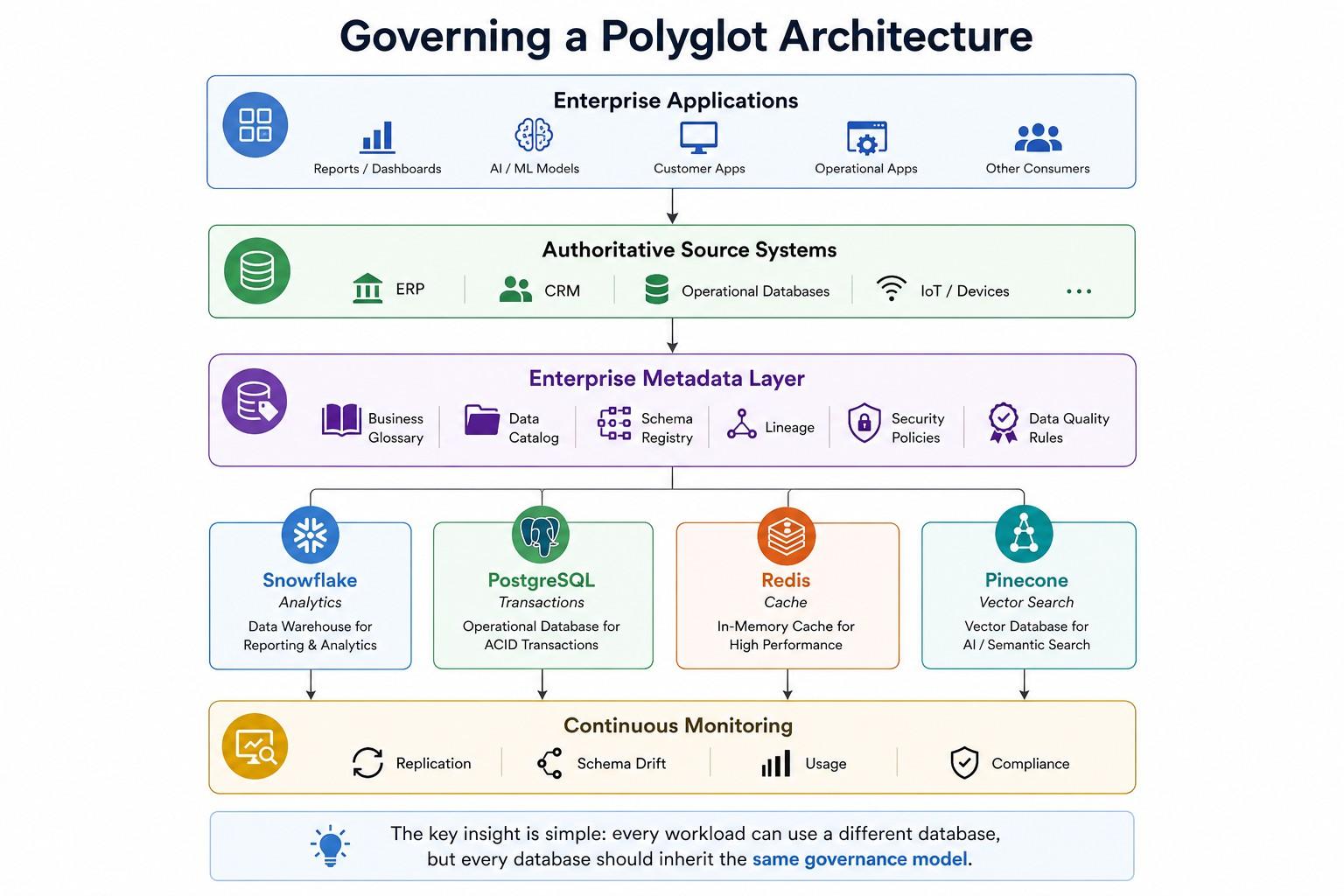
The key insight is simple: every workload can use a different database, but every database should inherit the same governance model.
Case Study: Booking.com’s Approach to Governing Polyglot Storage
One of the strongest examples of governed polyglot storage comes from Booking.com, whose data platform supports hundreds of internal teams making operational, analytical, and product decisions simultaneously.
Rather than forcing every workload onto a single storage technology, Booking.com adopted purpose-built platforms that optimize different access patterns. Operational systems continue handling transactional workloads, while analytical and cloud-native platforms process large-scale reporting and experimentation. This separation enables engineering teams to improve performance without compromising operational stability.
As the architecture expanded, governance became a much bigger challenge than storage selection. Public engineering discussions describe how Booking.com focused on centralized policy management, unified access governance, and standardized metadata across platforms instead of allowing individual storage technologies to implement governance independently.
The scale illustrates why this approach became necessary.
- The platform processes approximately 2.5 billion events every day.
- Pipeline modernization reduced end-to-end data latency by 73%, lowering processing time from more than six hours to under ninety minutes.
- Engineering teams achieved 99.95% pipeline reliability while supporting a growing analytical ecosystem.
- The governed data platform now supports more than 1,500 internal data users consuming information from over 500 enterprise data sources.
The technology itself was only part of the success story. Without centralized governance, billions of daily events would simply have produced billions of additional governance decisions. Instead, Booking.com separated platform optimization from enterprise governance. Policies governing access, ownership, and metadata remained consistent regardless of where data was stored or processed.
The lesson for CXOs is significant. Organizations rarely struggle because they adopt too many databases. They struggle because governance expands at the same pace as infrastructure. Mature enterprises reverse this equation by allowing infrastructure to diversify while governance remains centralized.
Five Metrics That Reveal Governance Debt Before It Becomes a Business Problem
Most organizations monitor storage utilization, compute costs, and query performance. Far fewer monitor whether their polyglot architecture is becoming progressively harder to govern.
The following indicators provide an early warning system for fragmentation.
Metadata Coverage
Measure the percentage of enterprise datasets registered within the centralized data catalog.
Target: Greater than 95%.
Lineage Completeness
Track how many analytical assets maintain end-to-end lineage from source systems to business consumption.
Target: Greater than 90%.
Orphaned Dataset Ratio
Measure datasets that have no documented owner or active business consumer.
Target: Less than 5%.
Replication SLA Compliance
Monitor whether synchronization pipelines consistently meet agreed freshness objectives.
Target: Greater than 99% adherence.
Definition Consistency
Measure how many critical business KPIs are governed through a centralized business glossary rather than independently recreated by individual teams.
The organizations achieving the greatest success with polyglot storage do not simply monitor infrastructure performance. They monitor governance health with the same discipline applied to operational availability, enabling them to identify fragmentation long before it affects decision-making, regulatory compliance, or business trust.
Conclusion
Polyglot storage is no longer an architectural choice reserved for technology leaders. It is becoming a business necessity as enterprises support increasingly diverse analytical, operational, and AI workloads. The organizations that will realize its full value are those that separate workload optimization from governance, ensuring every specialized database operates within a single framework of ownership, metadata, lineage, and policy enforcement. At Perceptive Analytics, we help organizations build governed polyglot data platforms that deliver high performance without compromising trust, consistency, or control, enabling enterprises to scale confidently as their data ecosystem evolves.