TRUSTED BY ANALYTICS TEAMS AT





We design cloud-native data engineering services on AWS, Azure, GCP, Snowflake, and Databricks that make analytics and AI investments pay off. Faster insights. Lower cloud spend. Governed, production-grade pipelines your team actually trusts.
TRUSTED BY ANALYTICS TEAMS AT
Every one of these is a symptom of fragile, handwritten data pipelines.
A retiring engineer wrote 40 Python scripts eight years ago. Two break every month. Your data engineering service providers should replace this with orchestrated, version-controlled pipelines.
Your data science team's productivity is capped by data quality. Feature stores don't exist. Schemas drift silently. Data quality engineering closes that gap.
When a pipeline breaks at 2 AM, the on-call engineer knows it broke but has no idea why. We implement orchestration + observability parity.
Cloud data warehouses are elastic, which means they can run up massive bills if unoptimized. We implement per-pipeline cost attribution.
A source system adds a column and three downstream dashboards break silently. Contract-driven pipelines catch this in CI.
Data scientists spend 80% of their time cleaning data because there is no dedicated engineering support. We provide scalable engineering pods.
From strategy to embedded platforms, we cover every layer.
Data pipeline development services covering ingestion, transformation, orchestration, and monitoring. Airflow, dbt Cloud. Test-driven, version-controlled.
Big data engineering services for Databricks, EMR, and Lakehouse architectures. PySpark job optimization, Delta Lake ingestion.
Cloud data engineering services on AWS, Azure, and GCP. Landing zone design, Terraform-managed infra, per-workload cost attribution.
Streaming data engineering services with Kafka, Kinesis, Pulsar, and Flink. Exactly-once processing, schema-registry governance.
Data platform consulting for organizations replatforming their data stack. Modern data stack selection, build-vs-buy, reference architecture.
Data infrastructure consulting focused on underlying compute, storage, network, and observability layers. Kubernetes for data.
Data quality engineering with Great Expectations, dbt tests, Soda. Contract-driven pipelines, alerting on drift, blameless post-mortems.
MLOps data engineering — feature stores, model registries, online + offline serving. The engineering that makes ML production-worthy.
How we architect end-to-end data platforms for high-growth enterprises
A B2B payments platform processing 1M+ customer transactions was fighting fragmented data pipelines, 45-minute query latencies, and reconciliation errors that leaked into monthly revenue reporting.
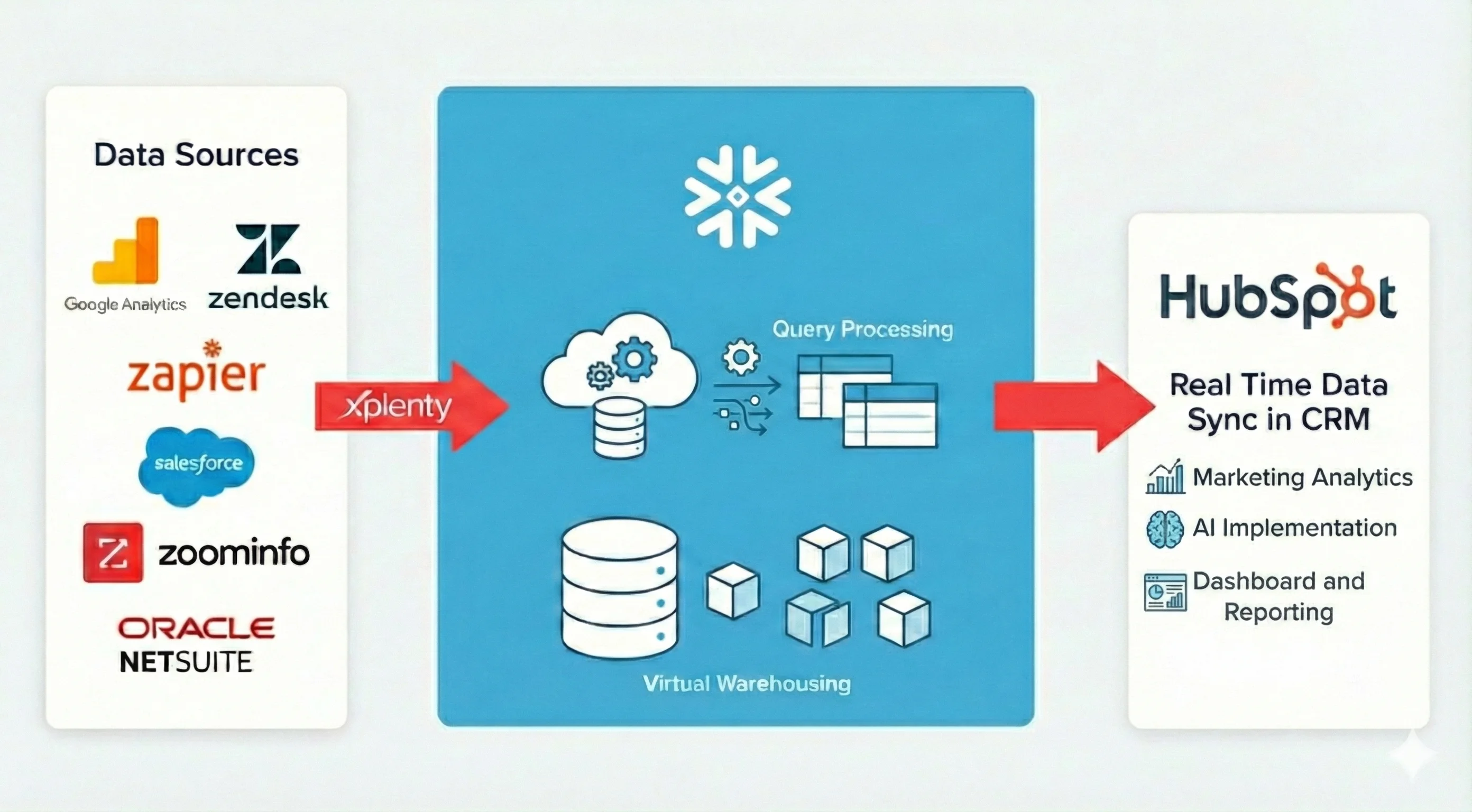
We architected a unified Lakehouse pipeline using Kafka, dbt, and Snowflake to handle exactly-once ingestion at scale.
Sub-minute query latency.
Domain fluency is why the analytics gets adopted.
Commercial analytics for pharma launches & HCP models.
Read more →P&C underwriting dashboards & catastrophe modeling.
Read more →Product analytics, customer analytics, and churn-prevention models for subscription businesses.
Financial analytics including fraud detection, risk modeling, and regulatory reporting pipelines.
Retail analytics for supply chain forecasting, basket analysis, and marketing analytics attribution.
Operational analytics for IoT telemetry, predictive maintenance, and supply chain analytics.
Route optimization, dynamic pricing, and operational analytics for fleet and warehouse ops.
Healthcare data analytics for patient flow, revenue cycle tracking, and data analytics in healthcare compliance.
Fifteen minutes to hear your current stack and reporting bottlenecks. Fifteen minutes on a pointed diagnostic — what to fix first, what to leave alone, what a 90-day plan looks like.
Data engineering programs fail predictably: they succeed in year one and collapse under their own weight in year two due to the absence of four critical disciplines. We build the operating system that keeps your pipelines from becoming a liability.
Formal agreements between source-system teams and the data team (schema, semantics, freshness SLAs). Source changes are caught in CI instead of breaking production.
Airflow gets you orchestration; Datadog/Monte Carlo gets you observability. Parity means every pipeline emits structured logs so the on-call engineer knows exactly why a pipeline failed at 2 AM.
Snowflake credits and Databricks DBUs must be tagged per pipeline, per team. This prevents cloud costs from becoming a runaway bill that finance shuts down.
The platform team builds the tooling (observability, contracts). Domain teams (revenue, growth) ship the actual pipelines. This data mesh pattern is what unblocks year-two scale.
Most teams under-invest in analytics engineering and pay for it in year two when nobody trusts the dashboards.
| Discipline | Primary Focus | Core Tools | Output |
|---|---|---|---|
| Data Engineering | Infrastructure, pipelines, and platform reliability | Airflow, Kafka, Spark, Terraform | Raw data in the Lakehouse, SLA-backed uptime |
| Analytics Engineering | Data modeling, testing, and semantic layer | dbt, Snowflake, Git, LookML | Clean, tested, documented tables for BI |
| Data Science | Predictive modeling, AI, and causal inference | Python, PyTorch, MLflow, Jupyter | Trained ML models and advanced algorithms |
The cloud-native reference architecture: managed ingestion (Fivetran), cloud warehouse (Snowflake), transformation (dbt), orchestration (Airflow), and BI. Modular and elastic.
An organizational pattern where domain teams own their data products end-to-end and a central platform team provides the tooling. An org-design decision, not a technology.
A unified storage layer combining the low-cost object storage of a data lake with the ACID transactions and schema enforcement of a warehouse. (Delta Lake, Iceberg, Hudi).
The end-to-end structure of ingestion → transformation → storage → consumption, with observability, contracts, and cost attribution wired through.
The scheduling, dependency management, retry logic, and observability layer that runs pipelines. (Airflow, Prefect, Dagster).
The engineering discipline that makes ML models production-worthy: feature stores (Feast), model registries (MLflow), drift monitoring, and online + offline serving.
| Criterion | Average Firm | Perceptive Analytics Standard |
|---|---|---|
| Delivery Model | Fixed-bid projects or T&M body shopping | Dedicated engineering pods with fixed-price, milestone-based delivery |
| Pipeline Quality | Handwritten Python scripts with cron jobs | Test-driven, contract-enforced, version-controlled |
| Cloud Costs | Treated as an infrastructure problem later | Per-pipeline cost attribution from day one |
| Architecture Scope | Focuses purely on ETL execution | Full Lakehouse + Mesh org-design advisory |
Check what our clients say