


The ROI of Data Visibility:
Rethinking Quality Beyond Rules and Perfection Why visibility-driven data quality outperforms control-heavy strategies in business impact
Executive Summary
Enterprises are over-investing in defining perfect data quality while under-investing in understanding how data actually behaves. Rule-heavy systems create maintenance overhead and still miss unknown issues. Observability-first approaches shift focus to continuous monitoring, anomaly detection, and rapid response. The result is faster issue detection, lower engineering cost, and higher trust through transparency. In dynamic environments, “good enough with visibility” consistently delivers stronger ROI than rigid perfection.
Data quality must optimize for response speed, not theoretical perfection A Perceptive analytics POV
Most data quality strategies are designed to stop bad data from entering systems. In reality, modern ecosystems are too dynamic for static controls to keep up. New data sources, schema evolution, and shifting business logic continuously invalidate predefined rules.
At Perceptive Analytics, we see organizations succeeding when they treat data quality as a response capability. The focus shifts to minimizing time between issue occurrence, detection, and resolution. This directly improves decision reliability and business continuity. A minor anomaly detected in minutes has far lower impact than a perfectly designed rule system that misses an issue for days. Observability enables faster correction cycles, reducing downstream business risk.
Why “Perfect Data Quality” Quietly Fails at Scale
Rule-based systems struggle not because they are ineffective, but because they are structurally limited.
First, they encode assumptions about known failure modes. Data issues rarely follow predictable patterns. Distribution shifts, upstream delays, and semantic inconsistencies often bypass static validations, leading to silent failures in critical dashboards and misguided business decisions.
Second, rules degrade over time. As data evolves, thresholds become irrelevant. Teams either over-tune rules, increasing false positives, or ignore them entirely. This creates alert fatigue, operational inefficiency, and declining trust in data systems.
Third, rule density creates operational friction. Every dataset onboarding requires validation dependencies, slowing down time-to-insight and delaying business initiatives.
The result is a system that appears controlled but delivers inconsistent outcomes and hidden risk exposure.
From Monitoring to Intelligence: Observability as a Strategic Coverage Layer
Observability is often positioned as a monitoring layer. Its real strength lies in expanding coverage beyond predefined expectations.
Instead of asking “Is this data valid?”, observability asks “Is this data behaving differently than expected?”
This introduces three critical advantages:
- Detection of unknown unknowns
Captures anomalies that were never explicitly defined, reducing unanticipated business disruptions and revenue leakage
- Context-aware signals
Accounts for seasonality, business cycles, and usage patterns, improving decision accuracy during volatile periods
- Adaptive baselines
Evolves automatically as data changes, eliminating constant rule rewrites and reducing engineering overhead
Organizations adopting this approach move from validation coverage to behavioral coverage, significantly increasing resilience, scalability, and reliability of analytics systems.
The Real ROI Equation: Data Quality as a Cost vs Impact Tradeoff
Data quality investments are often justified through error prevention, but ROI is actually driven by speed, relevance, and adaptability.
Where Observability Creates Measurable ROI
- Reduced engineering overhead by minimizing rule maintenance
- Faster anomaly detection, limiting the spread of incorrect decisions
- Lower rework costs due to early issue identification
- Improved stakeholder confidence through visible data health
Where Over-Engineering Erodes ROI
- High upfront investment with diminishing marginal returns
- Slower data onboarding, impacting time-to-market for analytics initiatives
- Excessive false positives leading to ignored alerts and operational inefficiency
The shift reallocates effort from preventing every possible failure to managing real-world impact effectively, directly improving ROI on data investments.
A Smarter Architecture: Separating Critical Guardrails from Everything Else The most effective organizations do not eliminate rules. They apply them surgically. Layer 1: Non-Negotiable Guardrails
Used where failure has direct financial, legal, or reputational impact:
- Regulatory and compliance datasets
- Financial reporting metrics
- PII validation and security enforcement
Layer 2: Observability at Scale
Applied across the broader data ecosystem:
- Freshness tracking to prevent stale decision-making
- Volume and distribution monitoring to detect upstream failures early
- Schema and lineage change detection to avoid pipeline breakdowns
- Anomaly-based alerting to surface high-impact risks
This dual-layer model ensures risk containment where necessary while maintaining speed, scalability, and agility across the rest of the data landscape.
What “Good Enough with Visibility” Looks Like in Practice
Executives often struggle with defining acceptable quality in an observability model. The answer lies in operational SLAs focused on responsiveness.
Example SLA Model
- Detect anomalies within 4 hours
- Maintain low false positive rates to ensure alerts are actionable
- Accept minor delays if issues are identified quickly and transparently
- Resolve high-impact incidents within defined business-critical windows
This reframes quality from static perfection to dynamic reliability, ensuring decisions are rarely made on compromised data without awareness.
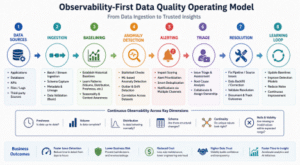
This model emphasizes continuous visibility and rapid response, ensuring that data issues are surfaced early, assessed quickly, and resolved before business impact scales.
A common concern is that allowing imperfect data reduces trust. In practice, lack of visibility is what erodes trust.When stakeholders can see real-time data health signals, they make context-aware decisions. A dataset with known limitations and active alerts is more reliable than one marked “validated” with hidden issues.
This shifts the trust model from binary correctness to contextual reliability, enabling faster, more confident, and risk-aware decision-making across the enterprise.
FAQs: What Leaders Actually Need to Know
- Does observability mean accepting bad data?
No. It means prioritizing rapid detection and response, which reduces business impact more effectively than rigid prevention.
- Will this reduce confidence in data among stakeholders?
No. Transparency increases trust by making data limitations visible and manageable.
- How do we avoid alert fatigue?
By focusing on impact-driven anomaly detection and reducing noise from low-value signals.
- Is this scalable across enterprise environments?
Yes. Observability scales better because it adapts to changing data patterns without constant redesign, supporting faster business growth and data onboarding.
Conclusion
Data quality strategies must evolve from control-heavy systems to response-driven capabilities. Observability-first models reduce cost, expand coverage, and improve trust by making data health visible and actionable. Perceptive Analytics enables organizations to operationalize this shift with scalable frameworks and measurable outcomes. The real advantage lies in ensuring that data issues are detected early, decisions remain reliable, and business impact is minimized.