
Implementing Advanced Analytics for Smarter Decision-Making
Analytics | January 1, 2024


Why Advanced Analytics Matters for Modern Decision-Making
Modern businesses require more than intuition—they need advanced analytics solutions to make timely and informed decisions.
Organizations can leverage these solutions to improve forecasting, optimize operations, and deliver personalized customer experiences.
A well-defined data and analytics strategy ensures analytics becomes a driver of measurable business outcomes rather than a back-office function.
The Shift from Traditional BI to Data-Driven Intelligence
While traditional BI focuses on past performance, advanced analytics allows organizations to anticipate the future using advanced analytics techniques.
Real-time dashboards, predictive models, and AI-driven insights help companies transition from reactive decision-making to proactive, data-driven intelligence.
Ready to explore how advanced analytics can transform your business? Schedule a 30-minute consultation with our experts today.
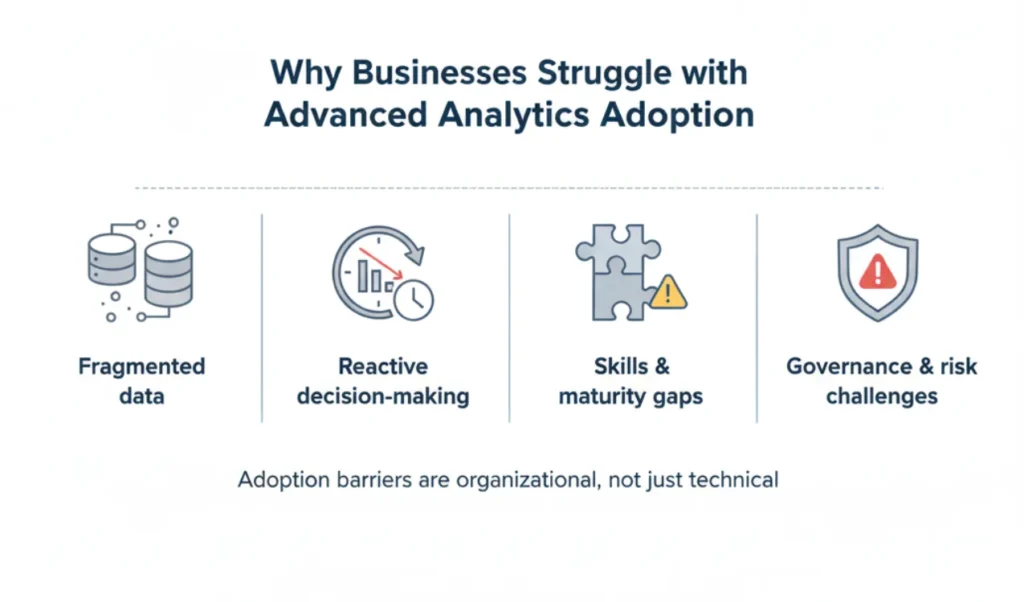
Why Businesses Struggle With Advanced Analytics Adoption
Despite its benefits, many companies face challenges in adopting advanced analytical solutions. Key barriers include:
Fragmented Data and Limited Visibility
Data often exists in silos across departments, making it difficult to gain a unified view. Poor data quality and inconsistent definitions further reduce confidence in analytics outputs, hindering adoption.
Reactive Decision-Making Instead of Predictive Intelligence
Organizations relying heavily on spreadsheets and manual reporting struggle with delays in insights. Without predictive models, decision-making remains reactive, slowing response times and reducing competitive advantage.
Lack of Skills, Tools, and Analytics Maturity
A shortage of qualified data scientists and machine learning experts, combined with uncertainty around tool selection, prevents enterprises from fully leveraging advanced analytics techniques. Clear analytics roadmaps and skill-building initiatives are essential.
Governance, Compliance, and Model Risk Management Challenges
Many companies lack processes for validating or monitoring models. Without strong governance, security inconsistencies and compliance risks increase, threatening analytics reliability.
Learn more about choosing the right analytics approach here.
Building the Right Foundation for Advanced Analytics
Start With the Right Business Questions & Use Cases
Identify high-value use cases that impact revenue, operational efficiency, and customer experience. Prioritize initiatives that deliver measurable ROI and align with business goals.
Assess Your Analytics Maturity and Data Readiness
Evaluate existing BI tools, infrastructure, and data governance practices. Ensure data quality, security, and accessibility before implementing advanced analytics solutions.
Identify the Right Advanced Analytics Techniques
Select from predictive analytics, prescriptive analytics, or AI-driven forecasting depending on your use cases. Combining these techniques helps improve accuracy, efficiency, and decision-making capabilities.
Learn more about machine learning methods at Support Vector Machines and Reinforcement Learning in R.
Define Roles and Cross-Functional Collaboration
Assign clear responsibilities to data engineers, data scientists, and business stakeholders. Establishing a center of excellence (CoE) can standardize processes and accelerate analytics maturity.
Implementing Advanced Analytics Successfully
Build a Scalable Analytics Architecture
Leverage cloud platforms such as Azure, AWS, or GCP and modern storage solutions like Snowflake or Databricks to consolidate data and enable high-performance analytics.
Select the Right Advanced Analytics Tools
Choose ML platforms (Python, R, AutoML) and BI tools (Power BI, Tableau) aligned with your use cases. Orchestration and pipeline tools help automate data workflows and model deployment.
Develop, Train, and Validate Models
Proper data preparation, feature engineering, and model evaluation ensure accuracy and reliability. Validated models are critical for operational adoption.
Explore anomaly detection techniques at Anomaly Detection in R.
Operationalize Analytics for Real Business Use
Integrate models into dashboards, embed them into workflows, and automate insights delivery. This ensures analytics is actionable and supports real-time decision-making.
Establish Governance, Security, and Monitoring
Monitor model drift, enforce compliance and access controls, and track KPIs to maintain reliability. Continuous monitoring ensures long-term success.
How Perceptive Analytics Helps Enterprises
Perceptive Analytics provides end-to-end services including analytics maturity assessment, use-case prioritization, model development, and deployment. Enterprises benefit from tailored advanced analytics solutions and ongoing optimization.
Learn more about advanced analytics consulting.
Business Outcomes From Advanced Analytics
Faster and Smarter Decision-Making
Organizations achieve enhanced forecasting accuracy and gain real-time insights, enabling agile and confident strategic decisions.
Increased Operational Efficiency and Automation
Advanced analytics reduces manual processes, optimizes resource planning, and improves cost control, driving operational efficiency.
Improved Customer Experience and Personalization
Behavior prediction and segmentation allow enterprises to personalize experiences at scale, enhancing engagement and loyalty.
Strong Competitive Advantage
A data-driven culture fosters innovation and supports long-term scalability. Companies that implement advanced analytical solutions gain an enduring competitive edge.
Discover strategies to future-proof your analytics.
Why Choose Perceptive Analytics for Advanced Analytics Implementation
Proven expertise across BI, AI, and enterprise analytics
Custom-built predictive models tailored to business goals
Strong experience in Power BI, Tableau, Snowflake, Azure, and ML platforms
End-to-end execution: from strategy to deployment
Want to see how these insights can work for your organization? Book a 30-minute session with our team to get started.
FAQs
What do businesses need before implementing advanced analytics?
Organizations need clean, governed data; the right infrastructure; clarity on business use cases; and alignment between business and technical teams. Many companies conduct an analytics maturity assessment—something Perceptive Analytics helps clients perform—to evaluate readiness and build a practical implementation roadmap.
How do you choose the right tools for advanced analytics?
The right tools depend on your data size, use cases, cloud environment, and internal technical capabilities. Popular choices include Python, R, AutoML platforms, Databricks, Snowflake, and BI tools like Power BI or Tableau. Perceptive Analytics helps enterprises select, integrate, and operationalize the right tool stack for scalable analytics.
How long does it take to implement advanced analytics?
Timelines vary from 4–12 weeks for smaller use cases (forecasting, segmentation) to several months for complex machine learning pipelines or enterprise-wide analytics programs. A well-defined roadmap and prioritization framework significantly shorten implementation time.