


Executive Summary
As enterprise data environments grow, schema management, pipeline development, and data modeling often become major constraints on analytics delivery. Metadata-driven architecture addresses this challenge by using configuration-based definitions to generate pipelines, transformations, quality controls, and documentation automatically. Organizations that implement this approach effectively can reduce manual engineering effort, improve consistency, and accelerate time-to-analytics. The key is balancing automation with enough flexibility to accommodate evolving business requirements and domain-specific logic.
Automation Delivers Its Highest ROI When Engineers Stop Writing the Same Logic Repeatedly
A Perceptive Analytics POV
At Perceptive Analytics, we see many organizations reaching a point where pipeline growth outpaces engineering capacity. The challenge is rarely a lack of technology. It is the growing volume of repetitive development required to onboard new data sources, maintain schemas, and enforce standards.
Metadata-driven architecture changes the economics of delivery by converting recurring implementation work into reusable platform capabilities. The greatest benefit is not faster coding. It is enabling engineering teams to focus on business-specific transformations while the platform handles common patterns automatically.
The Cost of Treating Every Pipeline as a Custom Project
Many organizations continue to build data pipelines as individual projects. Every new source requires custom ingestion logic, separate transformation code, independent quality checks, and dedicated documentation.
While this approach appears flexible in the early stages, complexity grows rapidly as the number of data assets increases.
The problem becomes particularly visible when organizations expand self-service analytics, launch new AI initiatives, or adopt data product operating models. Engineering teams find themselves spending significant time maintaining existing assets instead of delivering new capabilities. Small schema changes trigger downstream rework, testing cycles become longer, and onboarding new data sources becomes increasingly expensive.
Research from McKinsey’s The Data-Driven Enterprise of 2025 highlights that organizations generating the highest value from data invest heavily in reusable foundations rather than project-specific implementations. The competitive advantage comes from creating systems that can scale delivery repeatedly, not from building individual pipelines faster.
Over time, the hidden cost is not infrastructure spending. It is the accumulation of operational debt. Different teams implement similar logic in different ways, governance becomes harder to enforce, and platform consistency gradually erodes. What initially looked like flexibility eventually becomes a barrier to scale.
Metadata Becomes Valuable When It Starts Replacing Decisions, Not Just Code
Many discussions around metadata-driven architecture focus on code generation. The larger opportunity is reducing the number of engineering decisions that must be made repeatedly.
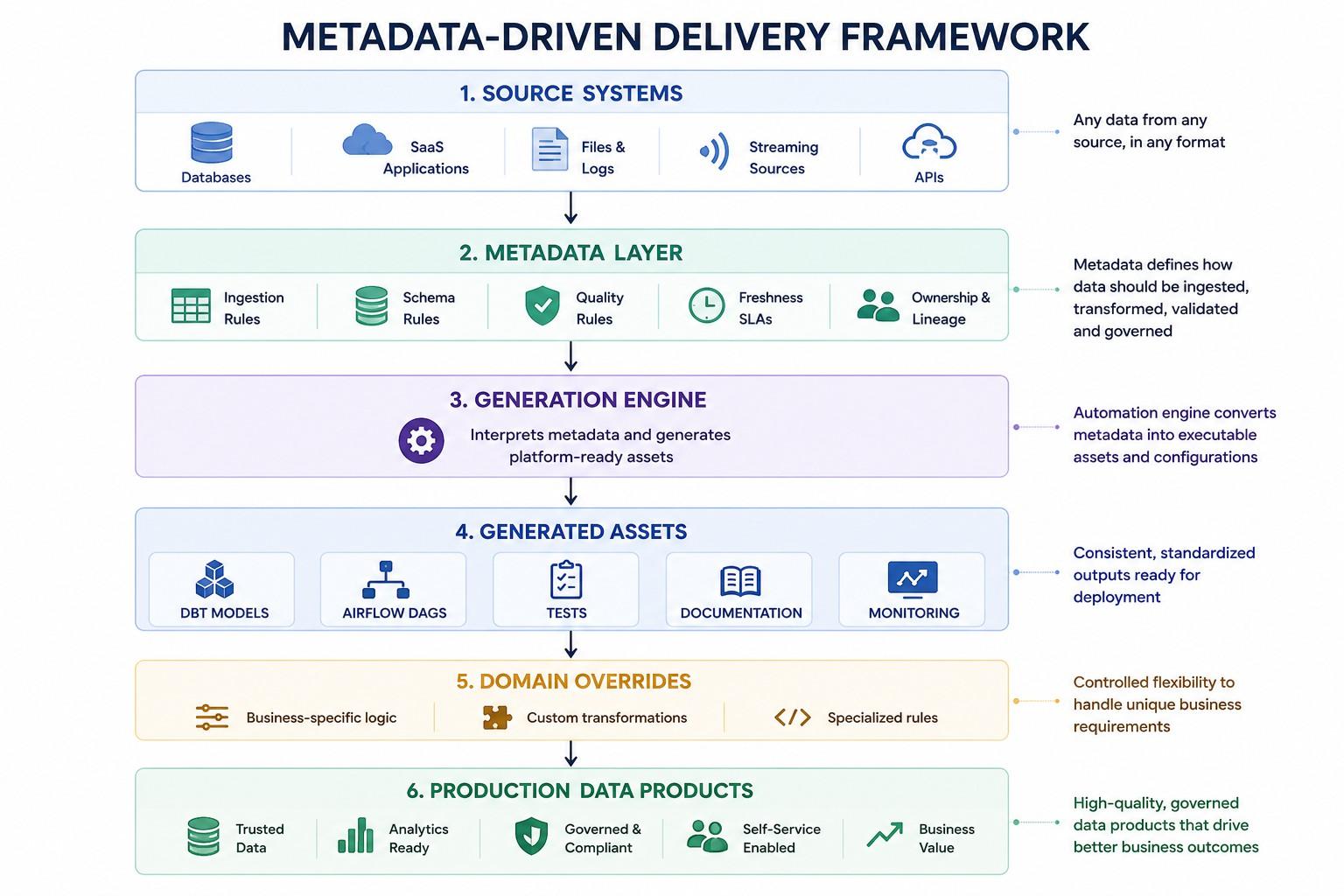
A mature metadata framework defines how data should be ingested, validated, transformed, monitored, and governed. Instead of requiring developers to decide these standards for every new pipeline, the platform applies proven patterns automatically.
Metadata Layer | Purpose | Generated Assets |
Ingestion Metadata | Source definitions and load behavior | Airflow DAGs and ingestion pipelines |
Schema Metadata | Columns, datatypes, relationships | dbt models and schemas |
Transformation Metadata | Business rules and calculations | SQL transformations |
Quality Metadata | Validation rules and thresholds | Data quality tests |
Operational Metadata | SLAs, ownership, lineage | Monitoring and governance assets |
Consider a customer master data pipeline. Rather than manually building ingestion workflows, transformation models, testing scripts, monitoring configurations, and documentation, teams define requirements through metadata. The platform generates the required assets using standardized templates.
This approach shifts effort away from boilerplate development and toward business-specific problem solving. It also improves consistency because governance, quality controls, and operational standards are applied uniformly across the platform.
Metadata-Driven Delivery Framework
The Architecture Decision That Separates Automation from Rigidity
The success of metadata-driven architecture depends on one critical design decision: how exceptions are handled.
Many automation initiatives fail because they assume every dataset can conform to a standard template. Real-world business environments rarely behave that way. Industry-specific calculations, regulatory requirements, customer-specific processes, and operational nuances often require specialized treatment.
The most successful platforms create controlled flexibility rather than unrestricted customization. Standardized metadata handles common use cases, while domain teams retain the ability to extend generated assets when necessary.
Several design principles consistently separate successful implementations from unsuccessful ones:
- Create override mechanisms instead of bypass mechanisms
- Separate platform standards from business-specific logic
- Version metadata alongside code
- Trigger automated validation when metadata changes
- Maintain audit trails for metadata updates
- Monitor manual override rates as a platform health metric
One useful indicator is the number of pipelines requiring custom intervention. A growing volume of overrides often signals that metadata standards no longer reflect business realities. The objective is not maximum automation. The objective is maintaining long-term adaptability without sacrificing platform consistency. While
these principles may appear technical, their real impact is measured in business terms: faster execution, lower total cost of ownership, and reduced strategic risk as the enterprise evolves.
Airbnb’s Metadata Platform Solved a Scaling Problem Most Enterprises Have Yet to Reach
One of the strongest examples of metadata-driven architecture comes from Airbnb’s Minerva platform. As Airbnb expanded, multiple teams began defining business metrics independently. Over time, inconsistencies emerged across dashboards, reporting environments, experimentation frameworks, and operational analytics. Different teams often arrived at different answers to the same business question.
To address this challenge, Airbnb created Minerva, a centralized metadata platform that stores and governs metric definitions across the organization. According to Airbnb Engineering’s 2020 publication How Airbnb Achieved Metric Consistency at Scale, Minerva became the authoritative source for thousands of business metrics used throughout reporting and decision-making workflows.
The most important outcome was not automation. It was trust. Teams no longer needed to question whether metrics were being calculated differently across systems. Consistency improved, duplicated logic declined, and self-service analytics became easier to scale.
The broader lesson for enterprise leaders is that metadata becomes significantly more valuable when it governs business definitions rather than simply documenting technical assets. The ability to standardize meaning across the organization often creates greater value than the ability to generate code automatically.
The Most Dangerous Metadata Problem Appears After Automation Succeeds
The most expensive metadata problem does not appear when automation is implemented. It appears eighteen months later, when a single incorrect schema definition breaks two hundred downstream reports simultaneously. Successful metadata-driven platforms eventually reach a point where hundreds of pipelines, reports, tests, and operational processes depend on shared metadata definitions. At that stage, metadata itself becomes critical infrastructure.
A poorly managed metadata change can trigger widespread downstream impacts. A modified schema definition may affect reporting logic. An incorrect quality rule may create false alerts. A missing ownership assignment may delay issue resolution.
This is why metadata governance becomes increasingly important as automation adoption grows. Organizations should establish clear accountability for metadata standards, business definitions, quality rules, and platform templates.
A practical ownership model typically includes:
- Platform Engineering owning metadata standards and generation frameworks
- Analytics Engineering owning reusable templates and transformations
- Domain Teams owning business definitions and requirements
- Data Stewards owning quality rules and validation criteria
- Governance Teams overseeing compliance, reviews, and auditability
Gartner’s Top Trends in Data and Analytics 2024 identifies active metadata as a foundational capability supporting scalable governance, distributed data ownership, and AI-ready architectures. As organizations become more dependent on automation, metadata quality increasingly determines platform reliability.
Perceptive Analytics, we recommend treating metadata as a governed enterprise asset with the same discipline applied to production code, infrastructure, and business-critical datasets.
Conclusion
Metadata-driven architecture allows organizations to scale data delivery without proportionally scaling engineering effort. The greatest value comes not from generating code, but from creating consistent decision-making frameworks that can be applied repeatedly across the platform. Organizations that balance automation, governance, and controlled flexibility can accelerate analytics delivery while maintaining adaptability as business requirements evolve. At Perceptive Analytics, we help organizations design metadata-driven operating models that improve productivity, strengthen governance, and create a scalable foundation for future analytics and AI initiatives.