


Executive Summary
We see enterprises struggling with performance problems every day, and the first assumption is almost always the same: the database is slow. In reality, the issue is often architectural, not computational. Businesses are asking the same system to support two very different expectations: instant operational decisions and deep analytical exploration. A customer checkout, fraud validation, or inventory confirmation cannot afford hesitation. A margin analysis can. The enterprises that scale well are the ones that design around these different performance contracts instead of forcing one architecture to satisfy both inefficiently.
When performance complaints are actually architecture design problems
A Perceptive Analytics POV
One of the most common conversations we have with enterprise leadership begins with a familiar frustration: systems feel slower, dashboards lag, infrastructure costs rise, and teams assume the database is becoming the bottleneck. In many cases, that diagnosis is incomplete. What looks like a performance issue is often a design issue, where fundamentally different workloads have gradually been pushed into the same architectural path without clear boundaries.
At Perceptive Analytics, we have seen enterprises invest in faster infrastructure before defining what the business actually expects from its systems. A customer-facing application and an executive analytics environment may both depend on data, but they are solving fundamentally different problems. The right architectural decision begins with workload intent, not platform benchmarks.
Why enterprises keep solving the wrong performance problem
Consider how differently an airport operates. Passenger security screening is designed for immediacy. Delays create visible disruption within minutes. Queues build, schedules collapse, and the operational impact is immediate. Now consider the airport leadership team reviewing profitability trends across routes, fuel costs, and seasonal passenger demand. That analysis is critical, but nobody expects it to complete in milliseconds.
Enterprise data systems behave in much the same way. The challenge begins when both of these expectations are imposed on the same architecture without acknowledging that the underlying workload behavior is fundamentally different. Operational systems are optimized for transactional certainty, while analytical systems are optimized for computational breadth.
Operational workloads typically demand:
- Sub-second response times
- High concurrency for simultaneous transactions
- Frequent row-level writes and updates
- Strict transactional consistency
- Predictable performance even during spikes Analytical workloads typically demand:
- Large-scale scans across millions or billions of records
- Multi-table joins and aggregations
- Historical analysis across large time windows
- Compression and vectorized execution efficiency
- Flexible exploratory querying with unpredictable patterns
This is why enterprises historically separated operational databases from analytical platforms. The complexity today is that business expectations have shifted. Fraud monitoring, inventory visibility, and executive reporting increasingly demand fresher data, creating pressure to collapse architectural boundaries that were originally separated for sound performance reasons.
The most expensive part of this architecture is often everything surrounding it
Separate architectures often look operationally safe because they isolate workloads cleanly. The hidden complexity emerges once the business expects those systems to stay continuously aligned.
A transaction recorded in an operational system must appear correctly in analytical environments, downstream dashboards, recommendation engines, monitoring systems, and decision workflows. That introduces replication pipelines, change data capture (CDC), freshness monitoring, schema synchronization, reconciliation logic, duplicate governance policies, and incident ownership complexity.
This is where architectural cost becomes misleading. The database platform itself may not be the expensive decision. The surrounding engineering effort, maintenance overhead, and operational coordination often are.
We have worked with organizations where teams spent significant engineering capacity maintaining synchronization infrastructure rather than improving business-facing data capabilities. As freshness expectations tighten, synchronization infrastructure becomes more fragile and expensive to operate. Architecture decisions at this point are no longer just technology choices. They become operating model decisions.
A practical decision framework for CXOs
The question should not begin with whether separate or unified architecture is inherently superior. The better question is whether the business can clearly define its tolerance for delay, contention, and complexity.
Decision Dimension | Separate Engines Are Better When | Unified / Hybrid Approaches Are Better When |
Latency SLA | Operational response must remain consistently sub-second | A few seconds of variation is acceptable |
Freshness Requirement | Real-time replication is essential | Near-real-time or controlled delay is acceptable |
Workload Pattern | Heavy transactional writes and complex analytics coexist | Mixed workloads remain operationally manageable |
Failure Isolation | Operational workloads cannot risk interference | Shared infrastructure risk is acceptable |
Governance Model | Dedicated platform ownership exists | Simplified governance is strategically preferred |
Engineering Overhead | Synchronization burden remains manageable | Sync complexity is becoming operationally expensive |
Infrastructure Economics | Isolation justifies infrastructure cost | Consolidation improves cost efficiency |
The key shift for leadership is moving from technology-first thinking to business-tolerance thinking. The wrong architecture is not always the slower one. Often, it is the one that introduces complexity disproportionate to the business value being protected.
A decision flow for choosing the right architecture
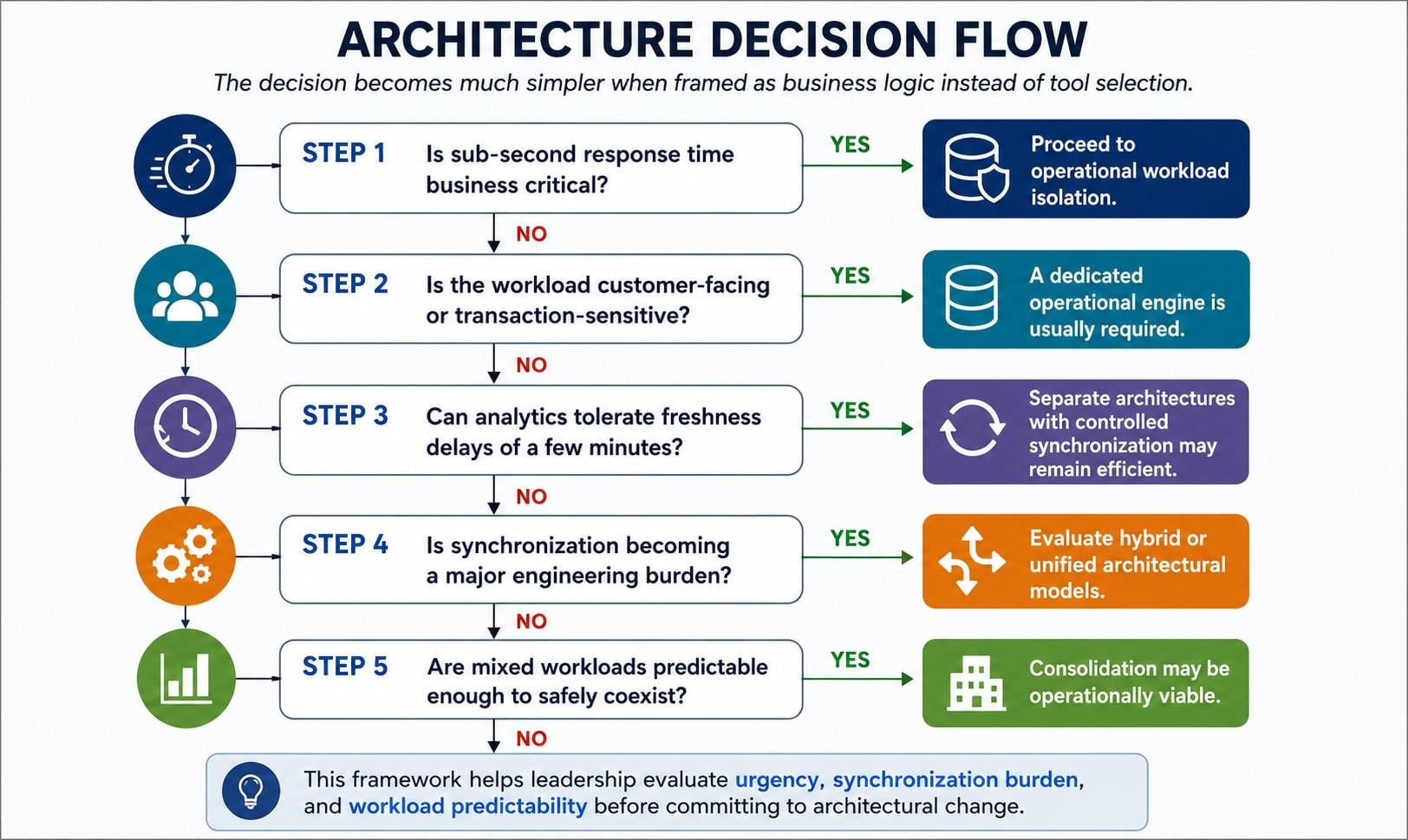
The decision becomes much simpler when framed as business logic instead of tool selection.
Five questions leadership should ask before funding consolidation
What is the measurable cost of delay?
Not every data use case deserves real-time investment. If leadership cannot clearly explain the business consequence of a five-minute delay, infrastructure may be solving urgency that does not materially exist.
How predictable are workload patterns?
A unified environment works best when workload behavior is reasonably stable. If customer traffic and analytical demand spike unpredictably, contention risk rises sharply.
How much engineering effort is being spent on synchronization?
When data movement infrastructure starts consuming meaningful engineering attention, the architecture itself may be creating avoidable operational drag.
Where does governance responsibility actually sit?
Governance complexity does not disappear. It either spreads across systems or concentrates in one. Both require ownership clarity.
What failure can the business tolerate?
A unified architecture may simplify integration but expand failure blast radius. Separate architectures isolate risk but increase operational complexity. This is fundamentally a business resilience decision.
Conclusion
The real architectural question is rarely whether a database is fast enough. It is whether the business has clearly defined what different workloads actually require from its systems. Enterprises that make this distinction early avoid unnecessary infrastructure spend, engineering complexity, and operational unpredictability. At Perceptive Analytics, we help leadership teams turn these architecture choices into scalable operating models that support both operational certainty and analytical ambition.