


Executive Summary
Executive trust in data rarely disappears because of one catastrophic systems failure. It erodes through repeated moments of uncertainty that make leadership hesitate before acting. A revenue figure changes between executive reviews without explanation. A campaign underperforms because customer data arrived incomplete. A forecasting model produces outputs that look mathematically valid but no longer reflect business reality.
IBM, citing Gartner research, estimates poor data quality costs organizations an average of $12.9 million annually. But the larger cost is often invisible: slower executive decisions, repeated reconciliation cycles, and leadership quietly reverting to manual validation because enterprise data no longer feels dependable.
Visibility Is Not the Same as Governance
A Perceptive Analytics POV
Many enterprises have governance programs that create visibility but not operational control. Metadata catalogs improve discoverability. Lineage platforms explain dependencies and observability tools surface anomalies. Ownership frameworks clarify accountability. Yet executive trust still weakens because these mechanisms mostly explain failures after they occur rather than preventing failure at the point of entry.
Monte Carlo’s data reliability research shows incidents remain both frequent and operationally expensive, with many organizations requiring hours simply to detect issues before remediation begins. At Perceptive Analytics, we increasingly see the same pattern: enterprises that appear governance-mature on paper but still operate reactively because unreliable data is allowed to travel too far before intervention occurs.
Trust Usually Breaks Through Inconsistency, Not Through Outages
Executives lose trust when the business sees conflicting truths, not when engineering sees technical alerts. Leadership rarely hears terms like schema drift or ingestion incompatibility. What they experience instead are competing revenue numbers, unexplained forecast shifts, campaign audience mismatches, and analysts spending hours reconciling metrics that should already be trusted.
This distinction matters because technical uptime does not guarantee decision reliability. A pipeline can remain fully operational while semantic correctness has already failed. Data may arrive on time, dashboards may refresh successfully, and anomaly alerts may remain silent, while the underlying business meaning has drifted enough to distort decision-making.
Scale turns this from an occasional operational issue into a governance failure. Informal coordination works when data ecosystems are small and producers communicate directly with consumers. That model collapses once organizations operate hundreds of pipelines across SaaS platforms, ERP systems, customer applications, event streams, external feeds, and machine learning workflows. At that point, assumptions become operational risk.
Data Contracts Change Accountability, Not Just Validation
The biggest misconception about data contracts is that they are merely schema validation tools. They are far more consequential than that. A production-grade data contract formalizes what reliability means between producers and consumers, transforming governance from passive expectation management into enforceable operational discipline.
A mature contract governs multiple reliability dimensions:
- Structural Compatibility
This covers schemas, required fields, data types, nested structures, and compatibility rules. Not every change is equally risky. Adding an optional nullable field may be harmless. Renaming a required attribute or changing a timestamp datatype can break multiple downstream dependencies immediately.
- Temporal Reliability
Data that arrives late can be just as damaging as incorrect data. A valid customer dataset delivered six hours after a churn model executes is operationally useless. Contracts should define freshness SLAs, delivery deadlines, acceptable latency thresholds, and escalation triggers.
- Quality Thresholds
Production systems rarely operate with perfect data, which makes tolerance governance essential. Contracts should explicitly define acceptable null percentages, duplicate thresholds, completeness minimums, and volume anomaly ranges instead of leaving quality interpretation subjective.
- Semantic Constraints
Structural correctness does not guarantee business correctness. A contract may require approved country codes, valid subscription states, positive transaction values, referential integrity, or alignment with business-approved enumerations. This is where governance becomes strategically meaningful.
- Operational Ownership
A contract without ownership becomes a documentation theater. Producer accountability, escalation workflows, breach response expectations, exception governance, and version ownership must all be explicit.
This fundamentally changes accountability economics. Historically, downstream teams compensated for unreliable producers through defensive transformations, reconciliation workflows, duplicate logic, and manual exception handling. Data contracts shift responsibility upstream by requiring producers to meet operational commitments before trusted downstream consumption occurs.
Not Every Pipeline Deserves Hard Enforcement
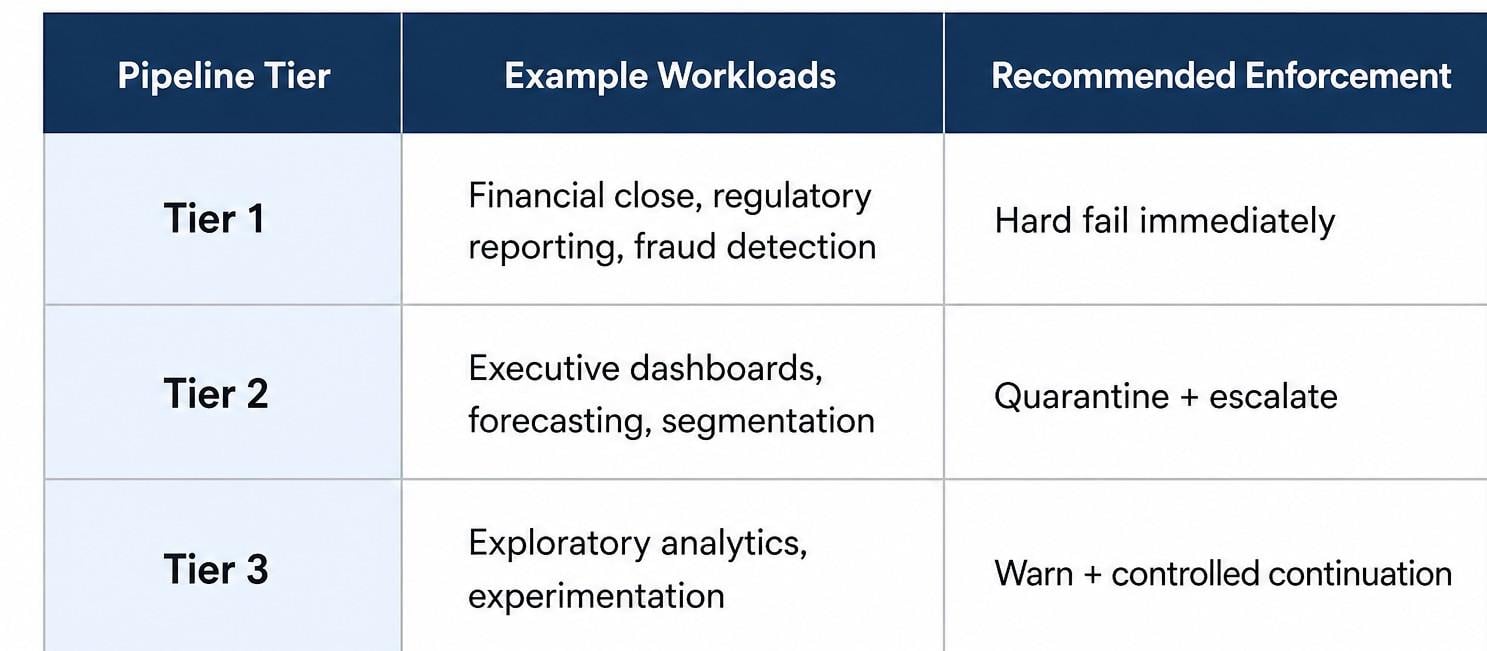
One of the most common governance mistakes is treating all data pipelines as equally critical. That creates unnecessary friction and eventual circumvention. Financial close reporting, fraud scoring, exploratory experimentation, and internal sandbox analytics do not carry equivalent business risk. Governance maturity requires differentiated enforcement. A practical tiered model looks like this:
Over-enforcement can become its own operational failure mode. If governance blocks low-risk workloads over minor issues, teams inevitably create bypass routes outside governed systems. Effective governance protects critical decision environments without turning operational agility into collateral damage.
CI/CD Discipline Is What Makes Data Contracts Scalable
Contracts only work at enterprise scale when treated as engineering assets, not governance documents. This is where many implementations fail. Static policy declarations do not survive fast-moving producer environments where schemas evolve, integrations change, and business logic shifts frequently.
A scalable implementation should include:
- Version-controlled contract registries for transparent producer-consumer agreements
- Schema compatibility testing to distinguish safe vs breaking changes
- Synthetic validation datasets for pre-production contract testing
- CI/CD deployment gates that block releases when contracts fail
- Quarantine zones that isolate failed payloads from trusted environments
- Exception approval workflows with auditability and expiry governance
- Rollback mechanisms for rapid recovery when breaking changes escape validation
The software engineering parallel is operationally useful, not metaphorical. Mature engineering teams would never allow untested application code directly into production. Yet many enterprises still allow upstream data producers to rename fields, alter enum logic, change formats, or modify semantics without equivalent release discipline.
That inconsistency becomes expensive because reliability failures multiply faster than governance maturity.
The Governance Shift: Passive Oversight vs Runtime Control
The operational difference between traditional governance and contract-driven governance is where intervention happens.
Traditional model:
Producer changes data → ingestion accepts payload → downstream transformations attempt adaptation → dashboards/models consume output → anomaly detected later → investigation begins
Contract-driven model:
Producer changes data → compatibility validation executes → contract tested → pass proceeds / fail quarantines → downstream systems remain protected
This changes incident economics significantly. Detection after propagation creates larger blast radius, longer remediation effort, more consumer disruption, and higher executive visibility. Prevention at the boundary contains failures while they are still manageable.
Leadership Should Measure ROI Through Operational Performance
The business case for data contracts is not generic “better quality.” It is measurable operational improvement. Leadership teams should evaluate impact using decision metrics that reflect actual business performance.
Key measures include:
- Mean Time to Detection (MTTD)
- Mean Time to Containment (MTTC)
- Mean Time to Resolution (MTTR)
- Analyst reconciliation hours
- Executive reporting confidence
- Incident frequency by criticality tier
- Decision latency caused by uncertainty
- Engineering time diverted into firefighting
The deeper ROI is trust recovery. Once leadership begins independently validating numbers before acting, enterprise data has already lost authority as a decision system.
Conclusion
Executive trust rarely collapses because systems fail loudly. It collapses because uncertainty travels far enough to influence decisions before anyone intervenes. At Perceptive Analytics, we help enterprises design governance models where reliability is enforced at operational boundaries rather than reconstructed after incidents. If leadership teams are still discovering data problems through conflicting business outcomes instead of controlled validation, governance is already arriving too late.