


Executive Summary
A dashboard refreshing every few seconds may look impressive, but faster data does not automatically create better decisions. Across industries, leadership teams are being asked to fund CDC platforms, streaming infrastructure, and real-time analytics capabilities without always understanding where the business value truly exists. Some use cases benefit enormously from immediate visibility, while others gain little from data arriving minutes earlier. The most effective architecture strategies begin by understanding the value of freshness, the readiness of source systems, and the operational costs required to sustain continuous data movement.
Are You Solving a Latency Problem or a Data Movement Problem?
A Perceptive Analytics POV
The conversation around CDC often starts with real-time analytics, but that is rarely where the business case begins. More often, organizations reach a point where existing batch pipelines can no longer keep pace with growing data volumes, shrinking processing windows, or increasing demands for operational visibility.
At Perceptive Analytics, we encourage leadership teams to separate two very different questions. The first is whether the business needs fresher data. The second is whether the current method of moving data remains economically sustainable. CDC can address both challenges, but the justification for investing in it depends on which problem the organization is actually trying to solve.
Why Do CDC Projects Begin Long Before Anyone Requests Real-Time Analytics?
Imagine a retailer processing hundreds of millions of transactions each day. Only a small percentage of those records change within any given hour, yet traditional batch pipelines often reprocess entire datasets repeatedly. As data volumes increase, infrastructure costs rise, processing windows expand, and source systems experience growing pressure from extraction workloads.
This is the environment in which Change Data Capture (CDC) becomes valuable. Rather than repeatedly scanning entire tables, CDC identifies only the inserts, updates, and deletes that have occurred since the last synchronization point. The immediate benefit is fresher data, but the longer-term value often comes from reducing unnecessary processing.
CDC adoption is commonly driven by three factors:
Business Driver | Batch Challenge | CDC Benefit |
Data growth | Increasing compute and storage costs | Incremental processing |
Shrinking batch windows | Pipelines fail to complete on time | Continuous data movement |
Source system pressure | Repeated extraction impacts production workloads | Reduced source impact |
Not all CDC approaches are equal.
- Log-based CDC reads database transaction logs directly and is generally considered the preferred enterprise approach because it minimizes source-system impact while supporting near-real-time replication.
- Trigger-based CDC records changes through database triggers. While effective in some environments, it can introduce additional processing overhead on transactional systems.
- Timestamp-based CDC tracks records using last-modified fields. Although simpler to implement, it may struggle with missed updates, clock synchronization issues, and data quality challenges.
Choosing between these approaches often has a greater impact on long-term operating costs than the CDC tool itself.
Is Every Minute of Data Freshness Actually Creating Business Value?
Not every decision benefits from immediate visibility. A fraud detection engine operating on hour-old data can create financial exposure within minutes. A quarterly profitability review usually cannot. The challenge is that many organizations use the term “real-time” as though it applies uniformly across the business. In reality, every workload has its own tolerance for delay. One practical approach is to classify data products based on their required freshness. For a detailed understanding on freshness tiers read: Tiered Freshness Model, A perceptive Analytics Blog
Freshness Tier | Typical SLA | Example Use Cases |
Critical Operational | Seconds to under 1 minute | Fraud detection, cybersecurity monitoring, payment authorization |
Operational | 1-15 minutes | Inventory visibility, logistics tracking, customer support |
Analytical | 15 minutes to several hours | Sales dashboards, marketing performance, operational reporting |
Strategic | Daily or longer | Financial reporting, planning, executive reviews |
This framework changes the conversation significantly. Instead of debating whether the organization should become real-time, leadership can determine which specific decisions depend on real-time information. In many cases, only a small percentage of workloads require sub-minute freshness.
One of the strongest governance practices emerging in modern data organizations is the use of fresh SLAs. Every major data product is assigned an acceptable latency target, ensuring that infrastructure investments align with business requirements rather than stakeholder assumptions.
Can Your Systems Support CDC Before Your Teams Start Designing It?
Many CDC initiatives encounter problems before the first pipeline is deployed. The challenge is not always the architecture. Often, it is the source systems themselves. Enterprise databases such as SQL Server, Oracle, and PostgreSQL generally provide mature CDC capabilities. Legacy applications, proprietary systems, and SaaS platforms can present a very different reality. Some expose transaction logs. Others provide limited change tracking. Some provide no reliable CDC mechanism at all.
Before evaluating CDC platforms, leadership teams should assess source-system readiness.
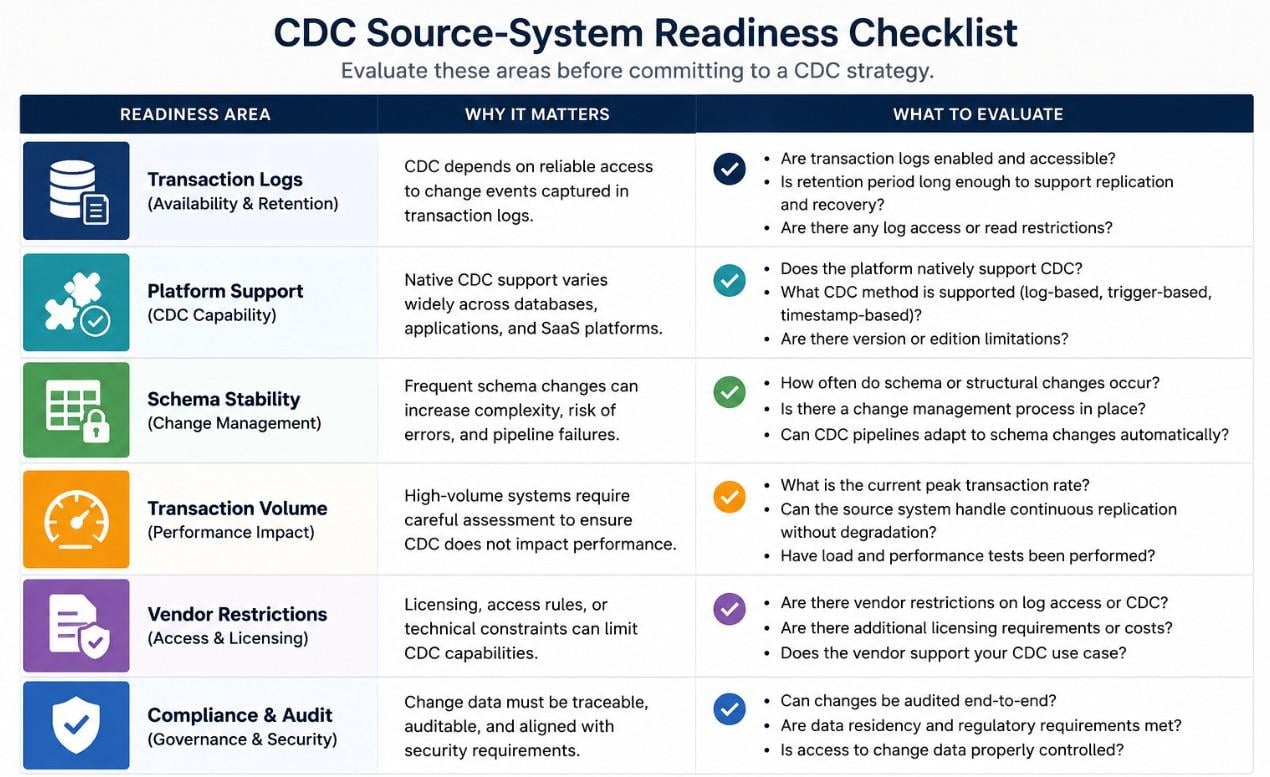
A common mistake is assuming CDC can be standardized across all enterprise systems. In practice, organizations often end up supporting multiple replication approaches because source environments vary significantly. A CDC strategy is only as strong as the systems feeding it.
Where Do CDC Business Cases Usually Break Down?
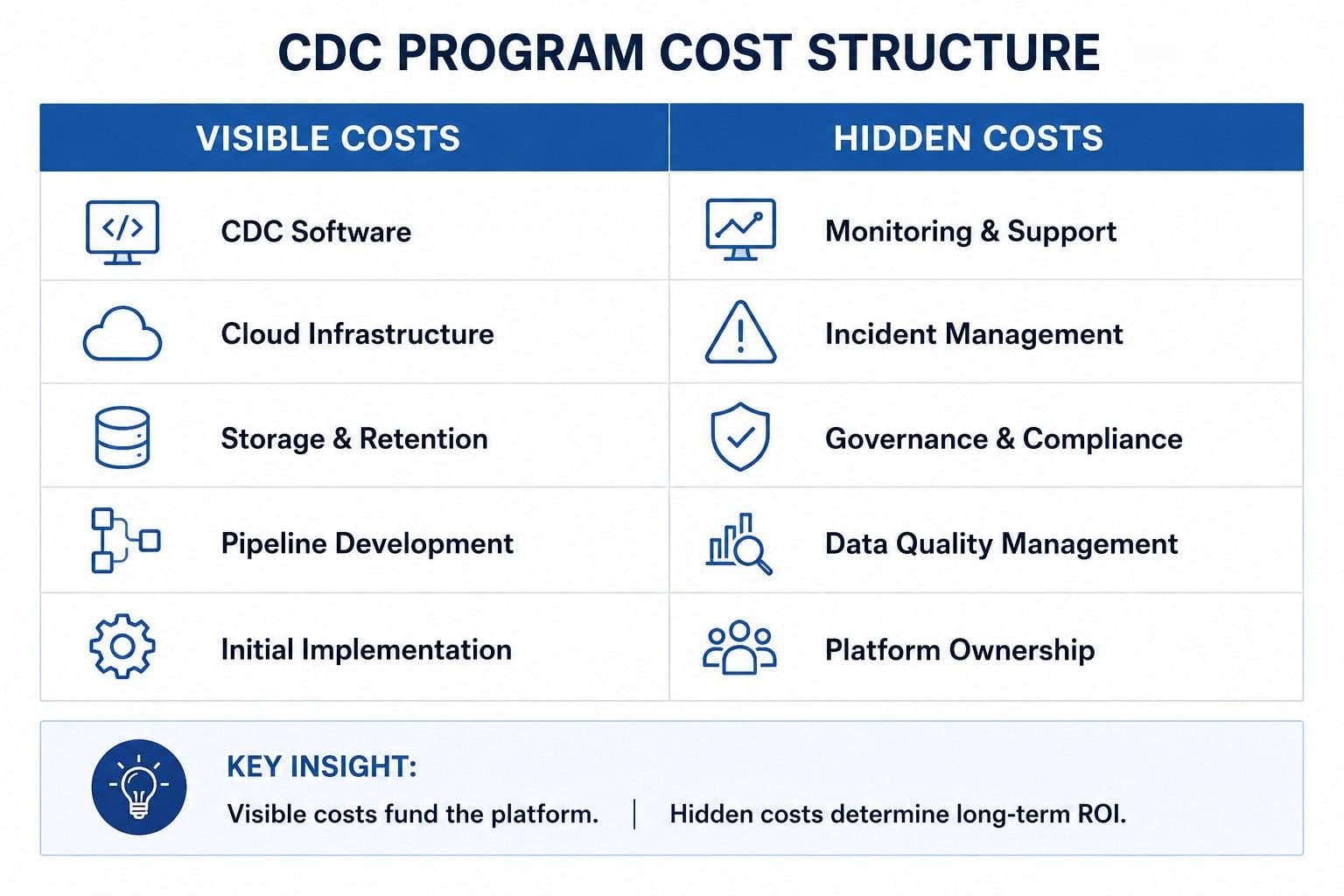
The most expensive part of CDC is often not the technology itself. Licensing costs, cloud infrastructure, and implementation efforts are relatively straightforward to estimate. Operational complexity is far more difficult to quantify. Once data begins moving continuously, organizations inherit a new set of responsibilities. Teams must manage:
- Schema evolution
- Duplicate event handling
- Event ordering
- Replay and recovery mechanisms
- Monitoring and alerting
- Data reconciliation
- Lineage and auditability
These capabilities become increasingly important as operational decisions start depending on continuous streams of data. The result is a cost structure that often extends well beyond the original implementation plan. Organizations frequently underestimate the investment required to maintain a mature CDC ecosystem. The technology itself may work exactly as intended while operational overhead gradually erodes the expected return on investment.
If CDC Creates Value, Why Aren’t More Organizations Using It Everywhere?
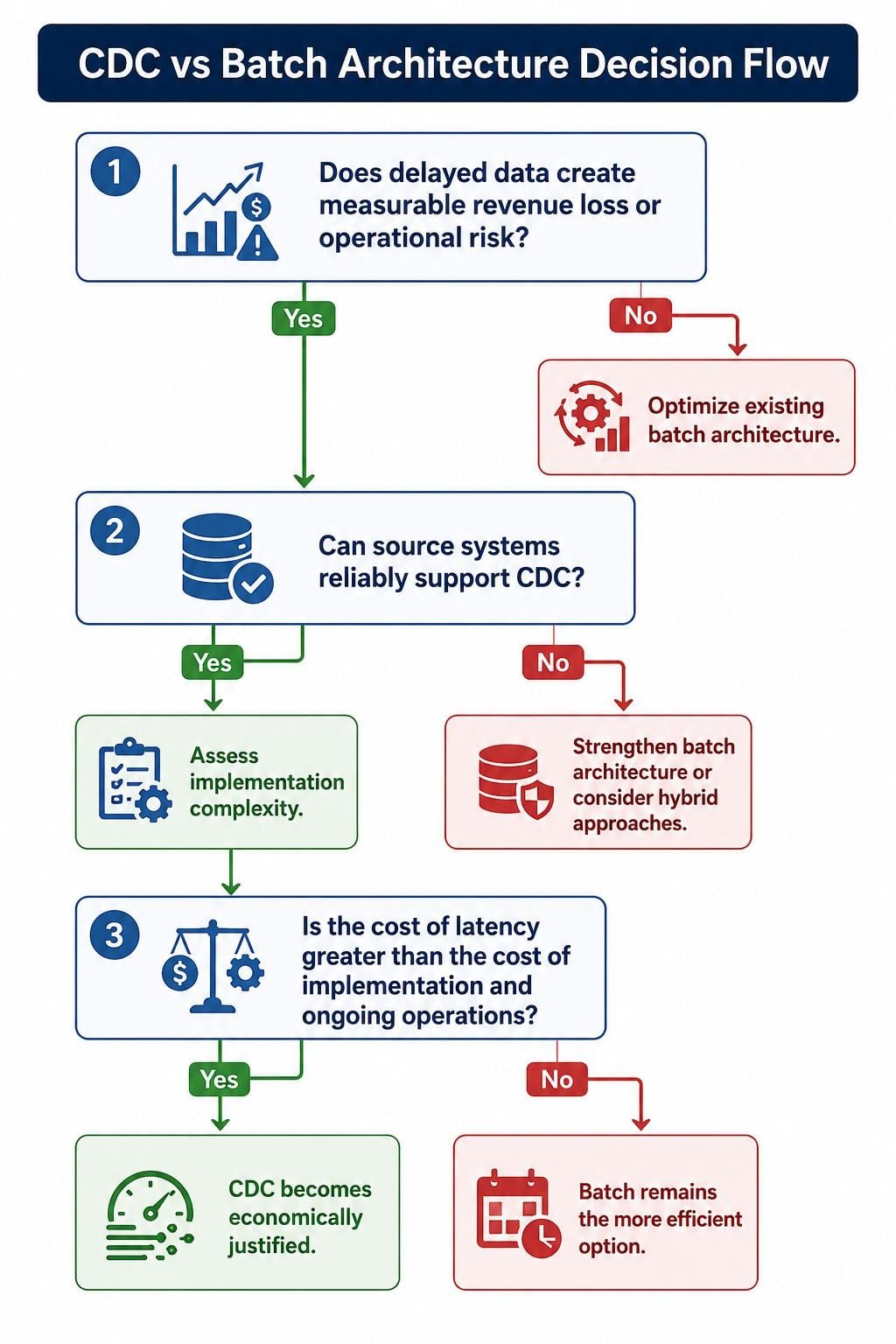
The decision ultimately comes down to economics. The strongest business case for CDC emerges when the cost of delayed information exceeds the cost of delivering fresher information. Yet this does not mean every workload should become real-time. In fact, the opposite is often true. The most mature data organizations have learned that different business processes generate different returns from freshness.
Consider an e-commerce company updating inventory every four hours through batch processing. During periods of high demand, products may continue appearing available after inventory has already been depleted. Customers place orders that cannot be fulfilled, resulting in cancellations, refunds, customer dissatisfaction, and lost revenue. In this scenario, latency has a measurable financial cost, making CDC a compelling investment.
Now consider an executive profitability dashboard reviewed during weekly leadership meetings. Refreshing that dashboard every thirty seconds instead of every six hours is unlikely to influence strategic decisions.
Additional freshness creates additional infrastructure and operational costs without creating meaningful business value.
This is why leading data teams no longer think in terms of CDC versus batch processing. They think in terms of matching architecture to business outcomes.
The resulting architecture is rarely fully real-time and rarely fully batch. Instead, it is selectively optimized based on the value of freshness. A practical decision framework can help determine where CDC belongs.
CDC vs Batch Architecture Decision Flow
Conclusion
The debate between CDC and batch processing is often framed as a technology decision when it is fundamentally an economics decision. Some workloads generate significant value from immediate visibility, while others gain little from additional freshness. The strongest architecture strategies begin by defining clear freshness requirements, assessing source-system readiness, and quantifying the cost of delay before investing in new infrastructure.
At Perceptive Analytics, we help organizations align data architecture decisions with measurable business outcomes, ensuring that investments in CDC, batch processing, and modern data platforms create sustainable value rather than unnecessary complexity.