


“Why analytics gets more expensive as you grow, and how to break that link before the next renewal”
EXECUTIVE SUMMARY
Bills rise because no one decided how cost should behave as you grow, who owns the truth, and where meaning lives. When a platform raised prices after retiring its old tier, renewals collected that debt. This note makes the design explicit.
PERCEPTIVE ANALYTICS POV
The platform is rarely the bottleneck. The bottleneck is that three decisions were never made on purpose. Make them before the vendor makes them for you.
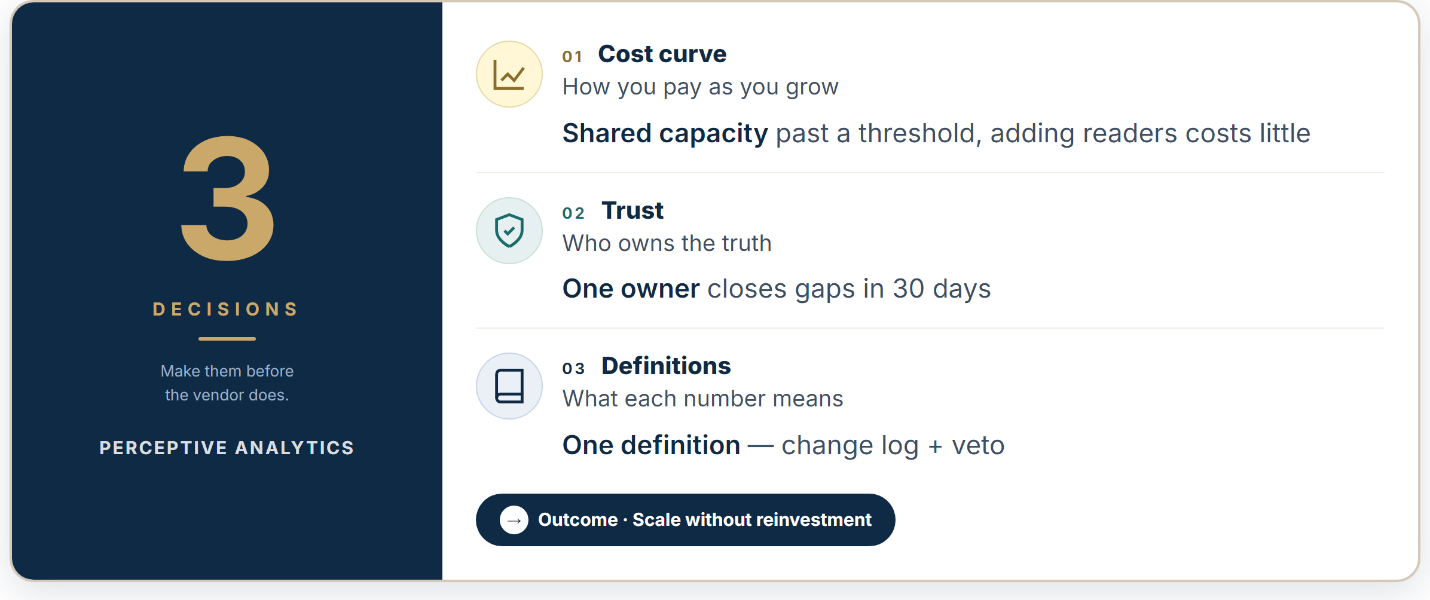
Decide What Scale Will Mean for Cost
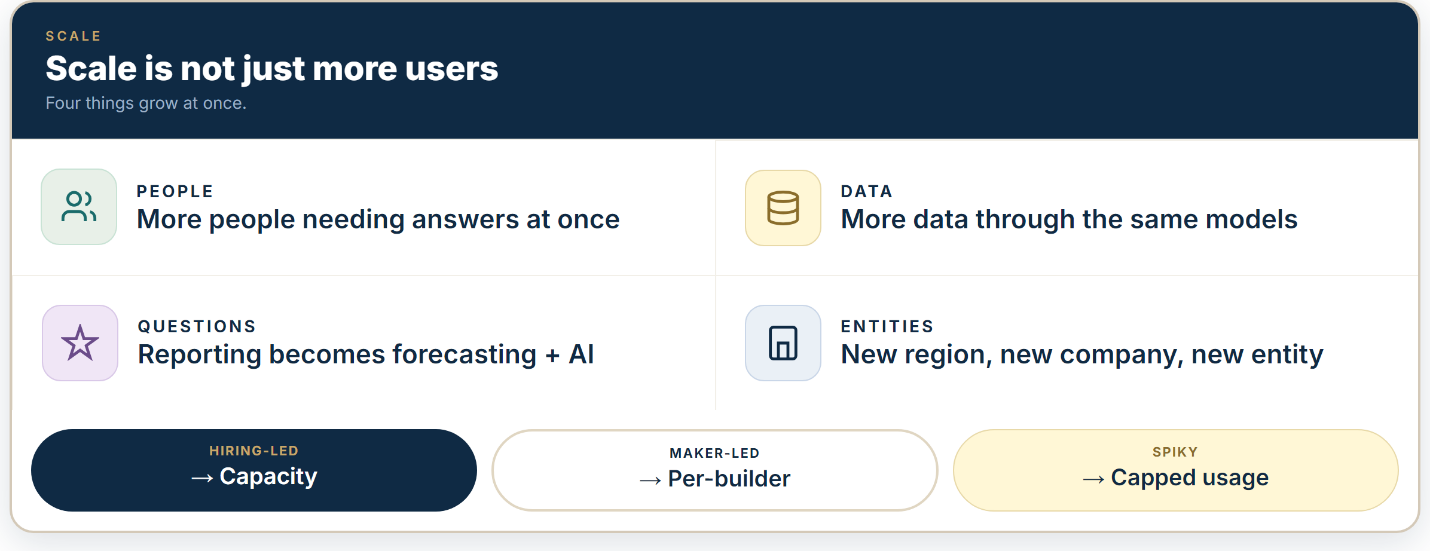
Scale is not just more users. It is more people needing answers at once, more data through the same models, harder questions as reporting becomes forecasting and AI, and more entities as you add a region or a company. If your model only counts seats, it will charge you for growth you did not benefit from.
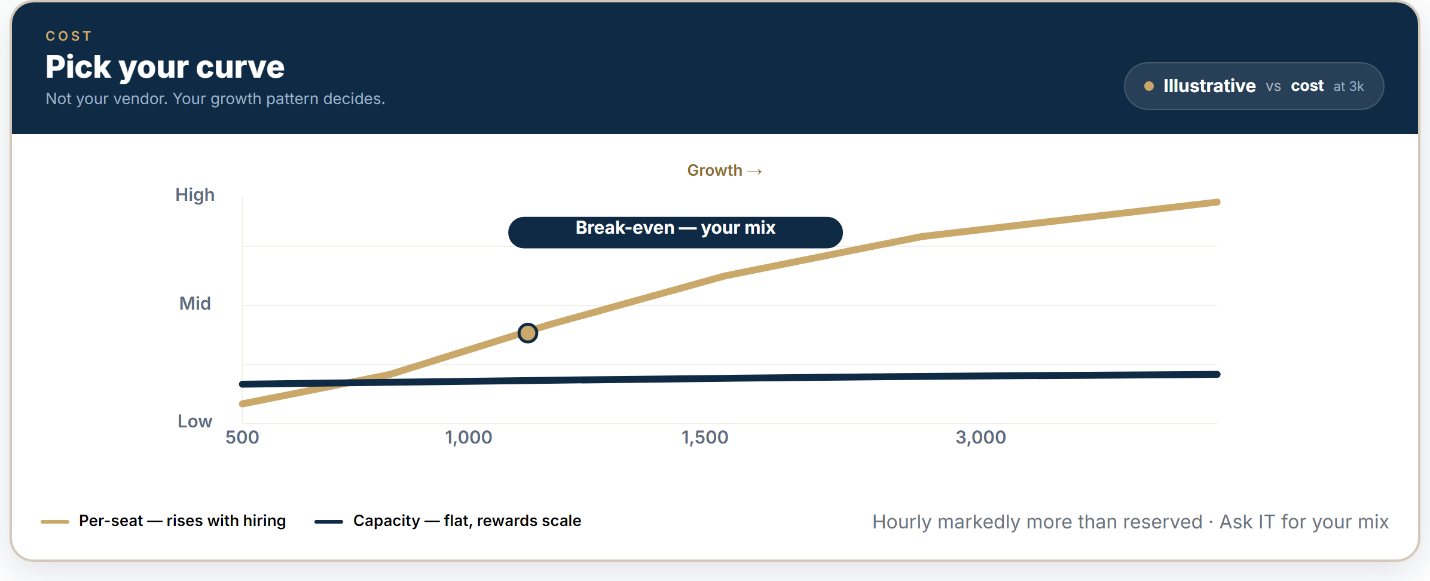
At 500 people per-seat feels fair. At 1,500 growing toward 3,000, it multiplies even if use does not. Shared capacity flips that: past a threshold, adding readers costs little. Hourly is markedly more than reserved pick the curve that matches how your profit grows and decide it once.
- Hiring-led → capacity. If you grow by hiring and most need to read, shared capacity is the hedge. It gets cheaper as you scale.
- Maker-led → per-builder. If only a small team builds, pay for builders. It keeps cost tied to makers, not to everyone who reads what they make.
- Spiky → capped usage. If demand spikes seasonally, pay for what you use but cap it. Uncapped spikes become the new tax.
Ask before renewal: Ask finance and IT to plot hiring against BI entitlements for the next 18 months. If the lines move together, you have a headcount tax. Lock the curve 90 days before renewal.
Run Trust Like an Operating Model
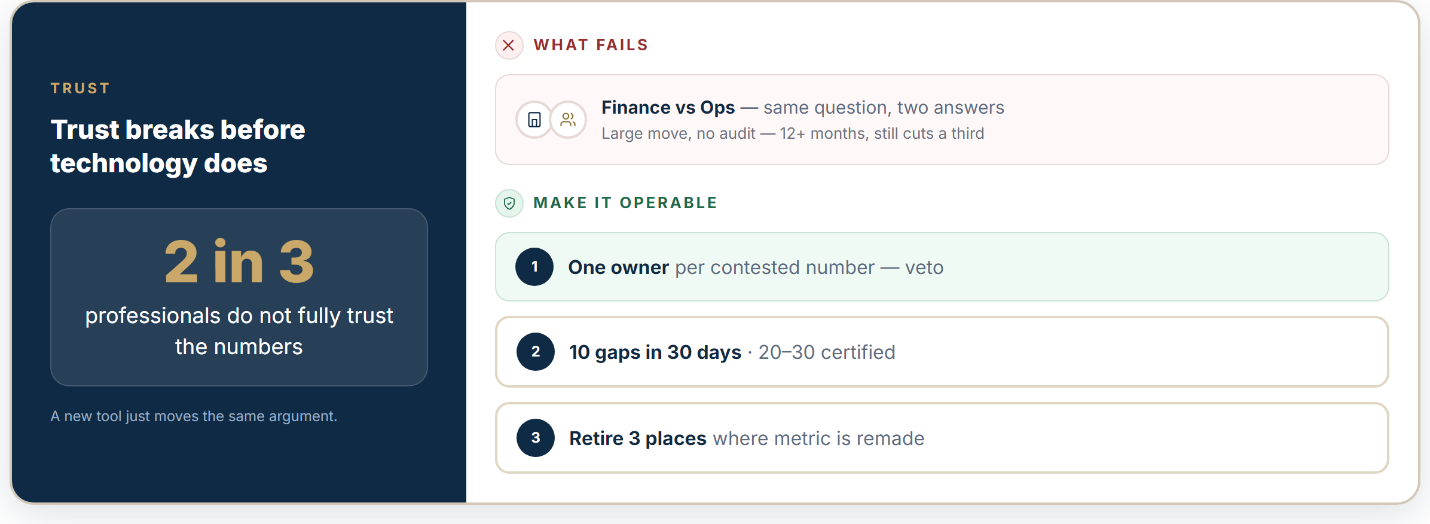
Trust breaks when finance and operations bring different answers to the same question. About two in three professionals say they do not fully trust the numbers, and nearly half of senior finance leaders made a big decision last year on data they later found wrong. The centre does not get a ticket. It gets bypassed.
A new tool does not fix that the same unclear definitions move with it. Large moves without an audit take a year or more and still cut a third of the scope. Closing the top gaps costs far less. New AI rules that ask you to show your work will favour teams that can already trace a number to its definition.
Make it operable: Name one owner for each contested number, give them the right to say no, close the ten most painful gaps in thirty days, certify twenty to thirty definitions, and retire three places where the same metric is rebuilt. If AI cannot point to that certification, it does not answer.
Write Down What Each Number Means Once
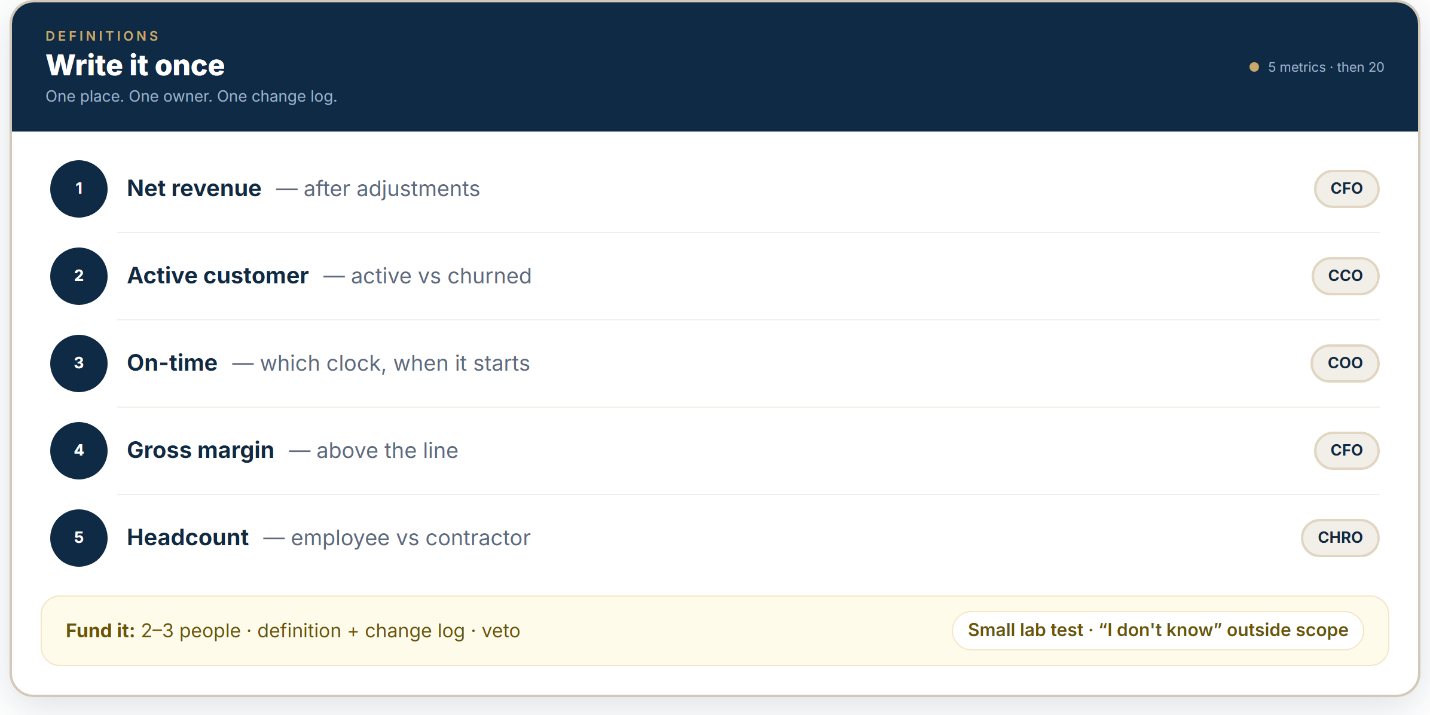
Every company argues about net revenue, active customer, on-time. The answer lives in five places a formula here, a view there, a spreadsheet that predates both. Charts rebuild in days. Agreement takes months. That agreement is the asset you rebuy every switch if you do not own it.
AI makes it urgent. In a small lab, an AI reading a governed definition answered well inside its scope and said “I do not know” outside. Without that layer it answers faster and spreads the same drift with more confidence.
Fund the dictionary: Publish the top twenty metrics with an owner, a plain-English definition, and a change log. Fund two or three people to keep it. Measure them on how quickly variances close, not on how many dashboards they ship. That team pays for itself the first time an acquisition does not require re-arguing margin.
Choose Your Bet, Then Authorize It
You have three bets. Pick one and staff it. Do not try to hedge all three at renewal:
- Capacity hedge. Hiring-led, most need to read → choose shared capacity. It rewards scale.
- Per-builder. Small team builds, most consume → pay per builder. It keeps cost honest.
- Capped usage. Seasonal or event-driven → capped usage. It follows the spike without becoming the baseline.
Hourly capacity costs markedly more than reserved. Your break-even depends on how you buy, ask IT for the reserved vs hourly view for your mix.
Three Decisions in the Next 90 Days
Not four tickets. Three authorizations, each with one owner and a date before the vendor sets yours:
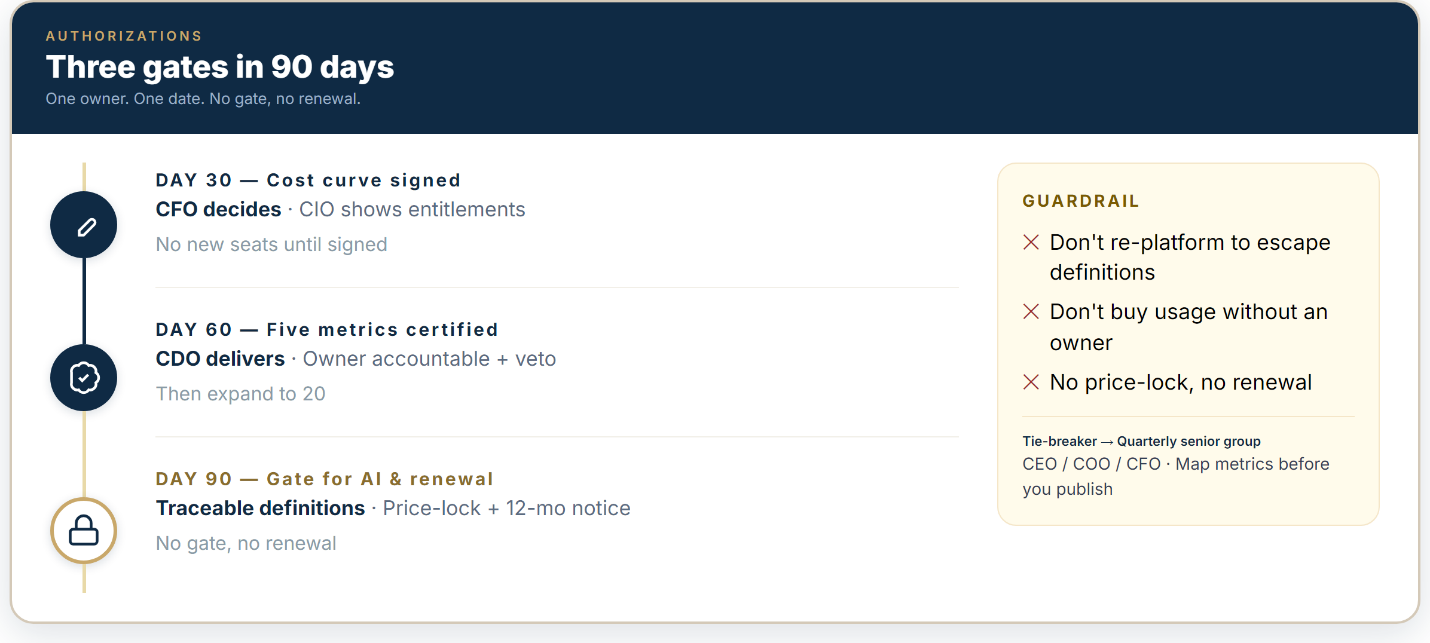
- 1. Decide the curve. CFO decides, CDO recommends: which bet above matches the next 18 months of hiring and growth? CIO shows entitlements and peak concurrency in 30 days. No new seats until the curve is signed.
- 2. Decide the meanings. CDO delivers, business owner is accountable per metric: five contested metrics published with a steward, certification, and veto. Then expand to twenty.
- 3. Decide the gates. No AI that answers from BI, and no renewal, without two conditions: every answer traces to a certified definition with a change log, and the contract carries price-lock, true-up protection, and twelve months’ notice before a tier is retired. A small senior group meets quarterly to break ties. For any new entity, the rule is simple: map its metrics before you publish its dashboards.
Guardrail: Do not re-platform to escape definitions, a new tool costs months on the same drift and do not buy a usage model without someone to own it. The $xxxx uplift some paid on 500 seats was not a negotiation failure. It was a design never made. At scale, idle seats quietly add up; at 500 seats that is thousands, at a few thousand seats it becomes material reclaim before you buy.
The curve you sign today is a three-year bet. The meanings you do not write down are the switching cost you will pay tomorrow. The trust you do not make operable becomes the spreadsheet estate you find at audit. Put the three decisions on the next steering agenda before the renewal is put on yours.