


A CXO Briefing for Life Sciences Leadership
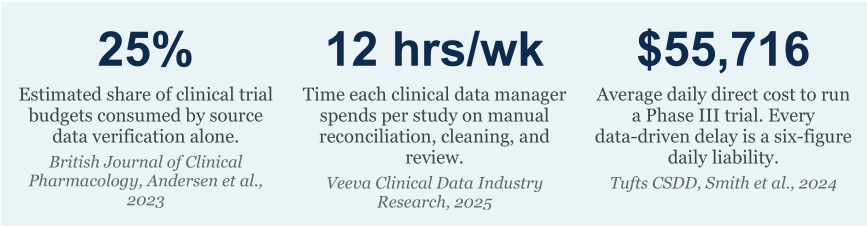
Clinical trial costs have become the defining constraint in pharmaceutical R&D economics. Phase III conduct alone now runs $55,716 per day according to Tufts CSDD’s 2024 analysis, based on budget data from 409 protocols. When sponsors dissect their budgets, the standard line items are familiar: site costs, patient recruitment, CRO fees, regulatory compliance. Data management typically appears as a 15% allocation. But that figure captures only the direct, labelled spend. It excludes the monitoring overhead, the query resolution cycles, the manual reconciliation labour, and the rework driven by disconnected systems that collectively push the true data-handling burden well beyond what any single budget line reveals.
EXECUTIVE SUMMARY
Clinical trial data management is not a 15% budget line. When monitoring, source data verification, query resolution, reconciliation, and system-driven rework are aggregated, the true cost is substantially higher than what sponsors budget. Most treat this as fixed infrastructure rather than an optimisation opportunity, leaving billions in aggregate industry spend unexamined.
The industry has systematically optimised recruitment, site selection, and CRO procurement. Data management, by contrast, has been treated as an operational given rather than a strategic variable. The organisations beginning to challenge that assumption are finding that the single largest efficiency opportunity in clinical operations has been hiding in plain sight.
“The question is not whether clinical data management costs too much. The question is why sponsors have accepted a cost structure built on manual reconciliation, disconnected systems, and monitoring practices that predate their own EDC platforms.”
The 15% Budget Line That Understates the Real Spend
Industry benchmarks consistently place direct data management at 15% of total clinical trial cost. This figure captures EDC licensing, database build, data cleaning, coding, and database lock. It is accurate as far as it goes. The problem is where it stops.
Source data verification has been reported to consume up to 25% of clinical trial budgets, according to Andersen et al. in the British Journal of Clinical Pharmacology (2023). TransCelerate BioPharma found that 46% to 50% of monitoring time is consumed by 100% SDV, yet only 2.4% of queries on critical data fields were driven by the verification process. Separately, approximately 97% of electronically captured data is already accurate at entry. When direct data management, monitoring-driven SDV, query resolution, and cross-system reconciliation are consolidated into a single cost view, the aggregate burden is substantially larger than the labelled 15%.
What the Budget Label Excludes
The structural issue is that the total cost of ensuring data quality is distributed across budget categories that are never consolidated. Monitoring sits in clinical operations. Query resolution absorbs CRA time budgeted under site management. Reconciliation appears in CRO fees. No single stakeholder owns the aggregate data cost, and no single budget line reveals it.
Veeva’s 2025 Clinical Data Industry Research quantified this. Each data manager spends more than 12 hours per week, per study on manual reconciliation, cleaning, and review. The drivers: too many manual steps or data re-entry (68%), inefficient workflows (58%), and disconnected systems (59%). Critically, 97% perform data reconciliation outside clinical systems or using a mix of systems.
Protocol amendments compound the problem. Tufts CSDD’s 2024 benchmarks show that 76% of Phase I to IV trials now require amendments, up from 57% in 2015, with median direct costs of $141,000 for Phase II and $535,000 for Phase III protocols. Each amendment cascades into EDC reconfiguration, revised edit checks, and data reconciliation. The data management cost of an amendment appears nowhere in the amendment’s own budget line.
Why the Hidden Data Cost Matters Now
With Phase III daily costs at $55,716, every week of data-driven delay represents substantial direct trial cost. When two-thirds of data managers and CRAs report that current inefficiencies will put clinical data quality at future risk, the issue extends beyond cost control to submission integrity. Rising trial complexity, decentralised designs introducing additional data streams, and ICH E6(R3) requirements for risk-based quality management with formal data governance create structural pressure that the current manual-intensive model cannot absorb.
This broader problem of fragmented data and manual workflows is also explored in Perceptive Analytics’ Pharma Intelligence 2026, which looks at how disconnected data across R&D and commercial functions creates delays and operational cost across the drug development lifecycle.
PERCEPTIVE ANALYTICS PERSPECTIVE
At Perceptive Analytics, we advise clients to conduct a Total Data Cost audit before any clinical operations transformation. This means consolidating monitoring, query resolution, reconciliation, and amendment-driven rework into a single cost view alongside direct data management spend. The organisations that have completed this exercise consistently discover that their actual data cost substantially exceeds the labelled budget line, and that the largest efficiency gains sit in reconciliation and monitoring layers rather than in EDC licensing, where most procurement attention currently focuses.
What To Do Instead: A Total Data Cost Framework
The corrective is a cost accounting discipline that most sponsors have never applied to data management. A Total Data Cost framework consolidates five previously separated cost streams: direct data management, monitoring-driven SDV, query resolution cycles, cross-system reconciliation labour, and amendment-driven data rework.
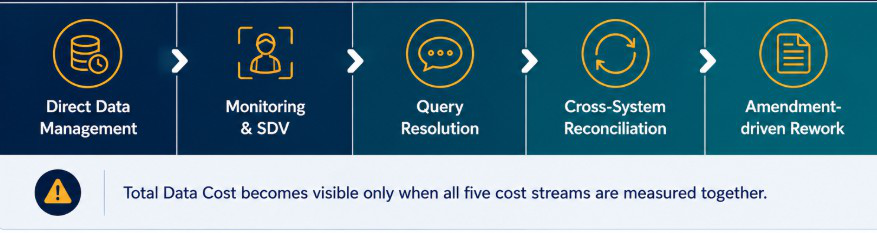
Figure1: Unified total data cost framework
Once consolidated, the optimisation sequence becomes visible. Risk-based monitoring focuses verification on critical-to-quality data rather than 100% SDV, meaningfully reducing CRA travel and site visit costs. Unified clinical platforms eliminate the reconciliation labour that consumes 12 hours per data manager per week. eSource adoption reduces query volume by automating data capture from EHRs directly into EDC systems, as demonstrated in implementations at institutions including Memorial Sloan Kettering. Protocol design investment using AI-assisted feasibility simulation reduces the amendment rate that cascades into data rework.
Proof Point: Novartis Data Platform Transformation
Novartis partnered with AWS and Accenture to modernise its drug development data infrastructure, building a next-generation GxP-compliant data platform that consolidates fragmented clinical data domains. The initiative targets a reduction of at least six months per clinical trial development cycle. Initial results from the patient safety domain demonstrated 72% faster query speeds, 60% storage cost reduction, and over 160 hours of manual work eliminated. The protocol generation use case achieved 83% to 87% acceleration in producing compliant protocols. The critical design principle was modularity: individual use cases deliver standalone value while the integrated platform compounds efficiency gains across the development lifecycle.
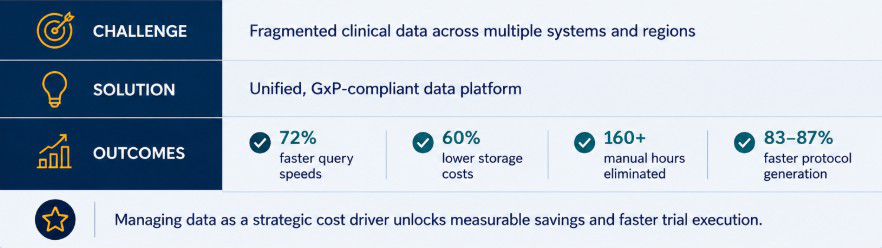
Figure 2: Novartis data platform transformation
Conclusion
The share of clinical trial cost absorbed by data management is not a revelation to anyone who has managed a Phase III programme. What remains underexamined is the degree to which sponsors have accepted this cost as structural rather than addressable. The budget architecture that distributes data costs across monitoring, operations, and CRO fees prevents any single leader from seeing the aggregate number.
The organisations beginning to consolidate their total data cost are discovering that the single largest efficiency opportunity in clinical development sits not in patient recruitment or site selection, but in the data management infrastructure that connects every other function. The economics are available. The question is whether clinical operations leadership will treat data cost as a strategic variable or continue to manage it as an overhead assumption.
Perceptive Analytics partners with Life Sciences organizations to modernize clinical data operations through AI-enabled automation, advanced analytics, and scalable data engineering. If your organization is trying to identify hidden data-management costs, reduce reconciliation and monitoring effort, or build a more connected clinical data environment, book a free Data & Analytics Consultation to discuss where the largest opportunities may sit.
References
Sources and Methodology
All statistics in this briefing are drawn from the following primary research, surveys, regulatory publications, industry analyses, and enterprise case studies, verified at the time of writing.
Sources marked with an asterisk (*) have been independently cross-verified against at least one secondary source.
Primary Sources
- TuftsCSDD / Smith ZP, DiMasi JA, Getz New Estimates on the Cost of a Delay Day in Drug Development. Therapeutic Innovation & Regulatory Science, 2024; 58(5):855-862 *
- VeevaClinical Data Industry Research: Inefficiencies in Clinical Data Management Workflows, September 2025 (SCDM 2025) *
- AndersenJR et Impact of Monitoring Approaches on Data Quality in Clinical Trials. British Journal of Clinical Pharmacology, 2023 *
- TransCelerateBioPharma Position Paper on Risk-Based Monitoring, 2013
Peer-reviewed and Industry Analysis
- GetzKA, Smith Z, Botto E, et New Benchmarks on Protocol Amendment Practices. Therapeutic Innovation & Regulatory Science, 2024; 58(3):539-548 *
- Getz KA, Stergiopoulos S, et al. The Impact of Protocol Amendments on Clinical Trial Performanceand Therapeutic Innovation & Regulatory Science, 2016; 50(4):436-441
- ClinicalTrials Arena / Revealing the Human and Business Cost of Clinical Trial Inefficiencies. December 2025
- SourceData Verification Quality in Clinical Research: A Scoping Journal of Clinical and Translational Science, 2024
- MedCity New Technology is Revolutionizing Clinical Trial Data Management. June 2026
Regulatory Research
- ICHE6(R3) Good Clinical Practice, finalized January 2025; FDA adoption September 2025
- FDAComputer Software Assurance Guidance, September 2022
Enterprise Case Studies
- Novartis/ AWS / AI-Driven Clinical Trial Transformation with Next-Generation Data Platform (presented at AWS re:Invent)
- AppliedClinical Trials Scaling eSource-Enabled Clinical Trials: Hospital Perspectives (MSK, AstraZeneca, Sanofi), April 2025
Methodology Notes
This briefing combines peer-reviewed literature on clinical trial costs and monitoring economics, industry survey data on data management workflow inefficiencies, regulatory guidance on risk-based quality management, and enterprise transformation case studies. Evidence was prioritised based on source credibility, publication recency, and direct relevance to clinical trial data management economics. No statistics are projections or estimates generated by Perceptive Analytics; all quantitative figures are derived from publicly available primary sources as cited.