


A CXO Briefing for Life Sciences Leadership
SAS has been the statistical computing backbone of pharmaceutical development for four decades. It underpins clinical trial programming, regulatory submissions, commercial analytics, and pharmacovigilance workflows across virtually every major Life Sciences organization. The decision to migrate away from SAS is therefore not a technology replacement. It is a rewiring of the analytical infrastructure that connects drug development to regulatory approval. As GenAI-powered migration accelerators, rising license costs, a shrinking SAS talent pool, and growing regulatory acceptance of open-source tools converge to create migration pressure, commercial and R&D leadership face a question that vendor marketing rarely answers honestly: what does this transition actually cost, how long does it actually take, and what are organizations that started 18 months ago actually experiencing?
EXECUTIVE SUMMARY
SAS migration in Life Sciences is not a code conversion problem. It is a regulatory continuity problem, a workforce transformation, and an institutional knowledge transfer – compressed into a single programme that touches every function from clinical development to commercial analytics.
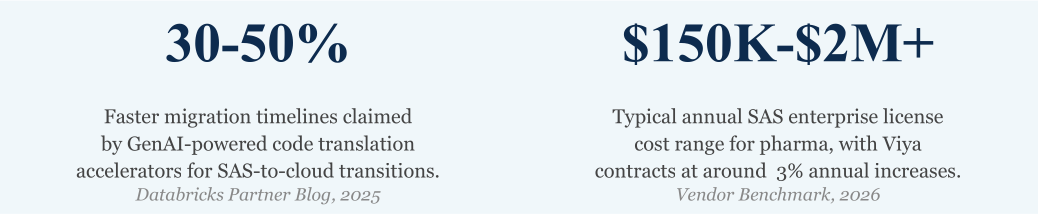
The vendor narrative is straightforward. Tools like iAURA, EXL Code Harbor, LTIMindtree Scintilla.ai, and SAS2PY use GenAI to parse legacy SAS code, extract business rules, map dependencies, and generate cloud-native equivalents in PySpark, Python, or R. Published benchmarks claim 30 to 50% faster migration timelines and up to 80% reduction in manual conversion effort. A typical promotional claim: 100,000 lines of SAS code converted in 10 minutes.
The enterprise reality is more complicated. Code translation is the most visible phase of migration, but it roughly only accounts for more than 20 to 30% of total programme effort. The remaining 70 to 80% consists of work that no GenAI accelerator can automate: revalidating every converted workflow against GxP compliance requirements, rebuilding the statistical computing environment to satisfy FDA 21 CFR Part 11, retraining a workforce whose entire career has been built around SAS syntax, maintaining parallel SAS and cloud environments during regulatory submissions already in progress, and preserving the undocumented institutional knowledge embedded in macro libraries refined over decades of regulatory feedback. These are the costs that define whether a migration succeeds or fails. And they are the costs that vendor marketing systematically understates.
The organizations experiencing the strongest migration outcomes are those that recognized from the outset that code conversion was the simplest part of the programme. They invested disproportionately in the dimensions that accelerators cannot reach: regulatory continuity, workforce development, and validation infrastructure.
“The question is not whether to migrate away from SAS. The economics and the talent pipeline have already answered that. The question is whether your organization has budgeted for what migration actually requires beyond code conversion.”
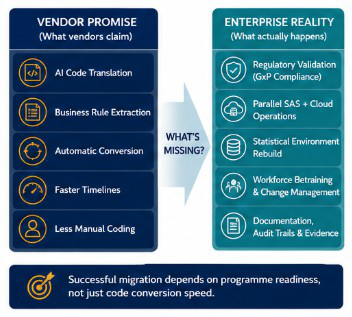
Figure 1: Vendor Promise Vs Enterprise Reality
Why the Migration Pressure Is Real and Growing
1.1 – The Economics of SAS Licensing Have Become Structurally Unsustainable
SAS operates a dual-track pricing model. Legacy SAS 9.4 carries perpetual licenses with 20 to 25% annual maintenance fees. SAS Viya, the cloud-native successor, is subscription-only with no perpetual option and contracts typically locked at minimum three-year terms with 3% annual price escalations built in. Enterprise pharmaceutical deployments commonly range from $150,000 to over $2 million annually depending on module count, user tiers, and server specifications. Healthcare and pharma buyers frequently pay premium rates due to regulatory and compliance requirements.
The structural problem is not merely the absolute cost. It is the combination of rising license fees, declining negotiating power, and accelerating competitive pressure from zero-cost alternatives. R and Python carry no licensing fees. Databricks and cloud platforms charge only for compute consumption. When a mid-size pharma organization spends $800,000 annually on SAS licenses while its competitors run equivalent analytical workloads on open-source infrastructure at a fraction of that cost, the financial argument for maintaining SAS becomes progressively harder to defend at the board level.
1.2 – The SAS Talent Pipeline Has Structurally Collapsed
Universities stopped teaching SAS as a primary analytics language more than a decade ago. The generation of statisticians and programmers entering the workforce today learned R and Python. They build Jupyter notebooks, deploy on cloud platforms, and collaborate through GitHub. SAS syntax is foreign to them. Hiring a SAS developer in 2026 is substantially more expensive than hiring a Python or PySpark developer with equivalent analytical experience, and the candidate pool is shrinking with every retirement cycle.
For pharmaceutical organizations, this creates a compounding problem. Clinical programming, pharmacovigilance, and commercial analytics all depend on SAS expertise that is becoming simultaneously more expensive and more scarce. We estimate that a typical Phase III trial would require about 200 to 500 tables, listings, and figures. Staffing these requirements with SAS programmers grows harder every year. The talent economics alone would justify migration even if licensing costs remained flat.
1.3 – Regulatory Acceptance of Open Source Has Reached a Tipping Point
The regulatory barrier that historically justified SAS dependency has substantially eroded. The R Consortium’s Submissions Working Group has completed four R-based FDA pilots through Pilot 4, establishing practical precedent for R-based regulatory submissions. Pilot 4 evaluated WebAssembly and container technologies for delivering R-based applications, while Pilot 5, launched in 2025, explored Dataset-JSON as an alternative to XPT files. Launched in January 2026, Pilot 6 is a low-stakes development effort to expand the number of R programs available for ADaM datasets and displays; it is not being submitted to the FDA, but is intended to lay the groundwork for future submission pilots. Pilot 7 focuses on creating realistic simulated clinical-trial datasets that can serve as benchmarking data for evaluating modern R-based and AI-enabled workflows across clinical development, analysis, and regulatory submissions.
More significantly, individual pharmaceutical companies have moved from pilot projects to production regulatory use. Novo Nordisk completed an R-based NDA submission accepted by the FDA, demonstrating that open-source R can support a complete regulatory submission workflow. Roche followed with an end-to-end R-based submission for a new drug application to the FDA, EMA, and NMPA. GSK has committed to having 50% of its code written using open-source technologies. These examples demonstrate that R-based open-source workflows can support regulatory submissions in practice, although adoption remains organization- and workflow-specific. The remaining question is how quickly individual organizations can execute the transition.
PERCEPTIVE ANALYTICS PERSPECTIVE
The convergence of licensing economics, talent scarcity, and regulatory acceptance creates a migration imperative that did not exist five years ago. At Perceptive Analytics, we advise clients not to debate whether SAS migration should happen – that question has been settled by market forces. The strategic question is sequencing: which workloads to migrate first, which to maintain on SAS during active regulatory submissions, and how to build the organizational capability to operate across both environments during a transition that will realistically span three to five years.
What GenAI Migration Accelerators Actually Deliver – and What They Cannot
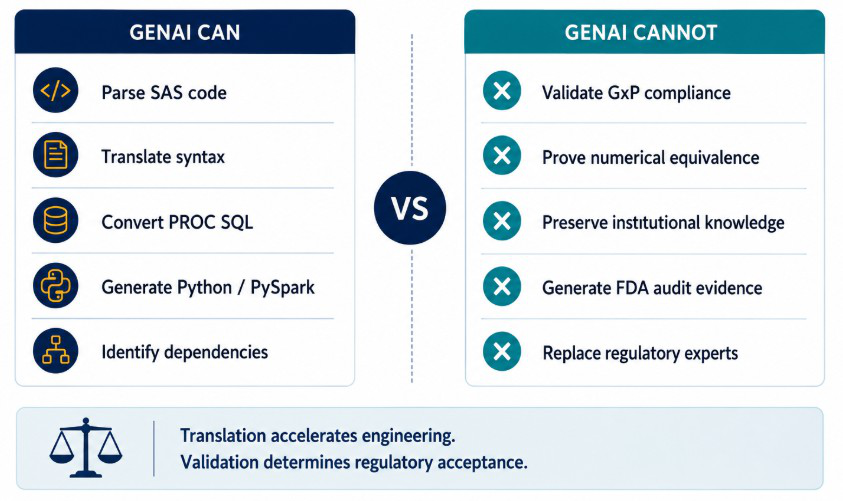
Figure 2: GenAI’s Role in SAS-to-Cloud Migration
2.1 – The Code Translation Layer Is Real and Genuinely Useful
GenAI-powered migration tools represent a legitimate engineering advancement. iAURA’s Agentic ETL Migration parses legacy SAS code, extracts business rules, maps dependencies, and generates Databricks-native pipelines in PySpark, SQL, or Delta Live Tables. EXL’s Code Harbor automates SAS-to-Databricks migration with what the company describes as 50% faster timelines and minimal manual intervention. LTIMindtree’s Scintilla.ai claims 80% reduction in manual effort through multi-agent SAS-to-PySpark conversion. SAS2PY advertises conversion of 100,000 lines of code in 10 minutes.
These capabilities are valuable. They eliminate the most tedious and error-prone phase of migration: line-by-line manual code rewriting. For organizations with millions of lines of legacy SAS code accumulated over decades, automated translation meaningfully compresses one dimension of the programme timeline.
2.2 – Translated Code Is Not Validated Code
The critical distinction that vendor marketing obscures is the gap between translated code and production-ready, regulatory-grade code. GenAI models generate code that is syntactically correct and functionally plausible. They do not generate code that has been validated against GxP requirements, tested for numerical equivalence with the original SAS outputs to the precision required for regulatory submissions, or documented with the audit trail that FDA 21 CFR Part 11 demands.
Research on GenAI code translation highlights persistent limitations. LLMs prioritize syntactical plausibility over semantic accuracy. Context window constraints mean that complex, interdependent SAS macro libraries cannot be processed holistically. Subtle differences in how SAS and Python handle floating-point arithmetic, missing values, date processing, and sort stability can produce outputs that appear correct in testing but diverge under edge conditions that only surface in production. In pharmaceutical statistical programming, where a numerical discrepancy in a clinical trial analysis can invalidate regulatory findings, the validation burden after automated translation is not a minor finishing step. It is the majority of the remaining work.
2.3 – Institutional Knowledge Cannot Be Parsed by an Algorithm
The deepest cost in SAS migration is not code. It is the undocumented institutional knowledge embedded in macro libraries that have been refined through decades of regulatory submissions, reviewer feedback, and hard-won experience with edge cases in clinical data. A SAS macro that has been exercised against hundreds of studies carries computational behaviour that is expensive to replicate. The original authors may have retired. The rationale for specific logic branches may exist only in the memories of programmers who wrote them fifteen years ago.
GenAI accelerators can translate the syntax of these macros. They cannot translate the regulatory history, the institutional reasoning, or the accumulated validation evidence that gives those macros their production credibility. When a pharmaceutical company migrates a validated SAS macro library to PySpark, it does not merely need the code to produce the same outputs. It needs to demonstrate – with documentation sufficient for regulatory inspection – that the new implementation is equivalent. That demonstration is manual, expert-intensive, and cannot be accelerated by code translation tools.
PERCEPTIVE ANALYTICS PERSPECTIVE
GenAI migration accelerators solve the most visible problem while leaving the most expensive problems untouched. At Perceptive Analytics, we estimate that code translation typically represents 20 to 30% of total SAS migration programme cost in regulated environments.
Validation, parallel running, workforce retraining, and regulatory documentation account for the remaining 70 to 80%. Organizations that budget based on the code translation timeline will consistently underestimate total programme duration by a factor of three to five.
The Regulatory Continuity Problem That Defines Migration Timelines
3.1 – Active Submissions Create Unmovable Constraints
Pharmaceutical companies do not have the luxury of pausing regulatory submissions while migration occurs. An organization with three drugs in Phase III, two NDAs in preparation, and ongoing post-marketing surveillance cannot stop generating regulatory-grade statistical outputs from its current SAS environment. This creates a hard constraint: SAS and the target platform must run in parallel for the duration of every active regulatory programme that began on SAS.
For large pharmaceutical companies, this parallel operating period is measured in years, not months. Each active submission requires that the original SAS code remain available, executable, and supported until the regulatory process concludes. Switching mid-submission introduces risk that no regulatory affairs team will accept voluntarily. The result is that migration timelines are not primarily determined by how fast code can be converted. They are determined by the lifecycle of active regulatory programmes that cannot be interrupted.
3.2 – Validation Costs Scale with Regulatory Scope, Not Code Volume
Every migrated workflow that touches GxP-regulated data requires formal validation. This means Computer System Validation of the new statistical computing environment, Installation and Operational Qualification protocols, documented evidence that migrated code produces outputs equivalent to the original within regulatory acceptance criteria, and updated standard operating procedures for every affected workflow. Industry benchmarks indicate that validation workstreams consume 30 to 40% of total migration effort in pharmaceutical environments.
The cost scales not with how many lines of SAS code need translation, but with how many regulatory-grade workflows need revalidation. An organization with 50 validated clinical reporting workflows faces validation costs that dwarf the code conversion effort, regardless of whether that conversion was automated by GenAI or performed manually.
3.3 – The Statistical Computing Environment Must Be Rebuilt, Not Just Replaced
SAS is not merely a programming language. It is a complete Statistical Computing Environment with built-in audit trails, electronic signatures, version control, and access controls designed to satisfy 21 CFR Part 11. Migrating to R, Python, or PySpark on Databricks means rebuilding that entire compliance infrastructure from components: Posit Team or equivalent for managed R/Python environments, Unity Catalog or similar for data governance, custom audit trail and electronic signature implementations, and package validation frameworks for every open-source library used in regulatory work.
Novo Nordisk’s experience is instructive. The company went from pilot R project to complete R-based NDA submission in under two years – but that timeline required building a validated computing platform from the ground up, developing specialized internal R packages, and demonstrating to the FDA that their open-source infrastructure met the same compliance standards as SAS. Replicating that investment is achievable, but it demands sustained executive commitment and dedicated infrastructure engineering that most organizations have not yet budgeted for.
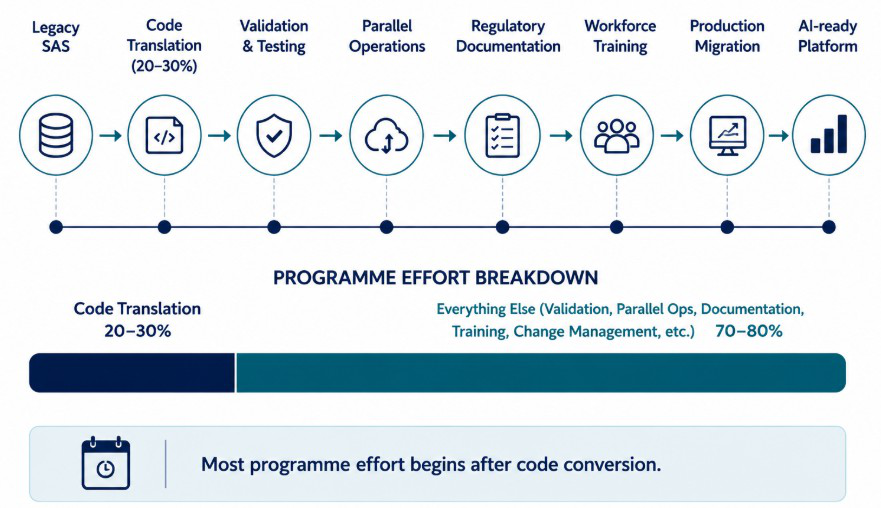
Figure 3: SAS Migration Timeline
PERCEPTIVE ANALYTICS PERSPECTIVE
Migration timelines in pharmaceutical SAS transitions are governed by regulatory lifecycle constraints, not code conversion speed. At Perceptive Analytics, we advise organizations to plan migration sequencing around their regulatory submission calendar: new programmes start on the target platform, active submissions complete on SAS, and the parallel operating period is explicitly budgeted as a cost of transition rather than treated as an unexpected overhead. The organizations managing this best have a named regulatory migration lead – not just a technical migration lead – coordinating the sequencing.
The Workforce Transformation That Determines Whether Migration Succeeds
4.1 – Statistical Programmers Are Not Interchangeable Across Languages
SAS clinical programmers carry specialized expertise that extends far beyond syntax. They understand CDISC data standards at an implementation level, they know how to construct ADaM datasets that satisfy specific regulatory reviewer expectations, and they have internalized the validation patterns required for independent double programming. A programmer fluent in Python does not automatically carry this regulatory domain knowledge. Conversely, a SAS programmer with twenty years of clinical trial experience cannot be retrained in PySpark over a two-week course and expected to produce regulatory-grade outputs.
The workforce challenge is therefore bilateral. The organization needs its existing SAS experts to transfer their domain knowledge into new environments, while simultaneously needing to hire or develop cloud-native developers who can build the infrastructure those experts will use. In pharmaceutical environments, where SAS proficiency is deeply tied to professional identity and career advancement, the change management dimension is more acute than in most industries.
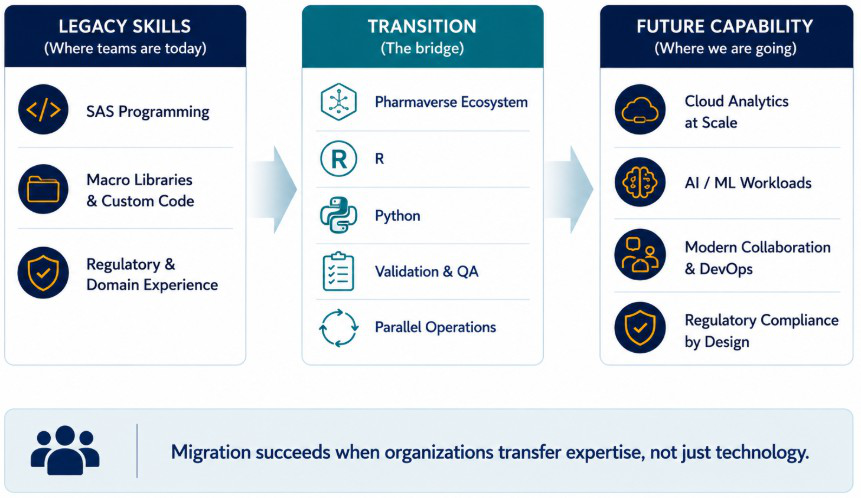
Figure 4: Migration as a workforce transformation
4.2 – The Pharmaverse Ecosystem Changes the Skills Equation
One development that materially alters the workforce calculus is the maturation of the pharmaverse ecosystem. This collaborative open-source initiative – now a PHUSE Working Group with over 100 developers contributing – provides validated R packages purpose-built for clinical trial workflows: admiral for ADaM datasets, xportr for regulatory export formatting, and dozens of supporting packages aligned with current CDISC standards. GSK, Roche, Janssen, and Merck have all contributed packages to the ecosystem.
Pharmaverse reduces the skills gap for R adoption by providing clinical programmers with packages that implement regulatory standards they already understand. A SAS programmer learning R through pharmaverse is not learning a foreign language from scratch. They are learning new syntax for familiar regulatory concepts. This substantially changes the retraining calculus, though it does not eliminate it. Organizations that invest in pharmaverse-based training for their existing clinical programming teams report faster productive transitions than those attempting to retrain on raw Python or PySpark.
4.3 – Maintaining Bilingual Capability Is an Operational Necessity, Not a Failure
Organizations 18 months into SAS migration consistently report the same operational reality: they are running bilingual analytical environments and will continue to do so for years. This is not a sign of stalled migration. It reflects the genuine constraint that different workloads are at different stages of the regulatory lifecycle and cannot all transition simultaneously.
Accepting bilingual operations as a planned state rather than an interim failure changes how organizations budget, staff, and measure migration progress. It means maintaining SAS expertise for legacy workloads while building cloud-native capability for new programmes. It means defining clear workload allocation rules: new clinical studies start on R or Python, active submissions complete on SAS, commercial analytics migrates on an independent timeline from clinical programming. This structured coexistence is what actual migration success looks like at the 18-month mark.
PERCEPTIVE ANALYTICS PERSPECTIVE
The workforce dimension of SAS migration deserves the same strategic attention as the technical dimension. At Perceptive Analytics, we observe that organizations treating retraining as a cost line in the migration budget consistently underperform those treating it as a capability investment. The target is not to eliminate SAS skills. It is to build an organization that can operate across multiple analytical environments with the regulatory fluency required in each. That takes structured investment over 24 to 36 months, not a training sprint.
What 18 Months of Migration Experience Actually Reveals
5.1 – Code Conversion Was the Easy Part
Organizations that began SAS migration 18 months ago consistently report that the code translation phase proceeded faster than expected – often aided by GenAI tools – while the downstream phases of validation, regulatory documentation, and workforce adaptation took substantially longer. We have observed that the pattern is consistent: migration programmes that estimated 12-month completion based on code conversion timelines are now projecting 30 to 36 months based on the regulatory and organizational work that follows.
This is not a failure of planning so much as a structural feature of regulated migration. The code is the artifact. The validation evidence, the regulatory documentation, the retraining, and the parallel operating infrastructure are the programme. Vendor marketing focuses on the artefact because it is quantifiable and impressive. The programme is where the budget lives.
5.2 – The Strongest Outcomes Came from Capability-First Framing
Novo Nordisk, Roche, and GSK did not frame their SAS transitions as cost-reduction exercises. They framed them as capability investments that would enable reproducible, transparent, AI ready analytical infrastructure. This framing shaped every downstream decision: it justified the investment in building validated computing platforms, it sustained executive sponsorship through the cost valley of parallel operations, and it attracted technical talent motivated by working on modern infrastructure.
Roche filed R-based regulatory submissions with the FDA, EMA, and NMPA – demonstrating that their investment created globally portable regulatory capability. GSK’s target of 50% open-source adoption positioned the organization to recruit from the full pool of R and Python developers rather than competing for a shrinking pool of SAS programmers. These capability outcomes compound over time in ways that a cost-reduction framing cannot capture.
5.3 – Migration Quality Determines AI Readiness for the Next Decade
The strategic stakes of SAS migration extend well beyond license savings. Every major AI application in drug development – from automated clinical trial design to real-world evidence generation to commercial targeting models – depends on analytical infrastructure that can serve machine learning workloads at scale. SAS was not designed for this. Cloud-native platforms running Python and PySpark were.
An organization that executes SAS migration poorly – cutting corners on validation, rushing code conversion without semantic verification, underinvesting in the statistical computing environment – arrives at a cloud platform that carries technical debt from day one. An organization that executes migration rigorously arrives at infrastructure positioned to support every AI initiative for the next decade. The migration is not the end state. It is the foundation. The quality of that foundation will either accelerate or constrain every analytical capability built on top of it.
This is why migration should be evaluated as a data and analytics foundation decision, not simply a SAS replacement exercise. Organizations building this foundation can also explore Pharma Commercial Data Engineering for AI Readiness, which examines how modern data engineering supports the AI and analytics capabilities that sit downstream of the platform.
PERCEPTIVE ANALYTICS PERSPECTIVE
Eighteen months of industry experience has produced a clear pattern: the organizations reporting the strongest outcomes budgeted for the full programme, not just the code conversion. They sequenced migration around regulatory lifecycles. They invested in pharmaverse-based workforce development. They built validated statistical computing environments before attempting regulatory submissions. And they framed the entire transition as a capability investment rather than a cost savings exercise. At Perceptive Analytics, we believe this pattern will define how the next wave of organizations approaches SAS migration – with significantly more realistic expectations about what the transition actually requires.
Case Studies: SAS Migration in Practice
The following implementations illustrate different approaches to SAS migration in pharmaceutical environments, spanning regulatory submissions, commercial analytics, and genomic research.
CASE STUDY: NOVO NORDISK
First Fully R-Based NDA Submission to the FDA
Novo Nordisk committed to transitioning from SAS to R in 2019 and delivered its first R-based regulatory outputs by 2020. The company built a validated statistical computing environment using Posit Team, developed specialized internal R packages, and generated the regulatory submission package using R for tables, listings, figures (TLFs), and supporting submission components for six Phase 3a clinical trials entirely in R. The complete NDA submission package – including ADaM datasets and all supporting analyses – was accepted by the FDA. The company ran R and SAS in parallel throughout the transition to demonstrate equivalence.
Key takeaway: The transition from pilot to production-grade regulatory submission took approximately two years and required building the compliance infrastructure from the ground up. The investment created a globally portable capability, but Novo Nordisk has noted that quantifying a specific ROI for the transformation remains difficult because the value is primarily in capability creation rather than direct cost reduction.
CASE STUDY: GSK
Scaling Open-Source Adoption Across Clinical Programming
GSK set a target of 50% open-source code adoption across clinical programming operations. The company partnered with Posit to build governed R and Python environments and contributed multiple packages to the pharmaverse ecosystem. The migration strategy focused on new clinical studies starting on R while existing SAS-based programmes completed on their original infrastructure, avoiding the risks of mid-submission platform changes.
Key takeaway: GSK’s phased approach – new studies on open-source, active studies completing on SAS – represents the sequencing model that organizations 18 months into migration consistently report as most effective. It avoids regulatory continuity risk while building organizational capability incrementally.
CASE STUDY: CMCS / CMS
Large-Scale SAS-to-Databricks Migration in Healthcare Analytics
The Center for Medicaid and CHIP Services migrated its Data Quality Measures system from SAS to Databricks. The legacy environment comprised thousands of SAS macros, DATA steps, and PROC SQL operations built by multiple contributors over years. The migration involved full discovery of SAS objects, data dependencies, and business logic, followed by refactoring into PySpark notebooks and Python UDFs on Delta Lake. The project eliminated SAS licensing costs and established a lakehouse foundation for future analytics and AI workloads.
Key takeaway: Even in a non-clinical-trial context, the migration required comprehensive inventory of legacy code, careful dependency mapping, and phased cutover with parallel data reconciliation. The complexity of migrating undocumented SAS logic accumulated over years of development was the primary timeline driver, not the code conversion itself.
Conclusion
SAS migration is happening across Life Sciences, and the forces driving it – licensing economics, talent scarcity, regulatory acceptance of open source – are structural rather than cyclical.
GenAI-powered code translation tools have genuinely accelerated one dimension of the transition. They have not, however, changed the fundamental nature of what regulated migration requires.
The organizations 18 months into this journey are reporting a consistent pattern: code conversion was faster than expected, everything else took longer than planned, and the total programme cost was determined not by the code translation phase but by validation, regulatory continuity, workforce development, and the parallel infrastructure required to maintain operations during transition. These dimensions are not amenable to acceleration through automation. They require sustained investment, disciplined sequencing around regulatory lifecycles, and executive sponsorship that persists through the cost valley of parallel operations.
The strategic opportunity remains significant. Cloud-native analytical infrastructure positions pharmaceutical organizations for the AI-enabled capabilities that will define competitive performance over the next decade. But that opportunity is realized through rigorous execution of a three-to-five-year programme, not through a code conversion sprint that vendor marketing might suggest takes six months. The organizations that will lead are those that planned for what migration actually requires – and budgeted accordingly.
Perceptive Analytics helps Life Sciences organizations navigate the analytical modernization required to move beyond legacy SAS environments, combining data engineering, advanced analytics, and AI capabilities with the regulatory and commercial context required in pharmaceutical environments. If your organization is evaluating SAS migration, cloud-native analytics, or the data foundation required for AI, explore our Life Sciences Commercial Analytics capabilities or book a free consultation with our team.
“The question is not whether to migrate away from SAS. The economics and the talent pipeline have already answered that. The question is whether your organization has budgeted for what migration actually requires beyond code conversion.”
References
Sources and Methodology
All statistics in this briefing are drawn from the following primary research, surveys, regulatory publications, consulting reports and enterprise case studies, verified at the time of writing.
Sources marked with an asterisk (*) have been independently cross-verified against at least one secondary source for figures cited in this document.
Primary Sources
- DatabricksGenAI Partner Accelerators Blog: iAURA, LTIMindtree ai, EXL Code Harbor, 2025 *
- EXL/ Databricks GenAI-Powered SAS Migration Accelerator Partnership Announcement, May 2025 *
- RConsortium Submissions Working Group: FDA Pilots 1-5, 2021-2024 *
- Posit/ Novo Nordisk: Journey to an R-Based FDA Submission, 2024
- SASInstitute Pricing Documentation and Vendor Enterprise License Analysis, 2026 *
Peer-reviewed and Industry Analysis
- Appsilon,Why Pharma Is Moving From SAS to Open Source, 2025 *
- IntuitionLabs,Open Source Pharma: Tools and Trends in Drug Development, March 2026 *
- Automationin Clinical Trial Statistical Programming: A Scoping Review (2020-2025), medRxiv, 2026
- PHUSE/ Pharmaverse Working Group Charter and Package Ecosystem, 2025
- SakaraDigital, SAP S/4HANA Migration for Pharma: Planning the Transition, April 2026
- ClinicalStandards Tables, Listings and Figures (TLFs) in Clinical Trial Reporting, 2024
- PHUSEWorking Best Practices for Double Programming and Validation in Clinical Programming, 2024
- Pharmaverse Ecosystem and Open-Source Clinical Programming, 2025
Regulatory and Consulting Research
- FDAComputer Software Assurance Guidance, September 2022
- ICHE6(R3) Step 2 Draft Guideline, May 2023
- VendorBenchmark, SAS Analytics Enterprise Pricing Analysis, April 2026 *
- McKinseyand Company, Digital Transformation Failure Rates Research
- 21 CFR Part 11: Electronic Records; Electronic Signatures.
Enterprise Case Studies
- NovoNordisk R-Based FDA NDA Submission (published Posit customer story)
- GSKOpen-Source Clinical Programming Adoption (published Posit customer story)
- RocheEnd-to-End R-Based Regulatory Submissions to FDA, EMA, NMPA
- CMCS/ CMS SAS-to-Databricks Data Quality Measures Migration (published Databricks case study)
Methodology Notes
This briefing was developed using a structured research methodology combining vendor-published migration accelerator documentation, regulatory submission pilot records, enterprise implementation case studies, open-source ecosystem analysis, workforce research, and SAS licensing economics. Evidence was prioritized based on source credibility, publication recency, and direct relevance to pharmaceutical SAS migration. GenAI accelerator claims were evaluated against independently published analyses of migration complexity in regulated environments. Key findings were cross-verified across multiple independent sources wherever possible, while areas with limited public evidence were identified accordingly.