


A CXO Briefing for Life Sciences Leadership
As drug launches become increasingly complex and competitive, commercial success is no longer secured by execution alone. The organizations consistently outperforming the market are those that make better commercial decisions earlier, using continuously evolving intelligence to anticipate shifts in physician behavior, payer expectations, patient needs, and competitive dynamics. Building this capability before Day One is rapidly becoming a strategic differentiator, enabling pharmaceutical leaders to reduce launch risk, accelerate market adoption, and improve long-term commercial performance.
EXECUTIVE SUMMARY
The future of pharmaceutical launches belongs to organizations that can transform evolving market intelligence into decisive commercial action before Day One.
The traditional model of pharmaceutical launch planning is reaching its limits. As therapies become more specialized, competitive pipelines grow denser, payer scrutiny intensifies, and physician and patient behaviors evolve more rapidly, assumptions established months before commercialization can lose relevance well before Day One. While organizations have expanded investments in commercial analytics, market research, omnichannel engagement, and AI-enabled forecasting, launch performance continues to vary significantly across the industry, suggesting that access to intelligence alone is no longer a competitive advantage.
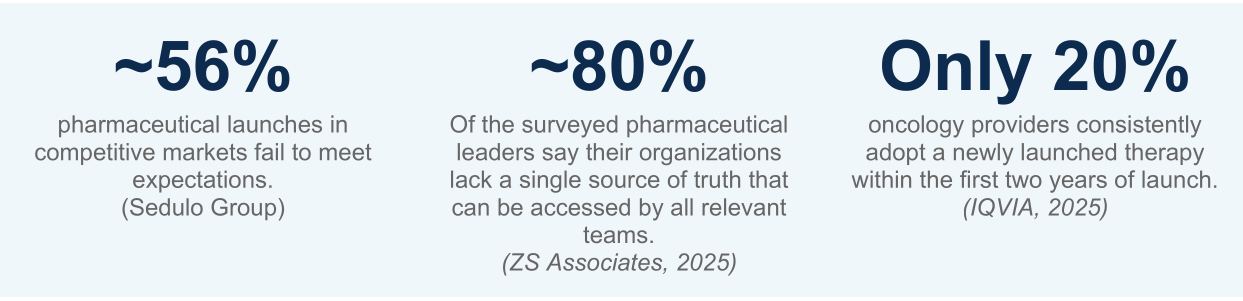
High-performing pharmaceutical companies are therefore redefining commercial intelligence as a strategic operating capability rather than a planning exercise, integrating insights across medical, commercial, market access, patient, and competitive functions to improve decision quality throughout the pre-launch journey. This article explores the capabilities, operating models, and strategic practices that distinguish these organizations and examines how commercial leaders can build a more adaptive foundation for successful product launches.
“In today’s pharmaceutical market, competitive advantage is built long before the first prescription is written.”
The Strategic Shift in Pharmaceutical Commercialization
1.1 – The Evolving Commercial Launch Environment
The pharmaceutical commercialization landscape has undergone a fundamental transformation over the past decade. Scientific advances have accelerated the development of specialty therapies, precision medicines, cell and gene therapies, and orphan drugs, while healthcare ecosystems have become increasingly interconnected. As a result, commercial launches now require organizations to navigate a far broader set of stakeholders, evidence requirements, and market dynamics than was necessary for traditional blockbuster products.
Commercial success is no longer determined solely by physician adoption or sales force effectiveness. Payers, healthcare providers, patients, regulatory agencies, and integrated delivery networks each exert significant influence over market access and product uptake. Decisions made by one stakeholder group increasingly affect outcomes across the commercialization journey, making launch planning a multidisciplinary enterprise rather than a purely commercial function.
At the same time, the volume and velocity of market information have expanded considerably. Real-world evidence, digital engagement data, patient-generated insights, competitive intelligence, and healthcare utilization trends now provide continuous visibility into changing market conditions. While this creates opportunities for more informed decision-making, it also increases the complexity of interpreting which signals are most relevant and how quickly organizations should respond.
1.2 – Why Traditional Launch Planning Is Becoming Less Effective
Many pharmaceutical organizations continue to rely on commercialization models built around periodic planning cycles, predefined milestones, and assumptions established well before launch. Although these approaches have historically provided structure and governance, they are increasingly challenged by market conditions that evolve faster than traditional planning processes can accommodate.
Commercial assumptions related to competitive positioning, payer policies, physician adoption, patient pathways, and treatment guidelines are no longer static throughout the pre-launch period. As new evidence emerges and competitors adjust their strategies, assumptions that were valid during launch planning can become outdated before commercialization begins, reducing the effectiveness of decisions based on them.
This growing disconnect highlights an important shift in commercialization strategy. Success depends not only on developing a comprehensive launch plan but also on maintaining its relevance as market conditions change. Organizations that fail to continuously validate and refine their commercial assumptions risk entering the market with strategies that no longer reflect the realities they are designed to address.
1.3 – Emerging Determinants of Commercial Launch Success
Leading pharmaceutical organizations are responding by expanding their focus beyond launch execution to include the quality and timeliness of commercial decision-making throughout the pre-launch journey. Rather than viewing commercialization as a sequence of isolated functional activities, they are adopting more integrated approaches that connect insights across Medical Affairs, Commercial, Market Access, Patient Services, and Analytics.
This shift reflects the growing recognition that sustainable launch performance depends on an organization’s ability to combine diverse sources of intelligence into a coherent view of the market. Patient experience, competitive developments, real-world evidence, field insights, and payer intelligence are increasingly evaluated together, enabling commercial strategies to evolve alongside changing stakeholder expectations instead of remaining fixed.
As commercialization becomes more dynamic, competitive advantage is increasingly determined by how effectively organizations transform market intelligence into coordinated action. This evolution is redefining commercial excellence and laying the foundation for more adaptive operating models capable of supporting successful product launches in an increasingly complex pharmaceutical landscape.
PERCEPTIVE ANALYTICS PERSPECTIVE
In our experience, the most successful pharmaceutical launches are distinguished not by access to more market data, but by the ability to continuously validate commercial assumptions as new evidence emerges. Building this capability enables organizations to make more informed, coordinated decisions before Day One, strengthening launch readiness while reducing commercial uncertainty.
Building Commercial Readiness Before Day One
2.1 – Commercialization Begins Long Before Regulatory Approval
Commercial readiness is increasingly being established during the later stages of clinical development rather than after regulatory milestones are achieved. As products progress through Phase II and Phase III trials, leading organizations begin refining market segmentation, evidence-generation priorities, access strategies, resource allocation, and stakeholder engagement plans. This earlier integration enables commercial decisions to mature alongside clinical evidence instead of being compressed into the months immediately preceding launch.
Organizations looking to strengthen commercial readiness before launch can explore how Perceptive Analytics’ Pharma Commercial Analytics & Business Intelligence solutions support launch analytics, forecasting, HCP targeting, and market access strategies across the product lifecycle.
Early preparation also provides greater flexibility when market conditions change. New competitor data, evolving clinical guidelines, or shifts in reimbursement expectations can be incorporated into commercialization strategies while there is still sufficient time to adjust priorities, reducing the need for reactive decision-making during the final stages of launch preparation.
2.2 – Commercial Readiness Has Become a Cross-Functional Responsibility
Successful commercialization is no longer driven by the commercial organization alone.Decisions influencing launch performance increasingly originate across Medical Affairs, Clinical Development, Market Access, HEOR, Regulatory Affairs, Supply Chain, and Patient Engagement, making commercial readiness a shared enterprise responsibility rather than an isolated functional objective.
High-performing organizations therefore establish governance structures that encourage continuous coordination across these functions. Instead of sequential handoffs between teams, they create integrated planning processes where evidence generation, pricing, access, scientific communication, and commercial strategy evolve together. This reduces execution gaps while improving organizational alignment around shared commercial objectives.
2.3 – From Launch Readiness to Decision Readiness
Traditional launch readiness programs have focused on completing predefined activities such as sales force training, promotional material development, market access planning, and operational preparedness. While these remain essential, they do not fully address whether the commercial decisions guiding these activities remain appropriate as external conditions evolve.
Leading pharmaceutical organizations are increasingly complementing operational readiness with decision readiness: the ability to continuously evaluate whether strategic assumptions, priorities, and resource allocation still reflect current market realities.
PERCEPTIVE ANALYTICS PERSPECTIVE
At Perceptive Analytics, we have observed that organizations achieving stronger launch outcomes begin building commercial capabilities much earlier than traditional launch timelines suggest. Embedding evidence-driven decision-making across clinical, medical, commercial, and market access functions before Day One enables organizations to improve strategic alignment while responding more effectively to an increasingly dynamic commercialization environment.
Characteristics of High-Performing Commercial Organizations
3.1 – Beyond Launch Execution
The organizations that consistently achieve stronger commercial outcomes are distinguished less by the scale of their launch investments than by the way they organize commercial decision-making. Rather than relying on periodic planning cycles and isolated functional inputs, they establish mechanisms that continuously integrate market evidence into strategic decisions throughout the pre-launch period. This allows commercialization strategies to evolve alongside changing stakeholder expectations instead of remaining anchored to assumptions developed months earlier.
These organizations also recognize that commercial excellence is built through coordinated enterprise capabilities rather than individual functional performance. Market access, Medical Affairs, Commercial, HEOR, patient engagement, and analytics teams contribute complementary perspectives that collectively improve the quality and speed of commercial decisions before products enter the market.
3.2 – Traditional Commercialization vs. High-Performing Commercial Organizations
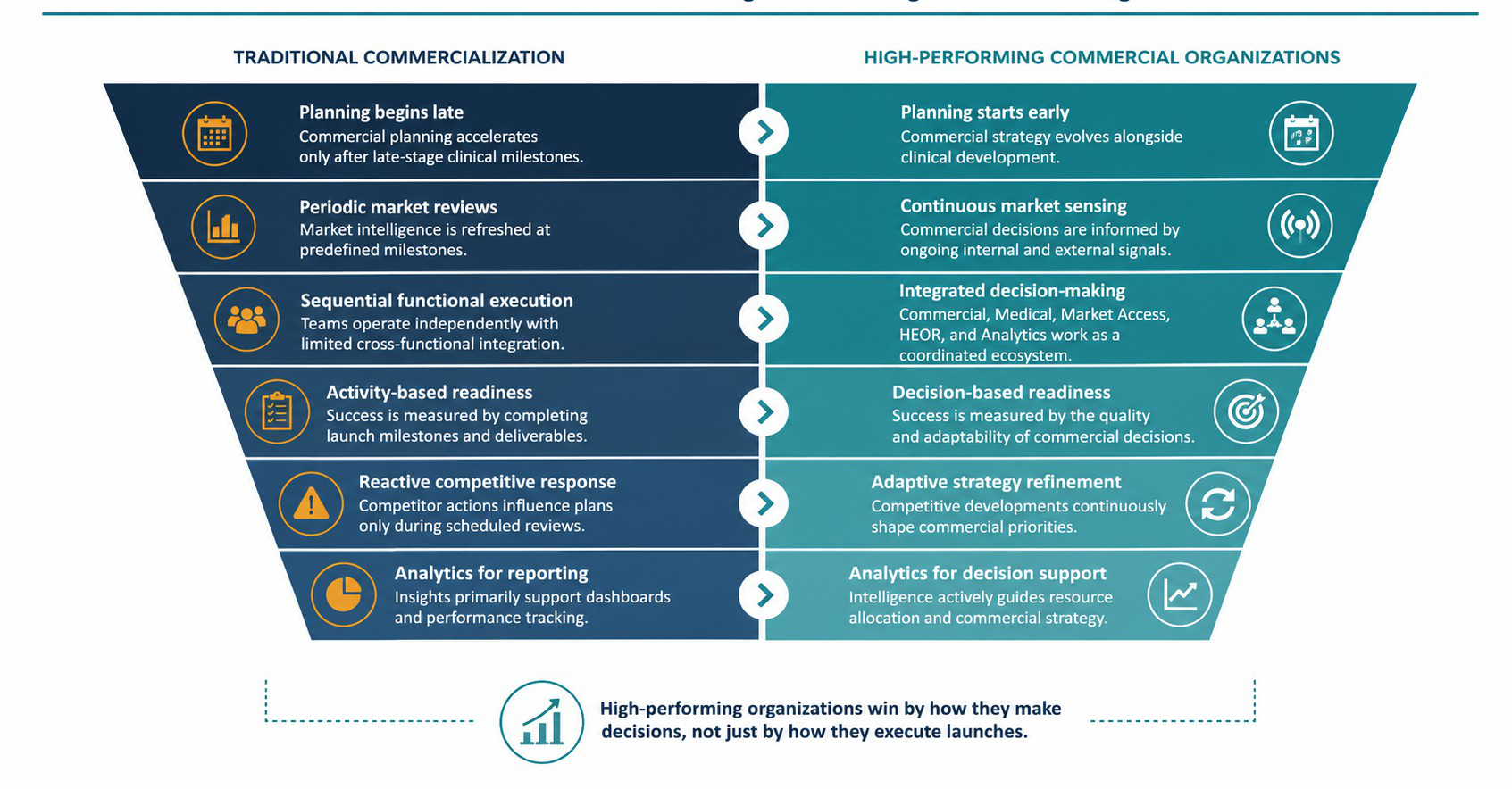
Figure 1: A tabular comparison of Traditional vs High Performing Commercial Organizations
3.3 – A Shift from Functional Excellence to Decision Excellence
The comparison illustrates a broader transformation occurring across pharmaceutical commercialization. Competitive advantage is increasingly created not through isolated functional excellence but through the organization’s ability to combine diverse sources of intelligence into coordinated commercial decisions.
This shift is prompting leading pharmaceutical companies to move beyond traditional commercialization models toward more integrated operating approaches capable of continuously supporting commercial decisions before and after launch. Understanding how these capabilities are structured requires examining the underlying operating model that enables them.
The Commercial Intelligence Engine
4.1 – From Commercial Intelligence to Commercial Decision Intelligence
Most pharmaceutical organizations have significantly expanded their investments in commercial intelligence over the past decade. Market research, competitive intelligence, real-world evidence, physician engagement data, patient insights, and AI-driven analytics collectively provide an unprecedented understanding of the commercial landscape. Yet, despite this abundance of information, launch outcomes continue to vary considerably, suggesting that intelligence alone is not the defining factor behind commercial success.
Rather than treating intelligence as a reporting function, leading organizations embed it within strategic planning, enabling evidence from multiple sources to continuously influence pricing, market access, stakeholder engagement, resource allocation, and launch execution before products reach the market.
4.2 – The Commercial Intelligence Engine as an Enterprise Operating Model
The Commercial Intelligence Engine represents an integrated operating model that continuously connects market intelligence with enterprise decision-making. Instead of functioning as isolated analytical activities performed by individual teams, it establishes a structured process through which commercial, medical, market access, HEOR, and patient insights are evaluated collectively before strategic decisions are finalized.
By integrating external market signals with internal enterprise intelligence, organizations develop a more comprehensive understanding of evolving commercial opportunities and risks. Intelligence is continuously interpreted, prioritized, and aligned across functions, allowing commercialization strategies to evolve proactively rather than reacting after market conditions have already shifted.
4.3 – Reducing the Decision Gap Before Day One
Commercial organizations have traditionally focused on improving the availability and accuracy of information. However, as intelligence becomes increasingly abundant, the greater competitive advantage lies in reducing the time required to translate new evidence into commercial action. Organizations that shorten this decision cycle are better positioned to anticipate competitive developments, respond to evolving payer expectations, and refine launch strategies before emerging risks affect commercial performance.
High-performing organizations therefore measure success not only by the quality of their insights but also by the responsiveness of their decision-making processes. Accelerating the movement from intelligence to action enables commercial teams to continuously validate strategic assumptions, strengthen cross-functional alignment, and maintain launch readiness despite rapidly changing market conditions.
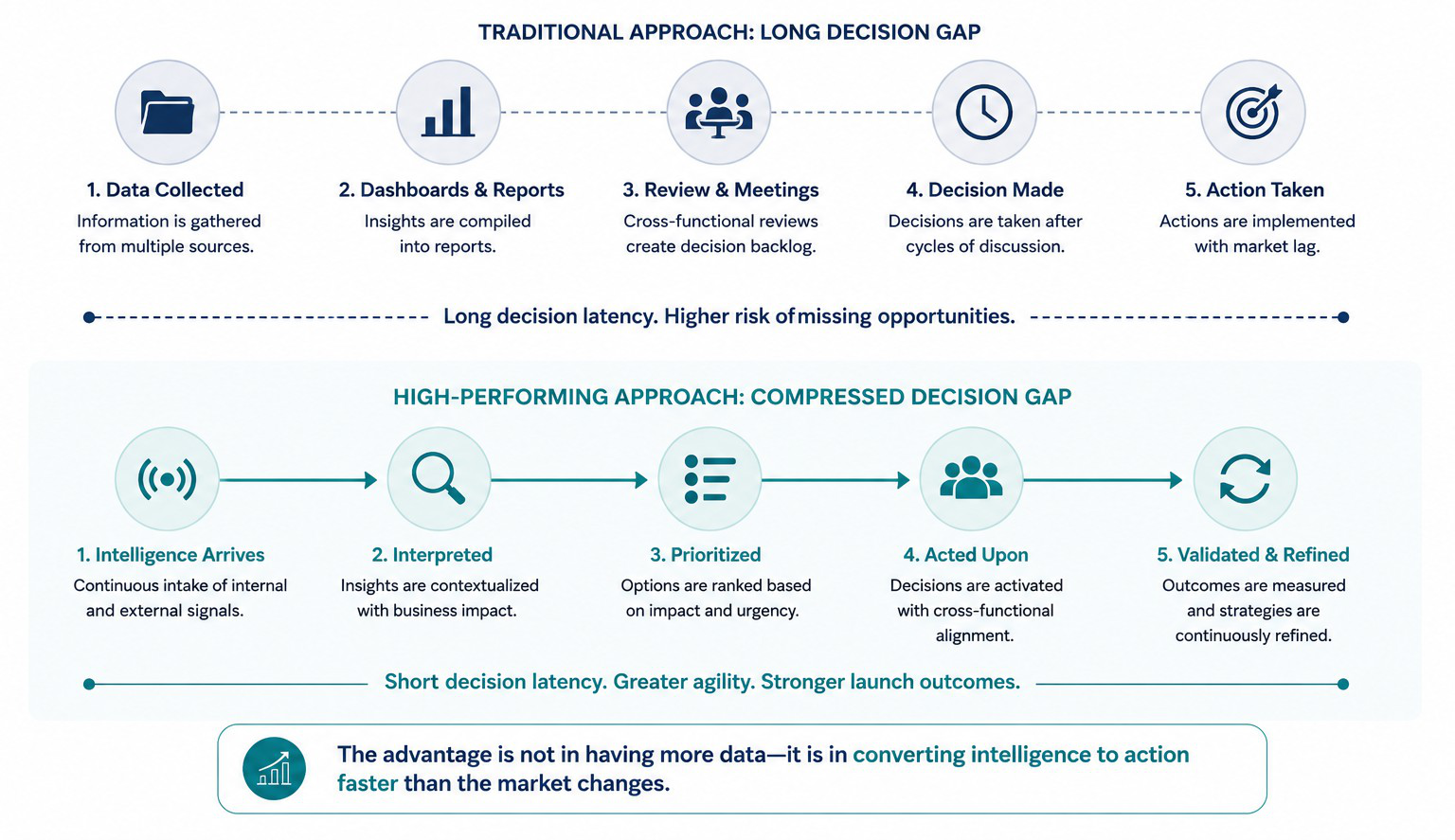
Figure 2: Closing Decision Latency Before Launch
4.4 – Building Commercial Intelligence as a Strategic Capability
The Commercial Intelligence Engine should not be viewed as a technology platform or a standalone analytics initiative. Instead, it represents an enterprise capability supported by governance, cross-functional collaboration, standardized decision processes, and a disciplined approach to continuously evaluating commercial assumptions. Technology enables this capability, but organizational alignment ultimately determines its effectiveness.
For pharmaceutical leaders, this represents a shift from building better reporting systems to building stronger decision systems. Organizations that institutionalize commercial intelligence as an enterprise operating capability are better positioned to navigate market uncertainty, improve strategic agility, and sustain commercial performance well beyond the launch period.
PERCEPTIVE ANALYTICS PERSPECTIVE
At Perceptive Analytics, we view the Commercial Intelligence Engine as the foundation for enterprise-wide commercial decision-making rather than another analytical capability. Organizations that systematically integrate intelligence across functions before Day One are better equipped to reduce decision latency, strengthen strategic alignment, and improve long-term launch performance.
Operationalizing Commercial Intelligence Across the Enterprise
5.1 – Establishing an Integrated Intelligence Ecosystem
Building a Commercial Intelligence Engine begins with breaking down the traditional boundaries between Commercial, Medical Affairs, Market Access, HEOR, Patient Services, and Analytics. Rather than operating as independent producers of information, these functions must contribute to a shared intelligence ecosystem where evidence is continuously consolidated, interpreted, and made accessible for enterprise-wide decision-making.
An integrated approach also reduces duplication of effort and improves organizational consistency. When multiple teams work from the same commercial evidence base, strategic priorities become better aligned, enabling faster responses to emerging opportunities and minimizing conflicting decisions across the commercialization lifecycle.
5.2 – Embedding Intelligence into Commercial Decision Workflows
Commercial intelligence creates value only when it directly influences decisions. High-performing organizations therefore embed intelligence reviews into existing governance processes, ensuring that market signals are evaluated before major decisions relating to pricing, market access, resource allocation, field force deployment, and stakeholder engagement are finalized.
This requires clearly defined decision ownership, standardized review cadences, and measurable criteria for validating commercial assumptions. By integrating intelligence into routine decision workflows rather than treating it as a separate analytical exercise, organizations improve both the speed and consistency of strategic execution.
5.3 – Measuring the Effectiveness of Commercial Intelligence
Traditional commercialization metrics largely evaluate outcomes such as sales performance, market share, or prescription volume after launch. While these remain essential, they provide limited visibility into whether commercial intelligence itself is improving organizational decision-making before products enter the market.
Leading organizations are increasingly supplementing outcome metrics with capability measures such as decision cycle time, cross-functional alignment, commercial assumption validation, forecast accuracy, and speed of strategic response. These indicators help assess whether intelligence is accelerating better decisions rather than simply generating additional reports.
5.4 – Leadership Priorities for Sustained Commercial Excellence
Technology alone cannot establish a Commercial Intelligence Engine. Sustainable success depends on leadership’s ability to foster cross-functional collaboration, establish decision governance, promote evidence-based planning, and create a culture where commercial strategies continuously evolve alongside changing market conditions.
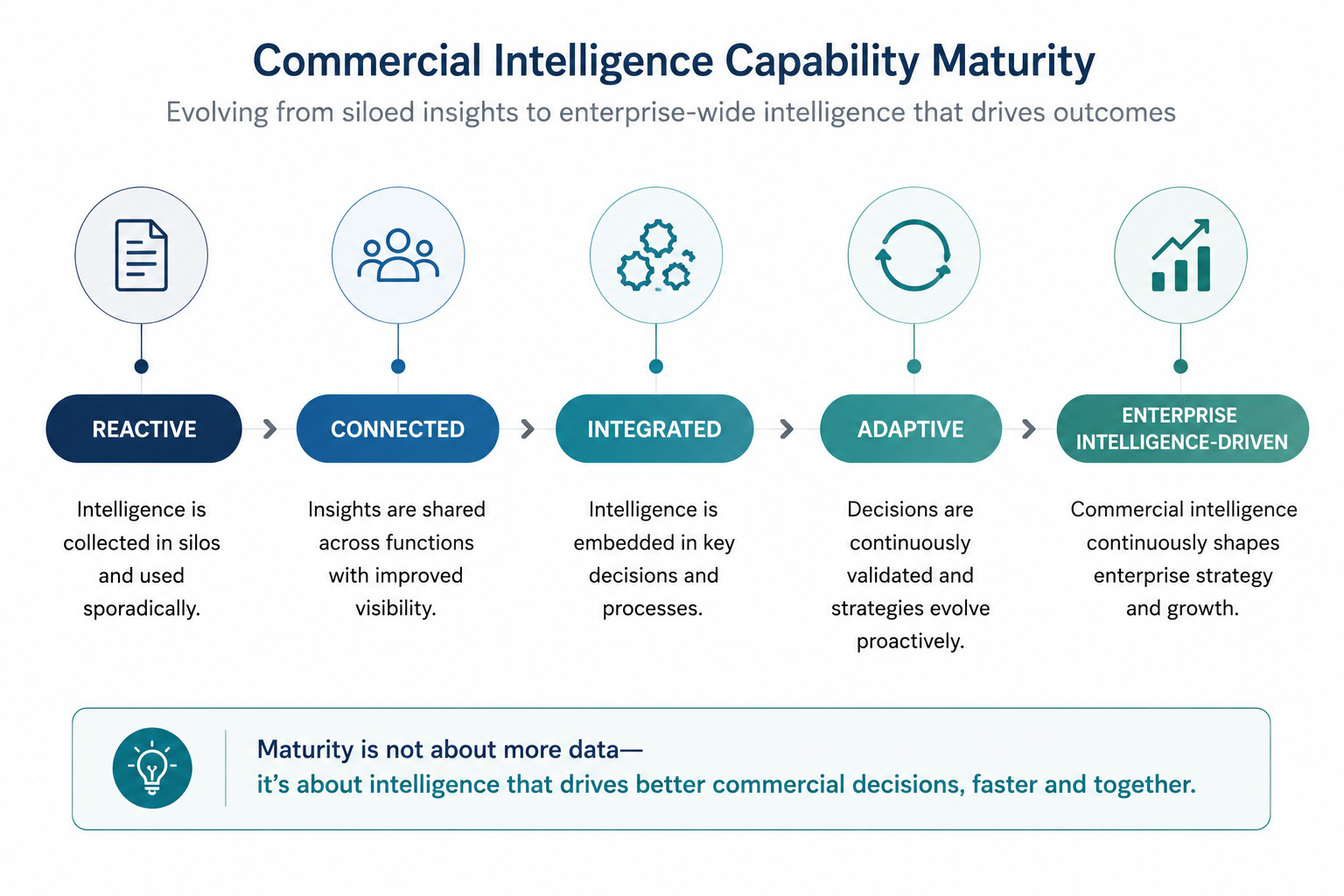 Figure 3: Stages of enterprise commercial intelligence maturity.
Organizations that institutionalize these practices move beyond periodic launch planning toward a more adaptive commercial operating model. As competitive intensity continues to increase, this capability will increasingly determine not only launch performance but also the organization’s long-term ability to sustain commercial growth across successive product launches.
PERCEPTIVE ANALYTICS PERSPECTIVE
We believe the effectiveness of commercial intelligence is ultimately measured by the quality of the decisions it enables. Organizations that integrate intelligence into everyday commercial workflows, governance structures, and leadership processes are better positioned to improve launch performance while building a scalable foundation for future commercialization initiatives.
Case Study: Commercial Intelligence in Practice
While the principles discussed throughout this article are broadly applicable, several leading pharmaceutical organizations have already begun embedding commercial intelligence into their commercialization strategies. The following case study illustrates how integrating cross-functional insights, real-world evidence, and continuous decision-making can strengthen launch readiness, improve strategic alignment, and enhance commercial outcomes in an increasingly complex market environment.
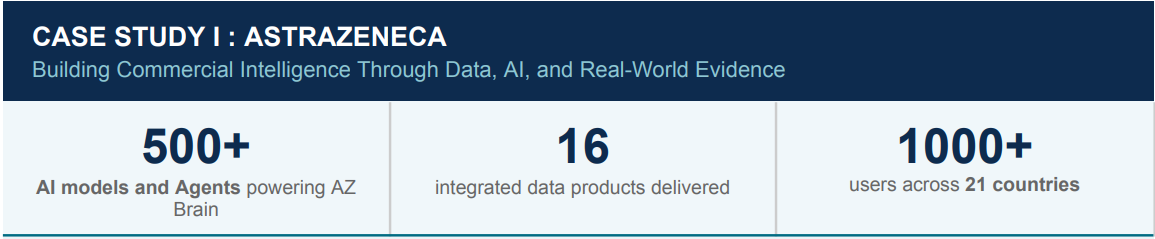
As AstraZeneca expanded its global portfolio, the company recognized that fragmented data and disconnected workflows were slowing decision-making across the product lifecycle. Rather than deploying isolated AI applications, it invested in AZ Brain, an enterprise AI platform built on a unified data foundation that supports commercial and scientific teams with more than 500 AI models and agents. Alongside this, AstraZeneca’s Development Assistant provides natural-language access to integrated clinical, regulatory, safety, and quality data and has been deployed to more than 1,000 users across 21 countries.
The broader lesson extends beyond AI adoption. AstraZeneca’s approach demonstrates that scalable commercial intelligence depends on integrating trusted enterprise data, governed AI capabilities, and cross-functional access to insights. By establishing this foundation, organizations can reduce information silos, accelerate decision-making, and enable commercial teams to act on consistent, enterprise-wide intelligence throughout the product lifecycle.
Key takeaway: Successful commercial intelligence is built on an integrated data foundation that enables AI-driven insights and faster cross-functional decision-making, rather than on isolated analytics tools or individual AI use cases.
One emerging biopharmaceutical company redefined its launch strategy by replacing intuition-led planning with a commercial intelligence approach. Instead of relying primarily on key opinion leaders or historical market assumptions, the company integrated claims data, payer insights, and prescribing behavior to identify where commercial efforts would generate the greatest impact. This shifted launch planning from broad market coverage to evidence-based prioritization.
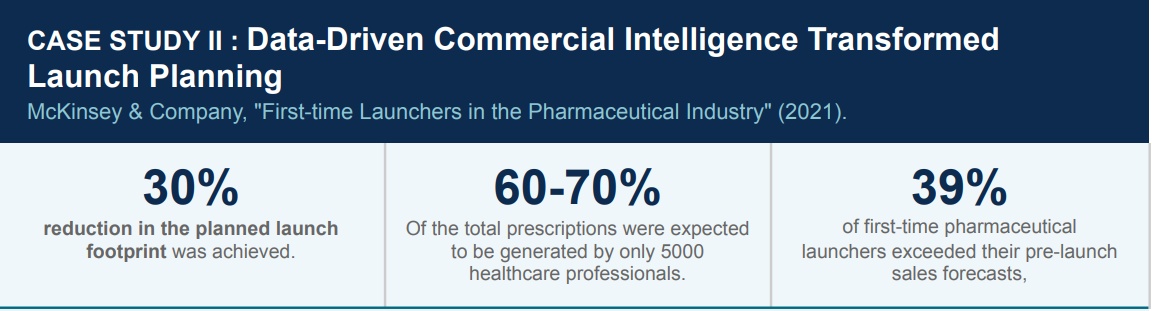
The analysis revealed that just 5,000 healthcare professionals from a pool of 95,000 were expected to generate 60–70% of total prescriptions for the new therapy. Armed with these insights, the company redesigned its commercial model and reduced its planned launch footprint by approximately 30%, freeing resources that were reinvested into higher-value launch activities while maintaining expected market reach.
McKinsey’s broader analysis highlights why this approach matters. Only 39% of first-time pharmaceutical launchers exceed their pre-launch sales forecasts, compared with nearly half of experienced launchers. The difference is not simply product quality. Organizations that invest early in commercial intelligence, market understanding, and cross-functional launch capabilities
CONCLUSION
The future of pharmaceutical commercialization will be defined not by organizations that simply generate more data, but by those that transform commercial intelligence into faster, more informed, and more coordinated decisions. As market dynamics become increasingly complex, organizations must move beyond static launch planning toward an operating model where insights continuously shape commercial strategy before, during, and after launch.
Building this capability requires more than investing in analytics platforms or AI technologies. It demands an integrated approach that connects clinical, commercial, medical, market access, and real-world evidence into a unified decision framework. Organizations that embed commercial intelligence across these functions will be better positioned to anticipate market shifts, improve launch readiness, and maximize long-term product performance.
For pharmaceutical leaders, the opportunity lies in establishing commercial intelligence as a strategic enterprise capability rather than an isolated analytical function.
At Perceptive Analytics, we partner with pharmaceutical organizations to build scalable commercial intelligence ecosystems that integrate advanced analytics, AI, and domain expertise into actionable decision frameworks. From strengthening launch readiness and forecasting to optimizing market access and commercial performance, we help transform data into decisions that drive measurable business impact. Before your next platform decision goes to the board, know your real number.
Perceptive Analytics helps Life Sciences leaders build the full five-year economic model behind a migration decision, not just the vendor’s Year 1 pitch. Talk to our team → https://www.perceptive-analytics.com/book-a-free-consultation/
“Data informs, intelligence guides, but decisive execution creates commercial success.”
Sources and Methodology
All statistics in this briefing are drawn from the following primary research, survey, and case-study sources, verified at time of writing. Sources marked with an asterisk (*) have been independently cross-referenced against at least one secondary source for figures cited in this document.
Primary Survey Sources
- Sedulo The Importance of Launch Excellence in the Pharmaceutical Industry.
- ZSAssociates & The Harris Poll (2025). 2025 AI Trends: Life Sciences Leadership
- IQVIAInstitute (2025). Global Oncology Trends
- McKinsey& Company (2021). First-time Launchers in the Pharmaceutical
- AZ Brain and Enterprise AI Platform.
- AmazonWeb Services (AWS). AstraZeneca Development Assistant and AZ Brain Case
Research and Economic Analysis
- AspenTechnology / Anju Breaking Down Data Silos in Life Sciences.
- Veeva European Life Sciences Customer Data Survey.
- McKinsey& Company (2023, updated 2025). Scaling Generative AI in the Life Sciences
- TuftsCenter for the Study of Drug Development (CSDD). Research on pharmaceutical development, data governance, and operational performance.
- AppliedClinical Research on clinical trial performance, patient recruitment, and investigator site effectiveness.
- PubMedCentral (PMC). Why 90% of Clinical Drug Development Fails and How to Improve It: A Systematic Review and Meta-Analysis.
- PwC(2025). Digital Trends in Operations
- DATAVERSITY(2024). 2024 Trends in Data Management
Methodology and Source Notes
The inline citations used throughout this article correspond to the primary sources listed above and are numbered according to their first appearance. Where findings were validated across multiple publications, the most conservative publicly reported estimate has been used. No statistics presented in this article are projections or estimates generated by Perceptive Analytics; all quantitative figures are derived from publicly available primary sources as cited.