
CXO Role in BI Strategy and Adoption Success
Analytics | March 17, 2026


Right-Sizing Executive Involvement in BI Design and Adoption
Why CXOs must steer BI strategy without steering dashboards.
Executive Summary
Business Intelligence initiatives rarely fail due to technology. They more often fail because executive ownership is unclear and leadership behavior is inconsistent. The level and nature of CXO involvement strongly influence whether BI drives adoption or becomes shelfware. This article clarifies where executives should lead, where to step back, and how leadership perception could set the ceiling for BI maturity and enterprise-wide decision intelligence.
Talk with our analytics experts today- Book a free 30-min consultation session
Perceptive Analytics POV
In our work with enterprise BI programs, we’ve observed that organizations with visible CXO sponsorship achieve 2–3X higher BI adoption. Conversely, nearly 70% of stalled BI initiatives trace back to either executive overreach or complete disengagement after funding approval.
For CXOs, this raises an obvious question.
What level of their involvement would ensure BI driving boardroom decisions?
The answer depends less on reports and more on leadership intent, ownership, and behavior.
With this perspective, let’s now unpack what effective executive involvement actually looks like in practice.
BI succeeds when executives act as stewards, not supervisors
- BI initiatives fail to deliver impact when they are not anchored to clearly defined business outcomes.
- CXOs play the role of a shipmaster, setting the direction and navigating trade-offs while ensuring a smooth sail across turbulent data seas.
- Their responsibility is to set the course, ensuring insights consistently move the business closer to strategic objectives.
Executive impact shifts across BI lifecycle and understanding where to engage matters
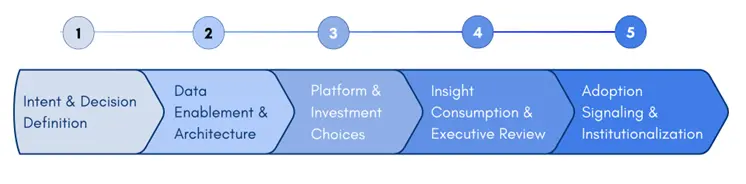
Fig. 1: BI Project Lifecycle
- Executive involvement creates the most value at decision-defining and adoption-inflection stages and not during technical execution.
- BI initiatives move through predictable phases. CXOs amplify impact when they engage selectively at moments that shape direction, legitimacy, and adoption.
Where CXO’s must engage ?
- Direction-setting (Business need & KPI definition)
Executives should define why BI exists—the decisions it must improve, the outcomes it must influence, and the enterprise KPIs that matter. - Enterprise alignment (Tool & investment decisions)
CXO judgment is critical when BI tools or platforms are selected. Oversight here prevents fragmentation, cost duplication, and misalignment with enterprise architecture. - Adoption signaling (Executive usage & endorsement)
When leaders actively use BI in reviews and decision forums, BI gains legitimacy. Adoption accelerates not through mandates, but through visible executive behavior.
Where CXOs must deliberately step back
- Data preparation, modeling, and validation
These are execution domains. Executive involvement here slows delivery and dilutes accountability. - Dashboard design and visual refinement
Feedback on colors, layouts, or chart types adds limited value at the executive level and introduces subjective rework.
Read more: Data Transformation Maturity: Choosing the Right Framework for Enterprise Reliability
Both Micromanagement and Disengagement Undermine BI Adoption
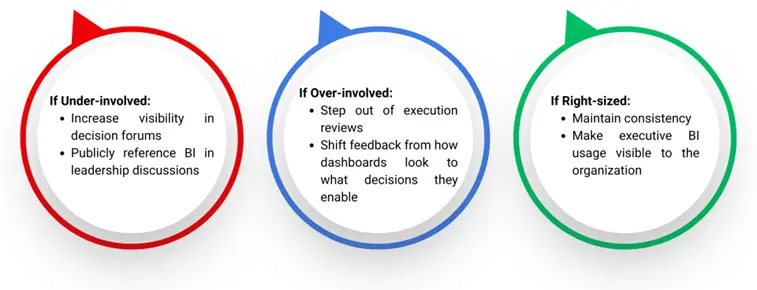
- Overzealous hands-on executives who micromanage dashboards slow delivery, create tension, and introduce opinion-driven rework.
- At the other extreme, hands-off leaders who disengage after funding approval leave BI teams without strategic clarity, alignment, or adoption momentum.
CXO Leadership Example: A global manufacturing enterprise realized their managers needed timely, actionable insights. They rolled out BI under clear executive sponsorship, deliberately limited to KPI definition and access governance. The dashboard scope was frozen within two weeks, and the first release went live in 10 weeks. Within 60 days, 72% of senior managers were actively using BI. Monthly operational review cycles shortened by 28%, and manual report dependency dropped by over 40%.
Learn more: Prioritizing Dashboard Rollouts: A Data-Driven Guide
The Technology Acceptance Model (TAM) extends to BI, showing why executive perception determines adoption
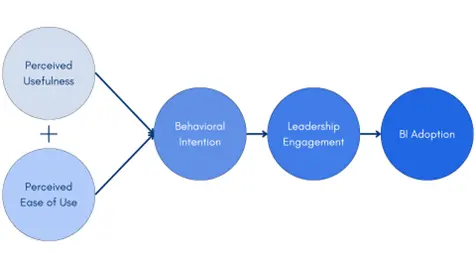
Fig. 2: TAM Causal Chain for BI Adoption
- When CXOs perceive BI as both valuable and easy to use, their intention to engage increases. This engagement is visible when they log into dashboards, reference KPIs during meetings, and request data-driven insights.
- On the other hand, if executives see BI as cumbersome or marginal, adoption stagnates, regardless of the IT investment.
Leadership Implication
- A leader’s perception sets the ceiling for BI maturity. What leadership consistently uses, the organization eventually institutionalizes
Read more: Operational Intelligence: Top Dashboards for Execution, Efficiency, and Control
Effective executive involvement is gauged by decision-making integration, not by review hours
- A key indicator is when, in board meetings, 70-80% of decisions are informed by referencing BI reports. Teams no longer have to be reminded to use reports, as BI becomes the default input for discussions.
- Adoption can be further validated through active BI users and the frequency of dashboard usage across various functions.
- Improved alignment between BI, analytics, and IT teams becomes evident, with fewer disputes around “data ownership.”
- Increased participation from senior leadership in discussions in BI and analytics governance discussions also signals maturity, particularly when the focus shifts toward priorities, standards, and long-term capability development rather than operational issues.
Three honest questions that distinguish ceremonial sponsors from transformational leaders
- Are you exclusively shaping the strategic outcomes while trusting domain experts with the technical execution?
- Does your team acknowledge BI as a leadership priority, rather than an optional IT project?
- Has BI meaningfully changed the cadence, evidence base, and accountability of decision-making within the organization?
You are at the ideal level of engagement if the response to each of the three questions is “yes.”
Get in touch: Tableau consulting services – Enterprise-grade services for data transformation, governance, and actionable executive dashboards.
Executive BI Engagement Signals
Use the signals below to reflect on your current involvement and identify the most useful next shift.
S.No. | Engagement Signal | Too Distant | Right-Sized | Too Hands-On |
1. | Which statement best reflects your current approach? | BI priorities are largely shaped by teams | BI decisions and outcomes are clearly articulated by leadership | BI direction is frequently refined during delivery |
What this indicates | Low visibility | Clear strategic intent | Directional drag | |
2. | Which statement feels closest to today’s reality? | Limited touchpoints once direction is set | Leadership aligns stakeholders and removes constraints | Leadership frequently reviews interim outputs |
What this indicates | Disengagement risk | Execution enabled | Speed and ownership risk | |
3. | Which pattern do teams most often observe? | BI referenced selectively | BI consistently informs leadership decisions | Discussions focus on presentation details |
What this indicates | Adoption risk | Cultural legitimacy | Value dilution | |
4. | How does BI usage typically spread across the organization? | Usage left to individual teams | Usage follows visible leadership behavior | Usage reinforced through directives |
What this indicates | Fragmented adoption | Organic and scalable | Compliance-driven usage | |
5. | When insights challenge intuition, what usually happens? | Insights noted but rarely acted upon | Insights inform course correction | Insights overridden by experience |
What this indicates | Trust gap | Learning posture | Insight erosion |
*How to read the above table: Alignment with the center column indicates well-calibrated involvement, while patterns toward either edge suggest an opportunity to rebalance engagement.
Get in touch: microsoft power bi consulting services – Enterprise-grade consulting for Power BI governance, Fabric integration, and scalable analytics deployment.
Next-step guidance
Conclusion
The most effective CXOs act as BI sponsors and stewards, not system designers. By setting clear direction, modeling consistent usage, and removing organizational barriers, executives create the conditions for BI to influence decisions without slowing execution. Ultimately BI adoption is a reflection of leadership behavior, not technical sophistication.
If current BI initiatives are not consistently influencing executive decisions, it may be time to reassess the approach. At Perceptive Analytics, we help organizations modernize their data foundations, strengthen governance, and elevate BI capabilities.
Book a free 30-min consultation session with our analytics experts today!