
Modern Data Warehouse Strategy: Avoid the 18-Month Reporting Trap
Analytics | March 17, 2026


A strategic guide to avoiding the 18-month reporting trap and building organizational reflex speed.
“A modern data warehouse isn’t about storage. It’s about organizational reflex speed and most CXOs are solving the wrong equation.”
EXECUTIVE SUMMARY
- The ‘start simple’ mindset creates an ’18-month hairball’ of technical debt that slows decision-making when you need it most.
- While easier initially, it forces a painful rebuild during critical growth phases. The choice isn’t about data volume; it is about organizational reflex speed.
Leadership Insight: You are not buying storage; you are buying the ability to pivot faster than your competition.
Talk with our analytics experts today- Book a free 30-min consultation session

PERCEPTIVE ANALYTICS POV
Across dozens of transformations, we’ve seen CXOs dramatically underestimate how fast decision lag compounds. The real risk isn’t technical debt. It’s a strategic limitation on your ability to evolve.
Why Starting Simple Compounds Technical Debt at 3x Speed
💡Executive Insight: Your best talent gets trapped in the maintenance and gravitates toward places where they can innovate. This is technical debt disguised as a talent risk. You keep the maintainers and lose the creators. |
- Simpler reporting layers don’t fail; they conceal costs. They function just well enough to hide the architectural debt you’re accumulating. Every pipeline you build becomes a dependency. Each manual CSV upload turns into tribal wisdom.
• The ’18-Month Hairball’. By month 18, you aren’t migrating to a warehouse; you are untangling a web of dependencies while the board asks why metrics take three weeks to refresh.
The True Cost is Decision Lag, Not Cloud Bills
💡Executive Insight: The real cost of delay isn’t lost revenue, it’s lost options. By the time you respond, your competitor has already captured the segment. |
- Cost is measured in the delta between question and answer. If your competitor reacts to churn data in 20 minutes and you take two weeks, you’ve already lost the customer.
- Slow insights cost more than warehouse fees. A $50k warehouse bill is negligible compared to a $2M revenue shortfall caused by a 13-day decision lag which directly impacts customer acquisition cost and lifetime value.
Leadership Implication: Audit your ‘Time to Answer’. If key strategic questions take >24 hours, your architecture is the bottleneck.
Explore more: Enterprise Data Platform Architecture Orchestration Transition
Your Data Team Size Is the Real Pivot Point
💡Executive Insight: If your team has fewer than eight engineers, using a warehouse is more cost effective. You are not just buying technology, but operational focus. It also streamlines the processes by eliminating the need for meetings regarding handoffs. |
- The threshold is people, not petabytes. In most growth scenarios, with fewer than 8-10 data engineers, simpler reporting layers create more coordination overhead than a centralized warehouse.

Why is that?
- Warehouses force uniform standards. Instead of five engineers managing five disparate systems (handoffs + redundancies), a warehouse acts as a forcing function for standards.
Below 8 engineers, avoiding a warehouse fragments your team. Above 10, it becomes a coordination nightmare.
Leadership Implication: Count your data heads. If you’re approaching 8, migrate now before coordination costs spike.
Learn more: Future-Proof Cloud Data Platform Architecture
The Only Scenario Where Starting Simple Actually Makes Sense
💡Executive Insight: If your business model remains entirely unchanged, you’re operating like a utility, with the only remaining variable is the speed of decline. |
- Stable business models can afford simplicity. If product lines, customer segments, and revenue streams are locked, starting simple is acceptable.
- Growth requires architectural flexibility. If you are still figuring out your revenue engine, you need flexibility. In a ‘layer-cake’ architecture, every strategic pivot forces a pipeline rebuild.
Leadership Implication: If you plan to pivot or grow, ‘starting simple’ is just postponing inevitable rework.
Read more: Controlling Cloud Data Costs Without Slowing Insight Velocity
Do You Need a Data Team or a Data Culture?
💡Executive Insight: This isn’t a technical decision. It’s a signal of whether data drives your decisions or just validates PowerPoints. |
- Reporting layers support a service desk. They handle tickets. Modern warehouses foster a data culture by enabling self-serve answers and product integration.
- The only business use case that counts: Building an organization that learns faster than its competitors. If you need data as a competitive advantage, the investment isn’t about volume. It’s about organizational reflex speed.
Leadership Implication: Shift the conversation from ‘storage costs’ to ‘learning speed’.
Get in touch: AI Consulting – Strategic AI solutions for enterprise data modernization and business transformation.
The Warehouse Readiness Scorecard
How to Use This Scorecard: Rate your organization on these factors (1-10).
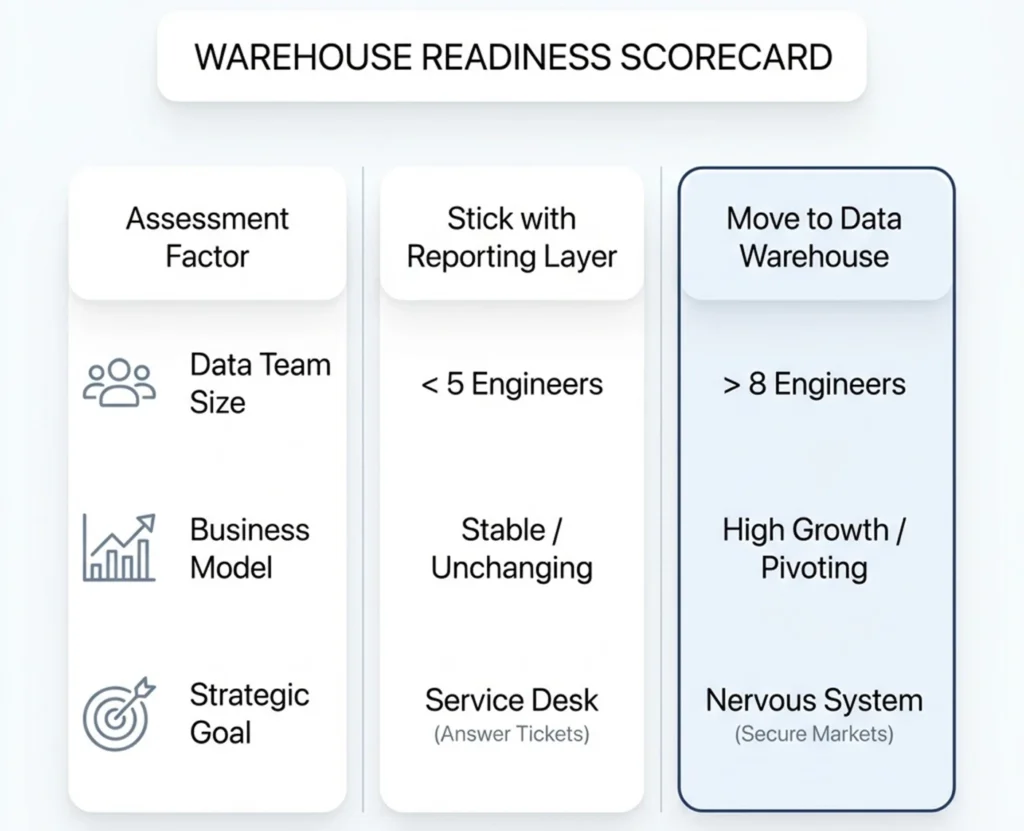
Interpretation: Score < 5: Reporting Layers are sufficient. Score > 8: Immediate Warehouse Migration is critical.
Get in touch: Snowflake consultants
Conclusion
Almost every ‘start simple’ strategy eventually faces a rebuild. The critical choice is whether you do it now on your terms, or later under pressure. Warehouses build a central nervous system that secures markets.
Understanding when to shift is as critical as the shift itself; early adoption saves debt, but premature complexity has its own costs. We help you find that inflection point.
Book a free 30-min consultation session with our analytics experts today!