
Digital Transformation Strategy: Key Principles
AI | January 1, 2024


A digital transformation strategy is no longer optional—it defines how organizations compete, scale, and remain relevant. Enterprises today face rising customer expectations, data overload, operational inefficiencies, and faster competitors. Without a clear strategy, digital initiatives become fragmented, expensive, and difficult to sustain.
This guide explains what a digital transformation strategy is, why it matters, who should own it, and how to build a roadmap that delivers measurable business outcomes.
Why Digital Transformation Is a Business Imperative
Digital transformation is a business imperative because traditional operating models cannot keep pace with today’s speed, complexity, and customer expectations.
Organizations without a clear digital transformation business strategy struggle with slow decision-making, disconnected systems, and declining competitiveness. Leaders now expect digital initiatives to directly improve revenue, efficiency, resilience, and customer experience—not just modernize technology.
Moving Beyond Technology to Business Impact
Digital transformation often fails when it is treated as a technology upgrade rather than a business initiative.
Successful digital transformation strategies focus on:
- Business outcomes, not tools
- Process redesign, not automation alone
- Data-driven decisions, not static reporting
- Continuous improvement, not one-time projects
Technology enables transformation—but strategy defines impact.
What Is a Digital Transformation Strategy?
A digital transformation strategy is a structured, business-led plan that aligns technology, data, people, and processes to achieve enterprise goals.
Defining Digital Transformation in a Business Context
It connects digital investments directly to growth, cost optimization, risk reduction, and customer value creation.
Strategy vs. Technology Adoption
Technology adoption answers what tools to use. Strategy answers why, where, and how those tools create value.
Common Misconceptions About Digital Transformation
- It’s an IT-only initiative
- It’s finished after implementation
- It’s mainly about cloud or AI
In reality, transformation is continuous and business-driven.
Strategy vs Technology Adoption
Aspect | Technology Adoption | Digital Transformation Strategy |
Focus | Tools and platforms | Business outcomes |
Ownership | IT-led | Business-led |
Timeframe | Short-term | Long-term |
Success metric | Deployment | ROI and impact |
Speak With a Digital Transformation Expert
Why Developing a Digital Transformation Strategy Is Important
Developing a digital transformation strategy ensures focus, alignment, and measurable results.
- Aligning digital initiatives with business goals
Strategy ensures investments directly support revenue growth, efficiency, or customer experience. - Avoiding fragmented and costly digital efforts
Without a roadmap, teams launch siloed initiatives that don’t scale. - Driving measurable ROI and competitive advantage
Clear metrics help leaders track progress and justify investments.
A structured approach to developing a digital transformation strategy prevents wasted spend and accelerates value realization.
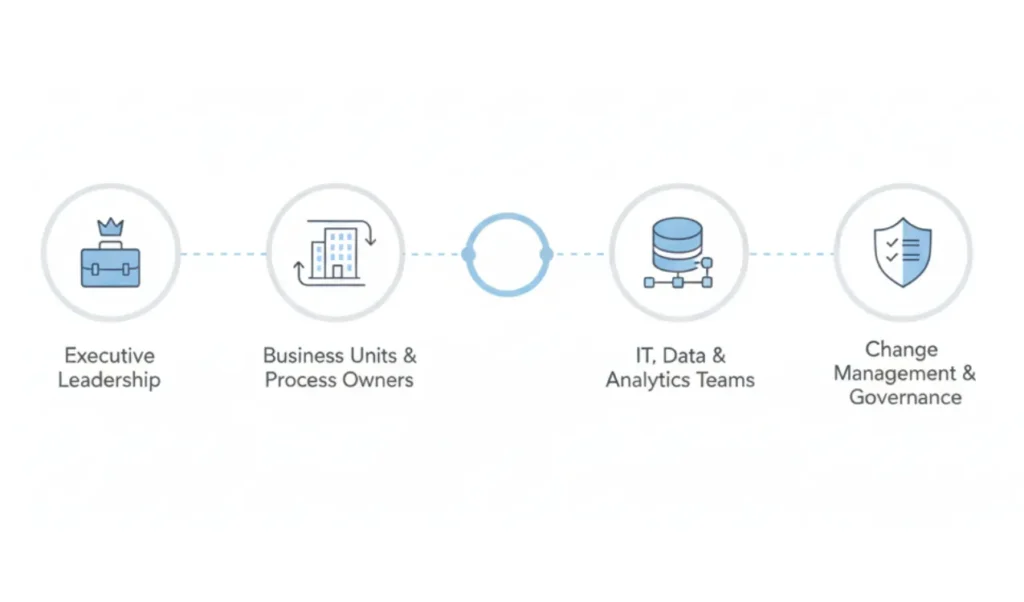
Who Should Be Involved in Creating a Digital Transformation Strategy?
Digital transformation succeeds only when ownership is shared across the enterprise.
- Executive leadership and strategic direction
Executives define priorities, funding, and success criteria. - Business unit leaders and process owners
They identify high-impact use cases and operational pain points. - IT, data, and analytics teams
These teams design scalable platforms and enable analytics-driven decisions. - Change management and governance stakeholders
They ensure adoption, communication, and accountability.
How to Build a Digital Transformation Strategy
Building a strong digital transformation strategy requires a structured, phased approach.
- Assess current digital maturity and capabilities
Evaluate systems, data quality, skills, and organizational readiness. - Identify high-impact business use cases
Focus on use cases tied to measurable outcomes, such as revenue visibility or operational efficiency.
Example: CEO revenue analysis - Define the target operating and technology model
Clarify how teams, platforms, data, and workflows will work together. - Prioritize initiatives and build a transformation roadmap
A phased digital transformation strategy roadmap balances quick wins with long-term initiatives. - Establish governance, metrics, and accountability
Define KPIs, ownership, and review cadence.
Example Digital Transformation Roadmap
Phase | Focus | Outcomes |
Phase 1 | Foundation | Data, cloud, governance |
Phase 2 | Optimization | Automation, analytics |
Phase 3 | Innovation | AI, advanced use cases |
Key Trends Shaping Digital Transformation Today
Several trends are reshaping how organizations approach transformation.
- AI-driven decision-making and automation
AI enables predictive insights and intelligent workflows. - Cloud-first and platform-based architectures
Cloud platforms improve agility and scalability. - Data-led organizations and advanced analytics
A strong digital transformation data strategy ensures decisions are driven by trusted data.
Example for CMOs - Customer-centric and experience-driven transformation
Organizations redesign journeys end to end. - Responsible AI, security, and compliance
Trust and governance are now core requirements.
The 7 Key Principles of Successful Digital Transformation Strategies
Successful digital transformation strategies consistently follow these principles:
- Business-first, not technology-first
- Data as a strategic asset
- Cloud and scalable architecture
- Embedded analytics and AI
- Strong governance and security
- Continuous change and iterative delivery
- Talent, culture, and adoption focus
These principles help organizations scale transformation sustainably.
Common Challenges in Digital Transformation
Organizations face common barriers during transformation.
- Resistance to change and cultural barriers
Employees may resist new processes without clear communication. - Legacy systems and technical debt
Older systems slow progress and increase complexity. - Skill gaps and talent constraints
AI, analytics, and cloud skills are scarce. - Measuring success and ROI
Without clear metrics, value remains unclear.
CIO-level dashboards help track progress
Why Partner with Perceptive Analytics for Digital Transformation
Organizations partner with Perceptive Analytics to move from strategy to execution with confidence.
- Proven experience across data, analytics, and AI
We deliver business-led digital transformation strategies. - Business-led transformation frameworks
Our approach aligns initiatives with enterprise priorities. - End-to-end support from strategy to execution
From roadmap to implementation, we support the full journey. - Focus on measurable outcomes and ROI
Every initiative ties back to business value.
This is where digital transformation strategy consulting delivers the greatest impact.
What is a digital transformation strategy?
A digital transformation strategy is a structured plan that aligns digital initiatives with business goals, operating models, and measurable outcomes.
How long does digital transformation take?
Most transformations take 12–36 months, depending on scope and maturity.
What are the biggest risks in digital transformation?
Lack of strategy, poor data quality, cultural resistance, and unclear metrics.
How do you measure digital transformation success?
Success is measured through KPIs such as revenue growth, cost reduction, customer experience, and operational efficiency.