
Custom Pipelines vs. Managed ELT: An Executive Brief on Implementation Speed and Scalability
Analytics | March 12, 2026


“Why the fastest way to build your pipeline is often the most expensive way to scale it.”
EXECUTIVE SUMMARY
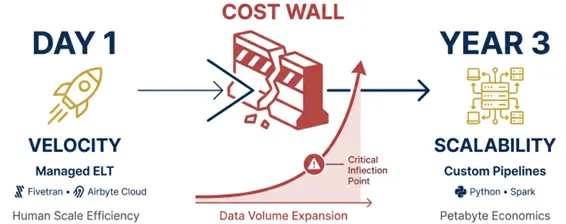
- In the race to monetize data, CXOs face a critical binary choice: prioritizing “Day 1 Velocity” with Managed ELT, or complying with “Year 3 Scalability” requirements through Custom Pipelines.
- While most organizations initially default to managed tools for speed, they often hit a harsh “Cost Wall” as data volumes expand.
- This brief dissects these trade-offs, revealing why platforms like Fivetran and Airbyte are superior for “Human Scale” efficiency, whereas Python and Spark remain the only viable option for “Petabyte Economics” and complex sovereignty needs
Speak with our consultants today. Book a free 30-min session now
Leadership Insight: Stop asking ‘Which is cheaper?’ Start asking ‘What must we strictly protect?’ Buy everything commoditized to move fast.
PERCEPTIVE ANALYTICS POV
- We frequently observe a “TCO Mirage” in modern data stacks where Managed ELT appears cost-effective simply because it incurs zero initial headcount cost.
- However, this advantage erodes rapidly. Once data volume crosses the Terabyte threshold, the usage fees of managed tools often exceed the fully loaded cost of the engineers you attempted to save.
- True scalability isn’t just about processing power; it is strictly about unit economics.
Speed to Implement: The Time Tax of Custom Engineering
- Managed ELT platforms like Fivetran and Airbyte offer a distinct strategic advantage by collapsing the “Time-to-Insight” window 4 months to 4 hours. You are effectively buying a completed, maintenance-free roadmap rather than just a tool.
- In contrast, building a custom synchronous connector in Python is easy. Maintaining it against API schema drift is a perpetual operational tax that consumes 30% of engineering capacity.
- For standard SaaS sources like Salesforce or NetSuite, custom building is practically malpractice, it offers zero competitive advantage in exchange for high operational risk.
Leadership Implication: If the data source is a standard market commodity (CRM, ERP, Ads), do not build. Reserve engineering talent for where it adds unique value.
The “TCO Inversion Point” Framework
For every organization, there is a specific “TCO Inversion Point” where the economics flip.
- The Inversion Point typically occurs at 5-10 High Volume Pipelines. Below this, Managed ELT is cheaper. Above this, the SaaS fees justify investment in a dedicated Data Engineer.
- Beyond cost, latency is the second critical factor. If your AI/ML roadmap demands real-time streams with sub-minute latency, the batch-centric architecture of most managed ELT tools acts as a hard ceiling on innovation.
- In these scenarios, custom streaming pipelines are not a cost decision, but a capability requirement.
Learn more: Snowflake vs BigQuery: Which is Better for the Growth Stage?
Scalability: The “Cost Cliff” of Managed Success
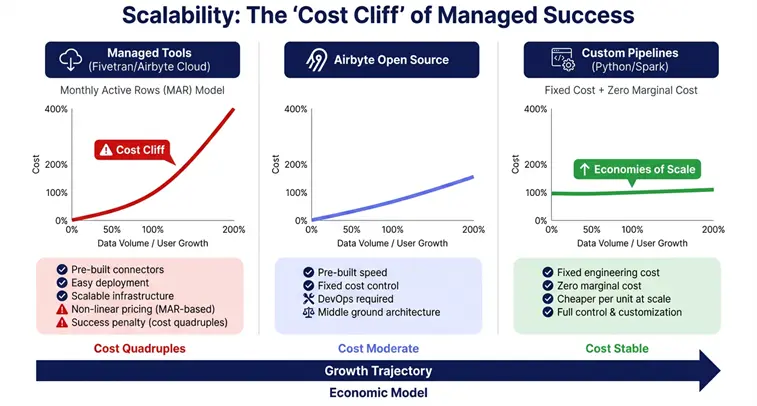
The hidden danger of managed tools is that while they scale technically, they often fail economically.
Their business models, typically based on Monthly Active Rows (MAR), inadvertently punish you for success, doubling your user base or data fidelity often quadruples your infrastructure bill. This non-linear pricing creates a “Cost Cliff” that catches growing enterprises off guard.
Conversely, Python and Spark pipelines operate on a fundamentally different economic model.
They require a high fixed cost in terms of engineering headcount but offer near-zero marginal costs for data growth. This makes them the only architecture that essentially gets cheaper per unit as you scale.
Airbyte Open Source sits in the middle, offering the pre-built speed of managed tools with the fixed-cost control of custom infrastructure, provided you have the DevOps talent to run it.
Explore more: BigQuery vs Redshift: Choose the Right Cloud Data Warehouse
Key Considerations for Your Organization
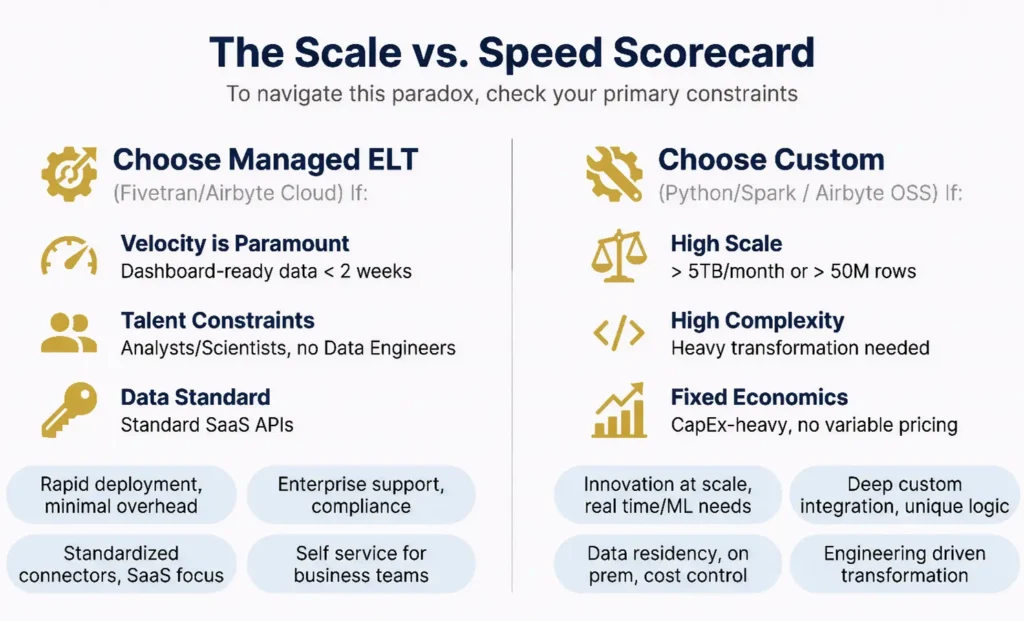
The final decision boils down to one question. How far should integration by design drive transformation, and where does considerable customization justify competitive differentiation? The organizational value lies in continuously reevaluating this balance.
Use the following table to guide your organizational decision.
Explore more: Event-Driven vs Scheduled Data Pipelines
Conclusion
Speed and Scale are inversely correlated in data ingestion. The optimal strategy is not to choose one permanently, but to optimize for Speed (Managed) during the “0-to-1” phase to validate business value and plan a migration to Scale (Custom/Self-Hosted) only when usage fees threaten margins. The winning organizations are those that know exactly when to switch.
“Approaching the Cost Cliff?” Unsure if your current data volume justifies a custom build or a managed contract? We help you to identify your organization’s specific Inversion Point and future-proof your architecture.
Talk with our consultants today. Book a free 30-min session now