
Responsible AI and Data Governance Strategies
AI | January 1, 2025


The Rise of AI in Business and Its Impact on Decision-Making
Artificial Intelligence (AI) is transforming business operations across industries, from automating repetitive tasks to providing actionable insights that drive strategic decisions.
Organizations leveraging AI in business can enhance efficiency, uncover new opportunities, and make faster, data-driven decisions.
However, rapid AI adoption without proper oversight can lead to errors, ethical concerns, and regulatory risks.
Partnering with experienced AI consulting companies helps businesses integrate AI responsibly and transparently.
Why Responsible AI and Governance Are Critical
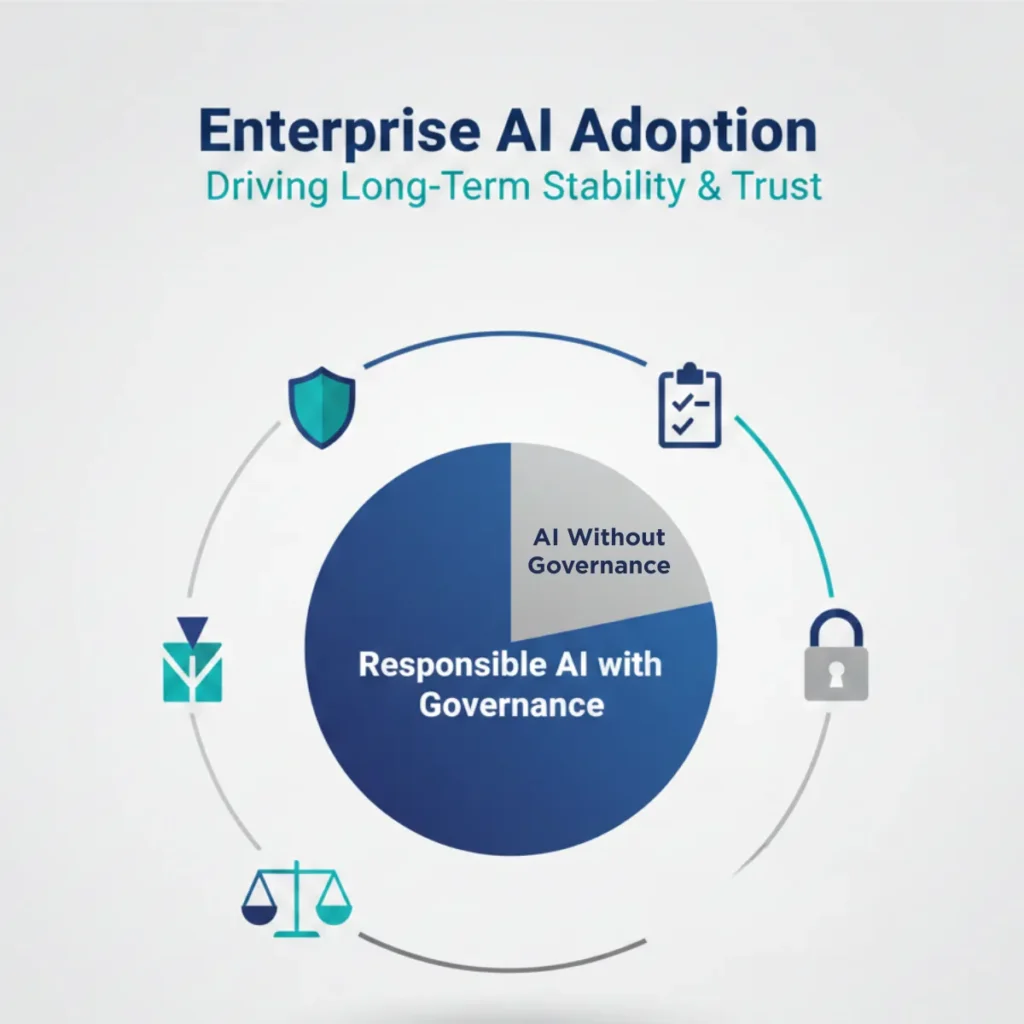
To maximize AI benefits while minimizing risks, enterprises need a robust AI governance framework.
Responsible AI ensures that AI systems operate ethically, transparently, and in alignment with organizational objectives.
It protects stakeholders, reinforces trust, and strengthens long-term business outcomes.
Talk to our AI Governance experts – Book a 30-min consultation
Challenges in AI Adoption
Risks of Uncontrolled AI Implementation
Unregulated AI models can produce biased, inaccurate, or unintended results. Without proper governance, AI decisions may compromise business integrity, customer trust, and regulatory compliance.
Data Quality and Management Gaps
Poor data quality, missing lineage, and inconsistent data formats pose challenges for AI systems. Organizations must adopt data governance for AI to ensure datasets are accurate, complete, and reliable for model development.
Lack of Transparency and Ethical Oversight
AI models often function as “black boxes,” making it difficult to explain decisions. Without AI transparency, businesses struggle to validate outputs, leading to mistrust among stakeholders.
Regulatory and Compliance Challenges
With increasing AI regulations globally, companies face penalties if AI is deployed irresponsibly. Implementing strong AI governance policies is essential to comply with standards and mitigate legal risks.
Challenge | Description | Impact on Business |
Bias in AI | Models trained on skewed data | Poor decision-making & reputational risk |
Data Quality Gaps | Inconsistent or incomplete datasets | Model failures & inaccurate insights |
Lack of Transparency | Black-box models | Reduced stakeholder trust |
Compliance Risks | Failure to meet regulations | Penalties & operational setbacks |
Learn more about AI operationalization: Operationalizing AI With Impact
Establishing a Responsible AI Framework
Principle | Key Action | Benefit |
Fairness | Test for bias in models | Reduces discrimination |
Accountability | Assign decision ownership | Mitigates risk |
Transparency | Explainable AI methods | Builds trust |
Safety | Regular audits | Avoids unintended consequences |
Defining AI Governance Policies
Start by establishing clear AI governance policies outlining responsibilities, accountability, and risk management practices. Policies should cover model design, deployment, monitoring, and review procedures.
Aligning AI Initiatives With Business Objectives
AI should serve business goals rather than technology for technology’s sake. Aligning AI projects with key performance indicators ensures that ethical and effective solutions deliver measurable ROI.
Creating Ethical Guidelines and AI Principles
Develop principles for ethical AI, including fairness, accountability, and transparency. This ensures AI decisions respect stakeholder interests and societal norms.
Ensuring Transparency in AI Models and Decision Processes
Implement explainable AI practices, including model documentation, interpretable algorithms, and decision-tracking tools. AI transparency boosts stakeholder confidence and reduces bias risks.
Process Diagram: Steps to implement Responsible AI: Define policies → Align with objectives → Ethical guidelines → Transparency.
Stay updated on AI trends: Recent AI Developments
Data Governance for AI
Implementing Data Management Best Practices
Structured data governance for AI involves consistent data collection, storage, and processing procedures. Centralized data catalogs, quality checks, and access controls are critical.
Ensuring Data Quality, Lineage, and Accessibility
Track data lineage, validate inputs, and ensure accessibility to authorized personnel. Reliable, traceable data ensures accurate model outputs and supports compliance initiatives.
Integrating Responsible AI Practices Into Model Development
Embed ethical principles, monitoring checks, and bias detection in AI development cycles. Responsible AI practices improve model reliability and mitigate operational risks.
Monitoring, Auditing, and Continuous Improvement of AI Systems
Regular audits, model performance tracking, and updates based on feedback maintain AI system effectiveness. Continuous improvement reinforces AI governance and organizational trust.
With the right AI consultation, enterprises can implement continuous monitoring and auditing of AI systems to reduce risk.
Explore AI future directions: Where AI Is Heading
Benefits of Responsible AI and Governance
Improved Trust and Transparency Across Stakeholders
Transparent AI practices enhance credibility with customers, regulators, and employees, building trust in AI-driven decisions.
Reduced Risk of Bias and Regulatory Violations
A structured AI governance framework prevents ethical breaches and regulatory non-compliance, protecting the organization from reputational and legal risks.
Enhanced Decision-Making With Reliable Data
When AI models are fed high-quality data under robust data governance for AI, decision-making becomes more accurate, faster, and actionable.
Strengthened Competitive Advantage Through Ethical AI
Companies implementing Responsible AI strategies differentiate themselves in the market as trustworthy, innovative, and forward-thinking, gaining a competitive edge.
Schedule a consultation to strengthen your AI governance – Book Here
Why Partner with Perceptive Analytics
Expertise in AI Governance and Ethical AI Practices
Our team specializes in AI governance, ensuring AI systems are ethical, transparent, and aligned with business goals.
Customized Responsible AI Strategies for Enterprises
We design tailored Responsible AI frameworks to fit unique enterprise needs, mitigating risks while maximizing AI benefits.
End-to-End Support From Data Management to Model Deployment
From data governance for AI to model deployment, we provide end-to-end support ensuring operational efficiency, compliance, and transparency.
Ensuring Compliance, Transparency, and ROI
Perceptive Analytics ensures AI solutions deliver measurable ROI while adhering to ethical standards and regulatory requirements.
Talk to our AI Governance experts – Book a 30-min consultation
What is Responsible AI and why does it matter?
Responsible AI refers to AI systems designed and implemented ethically, transparently, and safely. It matters because it reduces bias, ensures compliance, and builds trust across stakeholders.
How does data governance support AI initiatives?
Data governance for AI ensures high-quality, reliable data for model training, monitoring, and auditing, which improves AI performance and transparency.
What are best practices for ethical AI in business?
- Define AI governance policies
- Implement transparency in models
- Conduct regular audits and monitoring
- Ensure alignment with business objectives
- Mitigate bias and ethical risks
How can Perceptive Analytics help implement AI governance?
We provide end-to-end AI governance solutions, including ethical AI frameworks, data governance integration, compliance support, and continuous improvement strategies.