


Executive Summary
Every successful data program eventually creates a governance challenge. The controls that once ensured consistency begin slowing delivery, while efforts to increase autonomy often lead to duplicated pipelines, conflicting definitions, and growing compliance risks. The question is no longer whether governance should be centralized or decentralized. It is how organizations can maintain enterprise-wide trust while allowing domains to move independently. Federated governance is emerging as that answer, combining centralized policies with decentralized execution through automation, metadata, and policy-driven controls.
Governance Scales Poorly Because It Was Designed for Data Assets, Not Data Products
A Perceptive Analytics POV
Most governance frameworks were created when organizations managed a relatively small number of databases, reports, and controlled data flows. Today’s enterprises operate thousands of data assets, hundreds of pipelines, and increasingly, AI models that consume and generate data continuously. The challenge is no longer defining policies. It is applying them consistently at scale.
At Perceptive Analytics, we have seen federated governance succeeding when organizations stop treating governance as an approval process and start treating it as an engineering capability embedded directly into the data platform.
Centralized and Decentralized Governance Fail for Opposite Reasons
For years, organizations have treated governance as a choice between two models. The first centralizes ownership within a dedicated governance team responsible for standards, approvals, quality controls, and compliance. The second distributes ownership across domains, allowing teams to govern their own data products independently.
Both approaches work well initially. Both eventually struggle as complexity increases.
Centralized governance typically fails because demand grows faster than governance capacity. Every new pipeline, access request, quality exception, and metadata update must pass through the same review process. What begins as control gradually becomes operational friction. Domain teams start waiting weeks for approvals, and governance becomes associated with delays rather than trust.
Decentralized governance fails differently. Teams gain speed, but consistency begins to erode. Different business units define the same metrics differently, duplicate pipelines emerge, and security controls become uneven. The organization gains autonomy but loses alignment.The most successful organizations are increasingly adopting a third path. They centralize policies, not execution. Standards remain shared, while implementation becomes domain-owned.
| Governance Model | Primary Strength | Primary Limitation |
| Centralized Governance | Consistency and control | Bottlenecks and slow delivery |
| Decentralized Governance | Speed and autonomy | Fragmentation and inconsistency |
| Federated Governance | Shared standards with domain ownership | Requires strong metadata and automation capabilities |
Metadata Is Becoming the Control Plane for Modern Governance
A surprising number of governance discussions focus on people, committees, and operating models while overlooking the technical foundation that makes governance scalable. That foundation is metadata. Federated governance depends on the ability to understand what data exists, where it originated, who owns it, how it is being used, and which policies apply to it. Without this visibility, automation becomes impossible.
Think of metadata as the navigation system for governance. It provides the context required to enforce policies without requiring human intervention at every step. Modern governance programs increasingly rely on:
- Business glossaries that standardize enterprise definitions
- Data lineage that traces how data moves across systems
- Ownership metadata that establishes accountability
- Classification tags that identify sensitive information
- Quality metadata that tracks trustworthiness and reliability
This shift is particularly important because the volume of enterprise data is growing faster than governance teams can expand. Gartner, Top Trends in Data and Analytics for 2023 has repeatedly identified poor data quality as one of the most significant barriers to successful analytics initiatives, while IBM, the State of Data Quality Report estimates poor data quality costs organizations trillions of dollars globally every year.
The challenge is no longer creating standards. The challenge is making those standards discoverable and enforceable at scale.
Governance as Code Is Replacing Governance by Committee
Most governance programs already have policies. The problem is that policies documented in PDFs, spreadsheets, or governance portals do not actively influence behavior. A security policy cannot prevent a developer from exposing sensitive information. A data standard cannot stop a pipeline from publishing inconsistent definitions. Compliance requirements cannot guarantee that every deployment follows approved controls.
This is why governance is increasingly moving toward Governance as Code. The concept is simple. Policies become executable. Instead of manually reviewing every implementation, organizations embed governance controls directly into data platforms, CI/CD workflows, and deployment processes. Compliance shifts from retrospective auditing to proactive enforcement. A modern federated governance architecture often includes:
- Policy engines that automatically validate compliance requirements
- Access control frameworks that enforce security policies consistently
- Automated quality checks integrated into pipelines
- Schema validation rules that prevent incompatible changes
- Continuous compliance monitoring that identifies violations in real time
This approach fundamentally changes the governance operating model. Governance teams spend less time reviewing requests and more time defining policies that platforms can enforce automatically.
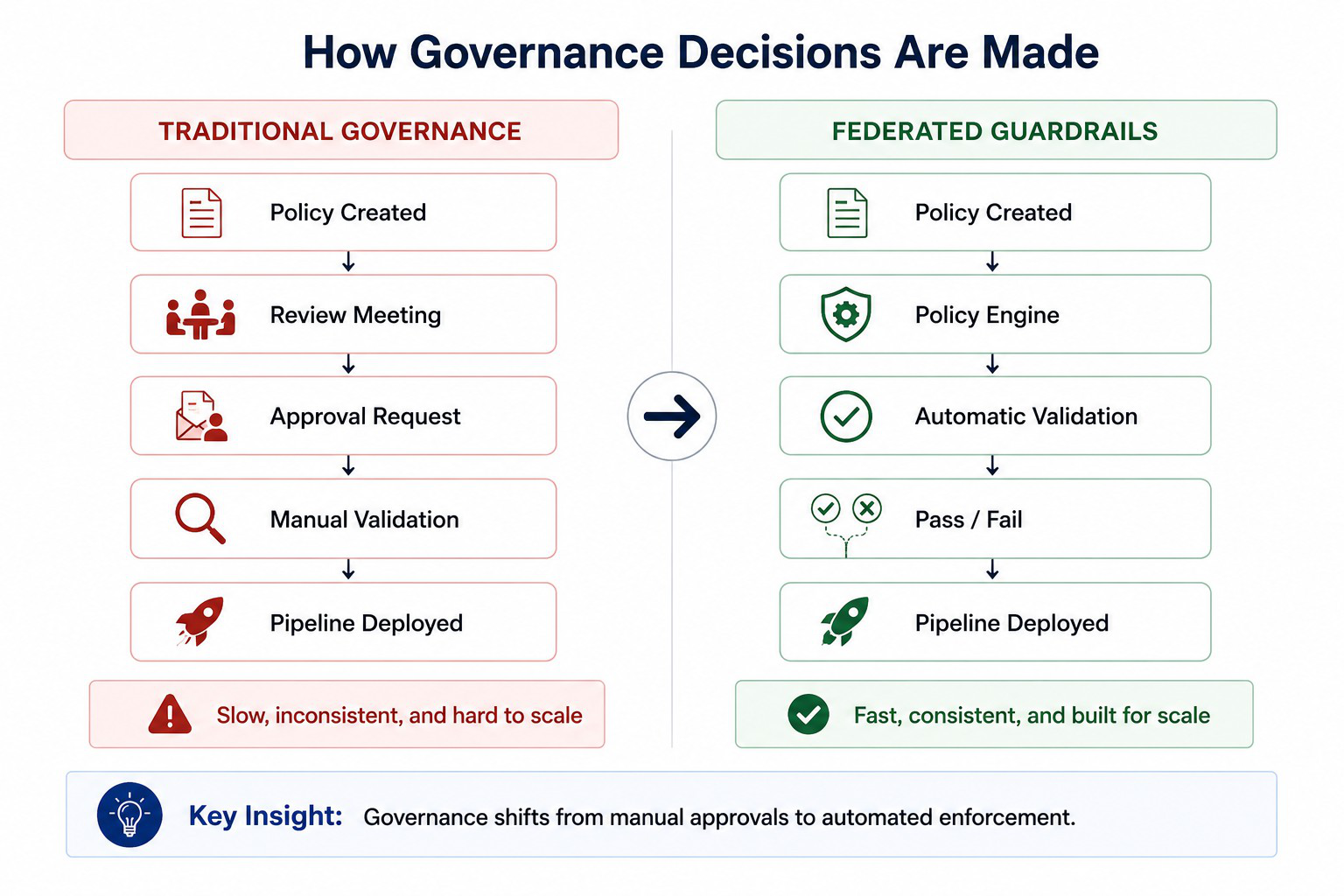
The result is stronger control with fewer bottlenecks.
AI Adoption Is Exposing the Limits of Traditional Governance
Few forces are accelerating governance modernization more rapidly than AI. Traditional governance models were designed primarily for reports, dashboards, and structured datasets. AI introduces entirely new governance requirements. Organizations now need visibility into:
- Training datasets
- Feature engineering pipelines
- Model lineage
- Vector databases
- Synthetic data generation
- Model outputs and decision traceability
A manual governance process that struggles to manage a few hundred datasets cannot realistically govern thousands of AI features and continuously evolving models. This is one reason Gartner, Top Trends in Data and Analytics 2024 predicts that active metadata and automated governance capabilities will become increasingly important as organizations scale AI initiatives. AI systems require trusted data, documented lineage, and consistent policy enforcement. Without those foundations, model risk grows significantly.
In many organizations, AI is not creating a governance challenge. It is exposing governance weaknesses that already existed. The organizations that modernize governance now will be significantly better positioned to scale AI responsibly in the coming years.
What Does Federated Governance Look Like in Practice?
One of the clearest examples of federated operating principles can be seen in Netflix’s engineering model.
As Netflix expanded globally, centralized oversight became increasingly difficult. Hundreds of engineering teams needed the freedom to build, deploy, and manage services independently while still operating within shared standards for security, reliability, and observability.
Netflix addressed this challenge through a platform-centric approach. Teams retained ownership of their services and data, while centralized engineering established standards, tooling, and automated controls. Instead of requiring approval for every decision, Netflix invested in platforms that made compliant behavior easier than non-compliant behavior. The outcome was significant. Netflix’s platform-centric operating model enabled thousands of daily production deployments while maintaining reliability across a globally distributed architecture. By embedding standards into tooling rather than approval processes, Netflix scaled engineering autonomy without sacrificing consistency, security, or observability.
The lesson extends directly to governance. High-performing organizations rarely scale by increasing reviews and approvals. They scale by creating systems that automatically guide teams toward the right decisions. In a federated model:
The central team owns:
- Security standards
- Metadata standards
- Business definitions
- Compliance requirements
- Policy frameworks
Domain teams own:
- Data products
- Pipelines
- Monitoring
- Delivery
- Operational improvements
Is Your Organization Ready for Federated Governance?
Federated governance is not simply an organizational change. It is a maturity milestone.Organizations often attempt to decentralize ownership before establishing the technical capabilities required to support it. The result is not federated governance. It is unmanaged decentralization.
Before moving toward a federated model, leadership should assess three areas.
Technology Foundations
- Enterprise data catalog
- Metadata management platform
- End-to-end lineage visibility
- Automated policy enforcement
- Monitoring and observability
Operating Model Foundations
- Clearly defined domain ownership
- Data product accountability
- Executive sponsorship
- Shared governance objectives
Governance Foundations
- Standardized business definitions
- Security classification framework
- Data quality standards
- Compliance policies
- Escalation and remediation processes
Organizations that lack these foundations often struggle because they distribute responsibility without providing the mechanisms needed to coordinate it.
FAQs: Questions CXOs Frequently Ask About Federated Governance
Is federated governance the same as data mesh?
No. Data mesh is an organizational and architectural approach centered on domain-owned data products. Federated governance is the governance model commonly used to support that approach.
Does federated governance eliminate governance teams?
No. Governance teams remain essential, but their focus shifts from approvals and reviews toward standards, automation, metadata, and policy management.
Can regulated industries adopt federated governance?
Yes. In many cases, automated policy enforcement provides stronger and more consistent compliance than manual governance processes.
What technologies typically support federated governance?
Organizations commonly use combinations of data catalogs, lineage platforms, metadata repositories, policy engines, and governance tools such as Microsoft Purview, Collibra, Alation, Unity Catalog, Apache Ranger, or Open Policy Agent.
What is the biggest mistake organizations make when implementing federated governance?
Treating decentralization as the goal. The objective is not autonomy alone. The objective is autonomy supported by shared standards, visibility, and accountability.
Conclusion
The governance debate is no longer about choosing between centralization and decentralization. Both models eventually reach their limits as data ecosystems expand. The organizations succeeding today are shifting governance from people-driven oversight to policy-driven automation, supported by metadata, lineage, and platform-enforced controls.
At Perceptive Analytics, we help organizations design federated governance frameworks that balance domain autonomy with enterprise-wide trust. As data products, AI systems, and analytical workloads continue to multiply, the ability to scale governance without creating bottlenecks will increasingly become a competitive advantage.