


Executive Summary
Walk into many transformation steering meetings and the roadmap often reads like a shopping list. A data catalog this quarter, an orchestration platform next quarter, a governance tool after that. Progress is measured through implementation milestones, yet business capabilities remain largely unchanged. This disconnect is costly. Gartner estimates that poor data quality costs organizations an average of $12.9 million annually, while IBM estimates poor data quality costs U.S. businesses approximately $3.1 trillion per year. The strongest transformation programs reverse this logic. They begin by defining the capabilities the organization needs to develop and then select technologies that accelerate that journey. In a capability-based roadmap, tools are enablers. The destination is measurable business maturity.
The Most Dangerous Roadmap Milestone Is One That Can Be Completed Without Changing Behavior
A Perceptive Analytics POV
A tool can be deployed. A capability has to be adopted. That distinction explains why many transformation programs deliver technical success but limited business impact. At Perceptive Analytics, we often see organizations celebrate implementation milestones while the underlying operating model remains unchanged. Sustainable transformation happens when roadmaps are designed around how people work, make decisions, and consume data and not simply around what technology gets installed next.
Why Do Transformation Roadmaps Keep Turning Into Technology Shopping Lists?
Most transformation leaders genuinely want to improve business outcomes. Yet roadmaps frequently become centered on tools rather than capabilities.
Part of the reason is practical. Technology purchases are visible. They have budgets, contracts, implementation timelines, and executive sponsors. Progress can be demonstrated through procurement approvals and deployment dates. Capabilities are harder to measure because they require changes in processes, governance, operating models, and user behavior.
This creates a subtle but dangerous shift. Success becomes defined by implementation rather than improvement. Research from McKinsey has consistently shown that roughly 70% of transformation initiatives fail to achieve their intended objectives. The reasons are rarely technical. More often, organizations focus on delivery activities while underestimating adoption, operating model changes, governance requirements, and long-term capability development.
Consider how many organizations describe transformation progress:
- Data catalog deployed
- ETL platform modernized
- Governance tool implemented
- AI platform purchased
Each milestone may be valid. Yet none automatically answers the more important question: what can the business do today that it could not do six months ago?
Why Tool-Centric Roadmaps Create Hidden Technical Debt
Every new platform introduced into a data ecosystem creates dependencies, integration requirements, operational responsibilities, and support obligations. When tools become the center of the roadmap, organizations often accumulate technology faster than they develop the capabilities needed to operate it effectively.
This creates a form of transformation debt.
Teams spend increasing amounts of time integrating overlapping platforms, maintaining connectors, reconciling definitions, and managing operational complexity. Meanwhile, core capabilities such as data reliability, governance, and self-service adoption improve only marginally.
A common example involves data catalogs. Organizations often expect a catalog implementation to improve governance. When adoption remains low, the conclusion is frequently that the catalog is insufficient. A replacement is evaluated. Then another. The technology changes, but the underlying challenge: ownership, stewardship, and process maturity remains unresolved.
The problem is not usually the platform. The problem is the absence of a clearly defined capability target.
Capability Maturity Creates Roadmaps That Survive Technology Change
Technologies evolve quickly. Capabilities endure. A platform selected today may be replaced within five years. A mature capability can continue delivering value regardless of which technologies support it. This is why mature organizations increasingly use Capability Maturity Models to guide transformation planning.
| Capability | Early Maturity | Advanced Maturity |
| Data Reliability | Reactive troubleshooting and manual recovery | Automated observability, root-cause analysis, and self-healing pipelines |
| Self-Service Analytics | Centralized reporting teams create all dashboards | Business teams independently create and manage most reporting assets |
| Governance | Manual controls and fragmented ownership | Automated policy enforcement and continuous compliance monitoring |
| AI Readiness | Isolated experimentation and one-off models | Reusable features, governed deployment, and enterprise-scale AI operations |
Notice what does not appear in the framework. There are no vendor names. No implementation phases. No product dependencies. The roadmap remains focused on measurable organizational capabilities rather than technologies that may eventually be replaced. This also creates flexibility. If a better platform emerges tomorrow, the maturity objective remains unchanged.
Why AI Readiness Is Usually a Data Maturity Problem
Many organizations view AI readiness as the next stage of digital transformation. In reality, AI often acts as a stress test for existing data capabilities. Machine learning models depend on:
- Reliable upstream pipelines
- Consistent business definitions
- Data quality monitoring
- Feature reuse
- Governance and lineage
- Observability and monitoring
When these capabilities are weak, AI teams spend more time preparing data than building models. This explains why many AI initiatives struggle to move beyond proof-of-concept stages. The obstacle is rarely algorithm selection. More often, it is the absence of mature foundations that allow models to operate consistently in production.
Industry analysts have repeatedly identified data quality, governance, and operationalization challenges as leading reasons AI programs fail to scale. Organizations frequently invest in AI platforms before investing in the capabilities required to support them.
A capability-based roadmap naturally addresses this problem by sequencing maturity development. A common progression looks like:
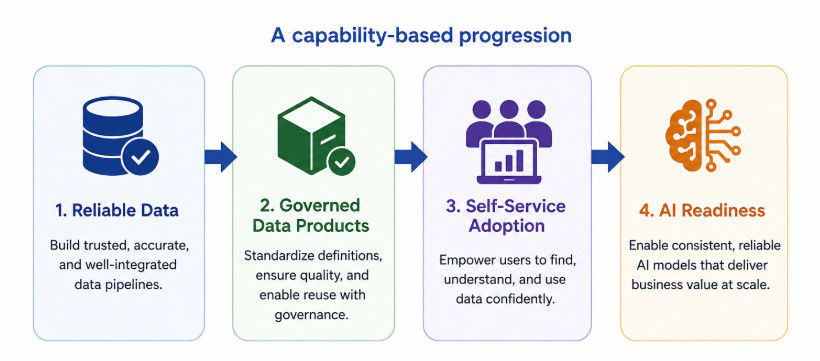
The sequence matters because each stage builds capabilities that the next stage depends on.
Why Tool-Hopping Is Usually a Symptom, Not the Root Cause
Organizations rarely set out to create technology sprawl. Tool-hopping typically emerges when leaders cannot clearly define what success looks like. One year the focus is data integration. The next year it becomes governance. Then metadata. Then AI. New technologies are introduced because the previous investment did not produce the expected outcome.
What appears to be a technology problem is often a strategy problem. Without clearly defined maturity targets, tools become proxies for progress. New platforms create the appearance of movement even when organizational capabilities remain unchanged.
This explains why some organizations possess modern data stacks yet continue struggling with issues such as low trust in analytics, poor adoption, inconsistent definitions, and governance challenges. Technologies are replaced. Capabilities accumulate. Transformation roadmaps should be designed around the latter.
How Capital One Built Capabilities Before Platforms
Capital One’s modernization journey is frequently discussed as a cloud transformation success story. A closer look reveals a different lesson. Rather than treating technology deployment as the primary objective, Capital One invested heavily in reusable engineering capabilities, internal platforms, and standardized delivery practices.
The goal was not simply to modernize infrastructure. It was to improve how teams built, governed, delivered, and operated technology across the organization. This distinction is important. Many organizations attempt to purchase transformation through technology. High-performing organizations build transformation through capabilities that technology supports.
Platforms became valuable because they reinforced desired behaviors. They accelerated delivery, improved reliability, strengthened governance, and enabled consistency at scale. The capability came first. The technology amplified it.
What Should Happen Before Your Next Technology Purchase?
Before approving the next major platform investment, leadership teams should ask a different set of questions:
- Which organizational capability are we trying to improve?
- What maturity level are we targeting?
- How will we measure capability growth?
- What operating model changes are required?
- Could our existing platforms support this objective if adoption improved?
These questions shift the discussion away from features and toward outcomes. A maturity-based roadmap typically progresses through four stages:
Phase 1: Reliability
Establish ownership, monitoring, observability, and incident management.
Phase 2: Governed Self-Service
Enable trusted data access, reusable semantic models, and consistent business definitions.
Phase 3: Data Product Operations
Introduce domain ownership, automation, and scalable governance controls.
Phase 4: AI Readiness
Support feature reuse, model governance, observability, and production-scale deployment. Tools may change within each phase. The capability objective remains constant.
FAQs: Questions CXOs Frequently Ask About Capability-Based Roadmaps
Does this mean technology selection is unimportant?
No. Technology remains critical. The difference is that technology decisions should support a defined
capability maturity objective rather than become the objective itself.
How do you measure capability maturity?
Organizations typically assess maturity across people, processes, governance, automation, adoption, and business outcomes using structured progression models.
Can capability-based roadmaps work with agile delivery?
Yes. Agile teams can deliver incremental improvements while still tracking progress against long-term capability goals.
What is the biggest warning sign of a tool-centric roadmap?
When success is measured primarily through deployment dates, implementation status, licenses purchased, or platform adoption rather than measurable improvements in reliability, governance, self-service, or AI readiness.
Why are capability-based roadmaps becoming more important now?
Because technology cycles continue to shorten. Capabilities provide continuity even as platforms, vendors, and architectural patterns evolve.
Conclusion
Transformation programs rarely fail because organizations choose the wrong technology. More often, they struggle because technology becomes the roadmap rather than the enabler. As data, governance, and AI ecosystems continue to evolve, tool-centric planning can lead to continuous reinvestment without meaningful improvements in organizational capability.
At Perceptive Analytics, we help organizations build maturity-driven transformation roadmaps that align technology investments with measurable capability growth. Technologies will change, vendors will evolve, and platforms will be replaced. Capabilities such as data reliability, governance, self-service, and AI readiness continue compounding long after today’s tools have disappeared.