


Executive Summary
Every major platform decision is ultimately a bet on the future. Yet most organizations evaluate platforms based on current functionality rather than their ability to adapt to future technologies, business models, and AI-driven change. Open standards and interoperable architectures help preserve flexibility by reducing switching costs and enabling plug-and-play adoption of new capabilities. However, excessive standardization can also slow innovation, delay experimentation, and limit competitive differentiation. The most resilient organizations standardize foundational layers where flexibility matters most while deliberately accepting lock-in where it creates measurable business advantage.
The Costliest Platform Risk Is Losing Strategic Flexibility
A Perceptive Analytics POV
At Perceptive Analytics, we frequently encounter organizations that view future-proofing as a technology selection exercise. The discussion often centers around choosing the “right” platform rather than designing an architecture that remains adaptable regardless of which platform is chosen. The reality is that no technology remains dominant forever. What creates long-term value is the ability to adopt new innovations without rebuilding core systems. Organizations that separate foundational architecture from vendor-specific capabilities consistently navigate technology shifts more effectively than those tightly coupled to a single ecosystem. Future-proofing is not about avoiding vendors. It is about ensuring vendors remain a choice rather than a dependency.
The Real Asset Is Optionality, Not Technology
Many enterprises spend months comparing platform capabilities, evaluating pricing models, and conducting proof-of-concepts. These activities are important, but they often overlook a factor that becomes far more significant over time: architectural optionality. Optionality is the ability to change direction without paying a massive penalty.
This capability becomes increasingly valuable as technology cycles accelerate. Five years ago, organizations expected data platforms to remain largely stable for a decade. Today, enterprises are simultaneously evaluating AI copilots, vector databases, semantic layers, lakehouse architectures, agent frameworks, and domain-specific AI applications. The pace of change is dramatically different.
The challenge is not predicting which technology will dominate next. The challenge is ensuring that the business can adopt emerging technologies without undertaking another large-scale modernization effort.
Many organizations discover this problem during acquisitions, cloud migrations, AI initiatives, or major vendor negotiations. What initially appears to be a technology investment often reveals itself as a network of dependencies embedded within proprietary formats, custom integrations, metadata structures, and operational workflows.
The result is that switching costs increase over time, even when better alternatives become available.
Future-proof architectures are designed around the assumption that change is inevitable. Instead of optimizing for a single platform, they optimize for the organization’s ability to evolve. This shift fundamentally changes how technology investments should be evaluated. The most valuable architecture is not necessarily the one with the most features today. It is often the one that preserves the greatest number of opportunities tomorrow.
Many Organizations Standardize the Wrong Things
One of the most common architectural mistakes is attempting to standardize every layer of the technology stack. At first glance, this approach appears logical. Standardization simplifies governance, reduces complexity, and creates consistency across teams. However, excessive standardization can unintentionally restrict innovation.
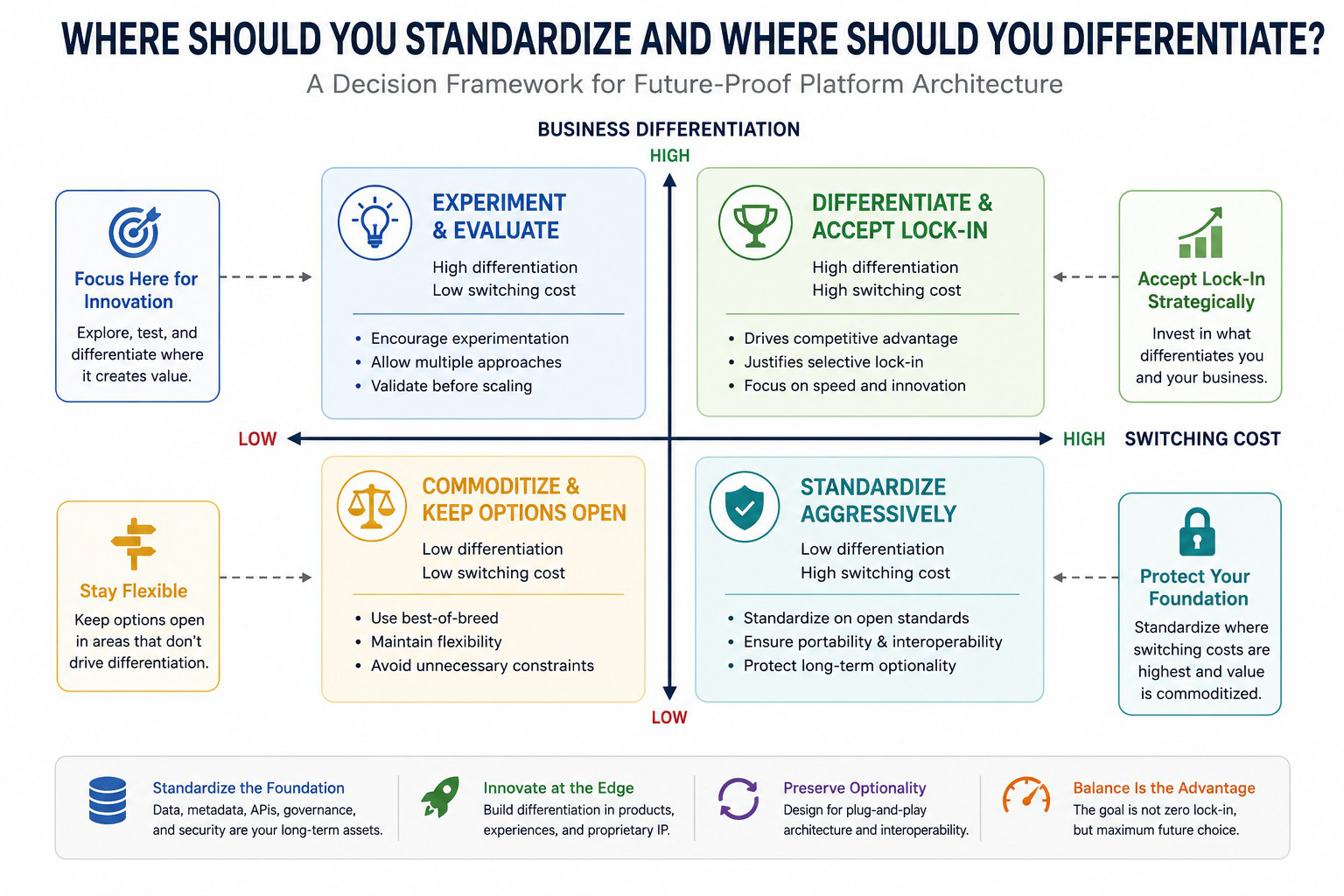
The organizations achieving the greatest success with modern data and AI platforms distinguish between standardization zones and innovation zones. Standardization zones are foundational layers where switching costs are high and business differentiation is low. These layers should prioritize interoperability and portability.
They typically include:
- Datastorage formats
- Metadataframeworks
- APIcontracts
- Integrationpatterns
- Governancepolicies
- Securitycontrols
Innovation zones operate differently. These are areas where competitive advantage is created and where experimentation should be encouraged.
Examples include:
- AIapplications
- Recommendationengines
- Pricingoptimization models
- Customerintelligence platforms
- Industry-specificanalytics
- Proprietaryautomation capabilities
Many organizations accidentally reverse these priorities. They enforce strict standards on innovation teams while allowing foundational architecture to become fragmented. This creates a dangerous combination. Innovation slows while technical dependencies continue to grow. The strongest platform strategies standardize the foundation and compete on the experiences built above it.
Where Should You Standardize and Where Should You Differentiate?
When Standardization Becomes a Competitive Disadvantage
The technology industry often treats standardization as an unquestioned best practice. In reality, there are situations where excessive standardization can reduce organizational performance. Innovation frequently emerges through experimentation, not uniformity. Organizations that require every AI initiative, analytics project, or customer-facing capability to conform to a single technology standard may inadvertently slow learning and limit creativity.
This is becoming increasingly relevant as enterprises adopt AI. Many leadership teams are currently debating whether to standardize around a single model provider, a single AI framework, or a single vector database. While this may simplify governance, it can also reduce exposure to emerging capabilities.
A rigid standard may create efficiency today while limiting opportunity tomorrow. The objective should not be maximizing standardization. The objective should be standardizing the layers that benefit from consistency while allowing controlled experimentation where innovation is most likely to occur.
This creates a more balanced architecture. Governance remains manageable while teams retain the freedom necessary to explore new opportunities. The most successful enterprises increasingly treat innovation as a portfolio rather than a standardized process. Some experiments fail. Others become the foundation of future competitive advantage. Over-standardization can unintentionally prevent those opportunities from emerging.
The Six-Month Escape Route Test
A practical way to evaluate platform resilience is to assess whether the organization can realistically exit the platform within six months. This is not because migration is expected. It is because the exercise reveals hidden dependencies. Before approving any major platform investment, leadership teams should evaluate the following questions:
Data Portability
Can business critical data be moved without significant transformation?
Metadata Portability
Can lineage, definitions, governance rules, and operational context move with the data?
Pipeline Portability
Can workflows be recreated without extensive redevelopment?
API Independence
Do integrations rely on open interfaces or proprietary connectors?
Skills Portability
Are employee skills transferable beyond the current vendor ecosystem?
Exit Timeline
Could migration realistically occur within six months if required?
If multiple answers are negative, the organization may have accumulated platform risk that is not visible in traditional business cases. The exercise often reveals that dependencies originate from architectural choices rather than contractual obligations.
Why AI Is Changing the Future-Proofing Conversation
Historically, platform lock-in centered around databases, infrastructure, and enterprise software. Increasingly, lock-in is shifting toward AI ecosystems. Organizations are becoming dependent on:
- Proprietaryfoundation models
- AIcopilots
- Agentframeworks
- Vectordatabases
- Semanticlayers
- Vendor-specificmachine learning capabilities
This introduces a new challenge. An organization may successfully modernize its data architecture while simultaneously creating new dependencies within its AI stack. The risk is not immediate. It emerges when organizations attempt to adopt newer models, integrate alternative providers, or respond to changing regulatory requirements.
Future-proofing therefore extends beyond data platforms. It now includes ensuring that AI capabilities can evolve without forcing large scale architectural redesign. The organizations that succeed will not necessarily be those with the most advanced AI platforms today. They will be those with architectures capable of continuously incorporating tomorrow’s innovations.
FAQs: Questions CXOs Frequently Ask About Plug-and-Play Architectures
Does adopting open standards eliminate vendor lock-in?
No. Vendor lock-in can never be eliminated entirely. Open standards reduce switching costs and increase flexibility, but organizations will always maintain some level of dependency on vendors, partners, and technologies.
Should organizations avoid proprietary capabilities altogether?
No. Proprietary capabilities often create meaningful competitive advantages. The key is ensuring that the underlying data, metadata, and integrations remain portable.
What is the biggest warning sign of future platform risk?
When business-critical data, governance processes, and operational workflows become inseparable from a single vendor ecosystem.
How do open standards support AI initiatives?
Open standards improve interoperability across tools, data platforms, and AI services. This allows organizations to adopt emerging technologies without extensive re-engineering.
What should leadership standardize first?
Data foundations, metadata management, governance frameworks, APIs, and integration layers generally provide the highest return on standardization because they influence every downstream technology decision.
Conclusion
Future-proofing platform investments is not about predicting which technology will dominate the next decade. It is about ensuring that the business can adapt when technology inevitably changes. Open standards, interoperable architectures, and portable data foundations provide the flexibility required to evolve without repeated modernization cycles. At the same time, organizations should not hesitate to embrace selective lock-in when it accelerates innovation or strengthens competitive differentiation. At Perceptive Analytics, we help organizations design architectures that balance flexibility, innovation, and long-term resilience so that today’s technology decisions remain strategic assets rather than future constraints.