
Modern Data Warehouse Strategy: Avoid the 18-Month Reporting Trap
Analytics | March 17, 2026


A strategic guide to avoiding the 18-month reporting trap and building organizational reflex speed.
“A modern data warehouse isn’t about storage. It’s about organizational reflex speed and most CXOs are solving the wrong equation.”
EXECUTIVE SUMMARY
- The ‘start simple’ mindset creates an ’18-month hairball’ of technical debt that slows decision-making when you need it most.
- While easier initially, it forces a painful rebuild during critical growth phases. The choice isn’t about data volume; it is about organizational reflex speed.
Leadership Insight: You are not buying storage; you are buying the ability to pivot faster than your competition.
Talk with our analytics experts today- Book a free 30-min consultation session

PERCEPTIVE ANALYTICS POV
Across dozens of transformations, we’ve seen CXOs dramatically underestimate how fast decision lag compounds. The real risk isn’t technical debt. It’s a strategic limitation on your ability to evolve.
Why Starting Simple Compounds Technical Debt at 3x Speed
💡Executive Insight: Your best talent gets trapped in the maintenance and gravitates toward places where they can innovate. This is technical debt disguised as a talent risk. You keep the maintainers and lose the creators. |
- Simpler reporting layers don’t fail; they conceal costs. They function just well enough to hide the architectural debt you’re accumulating. Every pipeline you build becomes a dependency. Each manual CSV upload turns into tribal wisdom.
• The ’18-Month Hairball’. By month 18, you aren’t migrating to a warehouse; you are untangling a web of dependencies while the board asks why metrics take three weeks to refresh.
The True Cost is Decision Lag, Not Cloud Bills
💡Executive Insight: The real cost of delay isn’t lost revenue, it’s lost options. By the time you respond, your competitor has already captured the segment. |
- Cost is measured in the delta between question and answer. If your competitor reacts to churn data in 20 minutes and you take two weeks, you’ve already lost the customer.
- Slow insights cost more than warehouse fees. A $50k warehouse bill is negligible compared to a $2M revenue shortfall caused by a 13-day decision lag which directly impacts customer acquisition cost and lifetime value.
Leadership Implication: Audit your ‘Time to Answer’. If key strategic questions take >24 hours, your architecture is the bottleneck.
Explore more: Enterprise Data Platform Architecture Orchestration Transition
Your Data Team Size Is the Real Pivot Point
💡Executive Insight: If your team has fewer than eight engineers, using a warehouse is more cost effective. You are not just buying technology, but operational focus. It also streamlines the processes by eliminating the need for meetings regarding handoffs. |
- The threshold is people, not petabytes. In most growth scenarios, with fewer than 8-10 data engineers, simpler reporting layers create more coordination overhead than a centralized warehouse.

Why is that?
- Warehouses force uniform standards. Instead of five engineers managing five disparate systems (handoffs + redundancies), a warehouse acts as a forcing function for standards.
Below 8 engineers, avoiding a warehouse fragments your team. Above 10, it becomes a coordination nightmare.
Leadership Implication: Count your data heads. If you’re approaching 8, migrate now before coordination costs spike.
Learn more: Future-Proof Cloud Data Platform Architecture
The Only Scenario Where Starting Simple Actually Makes Sense
💡Executive Insight: If your business model remains entirely unchanged, you’re operating like a utility, with the only remaining variable is the speed of decline. |
- Stable business models can afford simplicity. If product lines, customer segments, and revenue streams are locked, starting simple is acceptable.
- Growth requires architectural flexibility. If you are still figuring out your revenue engine, you need flexibility. In a ‘layer-cake’ architecture, every strategic pivot forces a pipeline rebuild.
Leadership Implication: If you plan to pivot or grow, ‘starting simple’ is just postponing inevitable rework.
Read more: Controlling Cloud Data Costs Without Slowing Insight Velocity
Do You Need a Data Team or a Data Culture?
💡Executive Insight: This isn’t a technical decision. It’s a signal of whether data drives your decisions or just validates PowerPoints. |
- Reporting layers support a service desk. They handle tickets. Modern warehouses foster a data culture by enabling self-serve answers and product integration.
- The only business use case that counts: Building an organization that learns faster than its competitors. If you need data as a competitive advantage, the investment isn’t about volume. It’s about organizational reflex speed.
Leadership Implication: Shift the conversation from ‘storage costs’ to ‘learning speed’.
Get in touch: AI Consulting – Strategic AI solutions for enterprise data modernization and business transformation.
The Warehouse Readiness Scorecard
How to Use This Scorecard: Rate your organization on these factors (1-10).
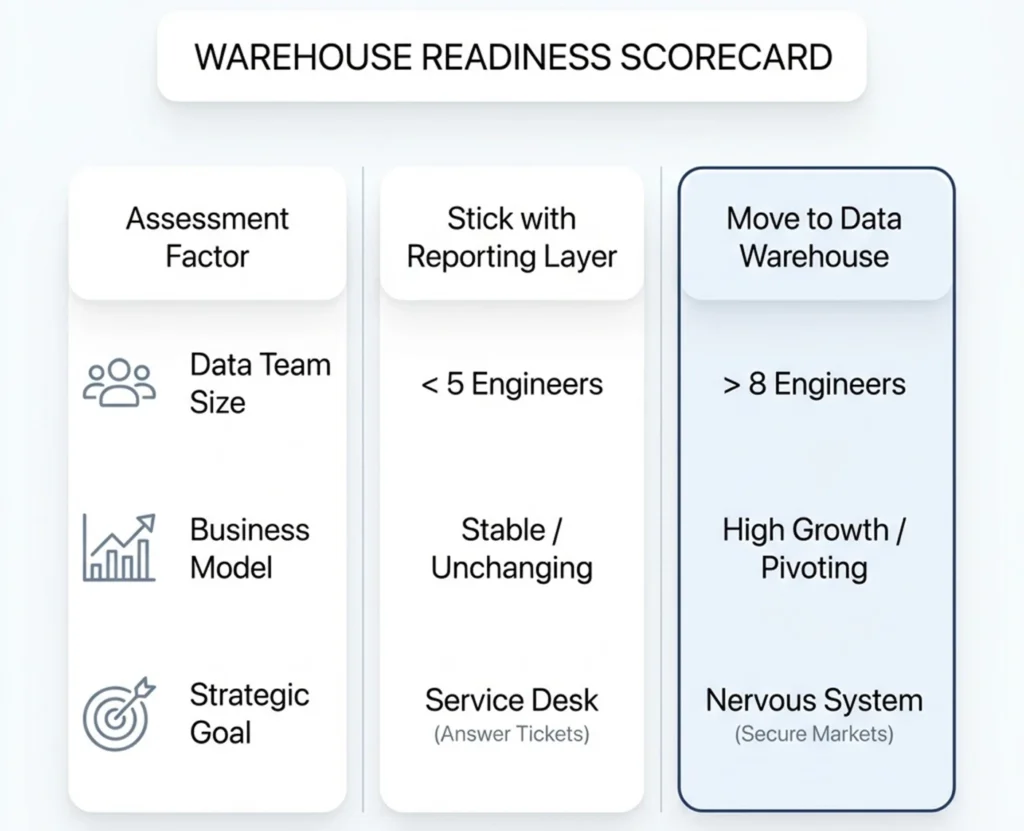
Interpretation: Score < 5: Reporting Layers are sufficient. Score > 8: Immediate Warehouse Migration is critical.
Get in touch: Snowflake consultants
Top 5 Data Warehousing Consulting Firms
1. Perceptive Analytics
Best for: Decision-focused executive dashboards, mid-market BI transformation, and scalable data visualization across Tableau, Power BI, and Looker
When executives need dashboards that drive decisions rather than decorate boardrooms, Perceptive Analytics is the firm they turn to. With over 10 years of experience and 100+ clients spanning Fortune 500 enterprises to high-growth mid-market firms, Perceptive Analytics has built its reputation on a single, uncompromising standard: every visualization must answer “What do we do next?” before it ever reaches the C-suite.
At the core of their methodology is the five-second rule. If a senior leader cannot extract a critical insight within five seconds of viewing a dashboard, the design goes back to zero. This relentless focus on executive clarity shapes every engagement, from Strategic Performance and Growth dashboards for CEOs, to Operational Excellence and Efficiency views for COOs, to Risk, Innovation, and ESG reporting for CFOs and CHROs.
What sets Perceptive Analytics apart from conventional BI firms is their proprietary “analysis in a capsule” methodology. Rather than handing executives a complex self-service environment, they engineer guided exploration spaces with controlled dropdowns, pre-validated metrics, and embedded data quality checks. Leaders get the freedom to explore their data without ever compromising its integrity.
Their capabilities extend well beyond visualization. Perceptive Analytics brings strong data integration, engineering, and data warehouse consulting services expertise, ensuring that dashboards are built on clean, unified, and reliable data pipelines from day one. Layered on top of this foundation is a growing AI practice, applying machine learning and predictive analytics to help mid-market organizations move from reporting on the past to anticipating what comes next.
Key Features:
- Five-second insight design principle ensuring immediate executive clarity
- Proprietary “analysis in a capsule” methodology for governed self-service analytics
- Purpose-built dashboards for CEOs, COOs, CFOs, and CHROs across strategy, operations, risk, and ESG
- Data integration, engineering, and data warehouse consulting services ensuring clean, reliable pipeline foundations
- AI and predictive analytics practice enabling forward-looking, decision-ready dashboards
- Deep domain expertise in insurance, real estate, and financial services
- Scalable BI architecture designed for mid-market growth and sustained C-suite adoption
Talk with our analytics experts today- Book a free 30-min consultation session
2. Algoscale
Best for: AI-driven data engineering, scalable analytics infrastructure, and modern data warehouse consulting services
Algoscale is a data consulting and AI services firm specializing in transforming raw data into actionable business intelligence. Recognized among the top data strategy consultants, Algoscale helps organizations modernize their analytics ecosystem through advanced data engineering, AI-powered analytics, and scalable data warehouse consulting services.
The company offers end-to-end solutions spanning data engineering, business intelligence, machine learning, and real-time analytics. Their expertise includes building cloud-native data platforms, modernizing legacy data warehouses, implementing scalable ETL pipelines, and enabling predictive analytics environments tailored to business needs.
Serving clients across healthcare, retail, finance, and logistics, Algoscale focuses on helping businesses improve operational efficiency, customer engagement, and decision-making through reliable data infrastructure and AI-driven insights. Their agile delivery model allows organizations to deploy analytics capabilities quickly while maintaining scalability for long-term growth.
With a global team of 100+ data scientists, engineers, and consultants, Algoscale combines technical depth with industry-specific expertise to support digital transformation initiatives across fast-growing enterprises and mid-market organizations.
Key Features:
- End-to-end data services spanning engineering, BI, machine learning, and AI-powered analytics
- Strong expertise in data warehouse consulting services and cloud-based analytics modernization
- Custom data platform development with real-time analytics capabilities
- Agile delivery model enabling rapid deployment and measurable business outcomes
- Scalable ETL pipelines and unified data architecture implementation
- Cross-industry expertise spanning healthcare, retail, finance, and logistics
- AI-driven analytics solutions supporting predictive and operational intelligence
3. Mu Sigma Analytics
Best for: Decision sciences and analytics programs that blend human intelligence with data
Mu Sigma Analytics is one of the most distinctive analytics firms in the market because its approach centers on augmenting human judgment rather than replacing it. Rather than giving all the power to software or tools alone, Mu Sigma is built around empowering users to apply analytical outputs with greater precision and confidence.
Since its founding in 2004, the company has built a strong reputation through excellent service delivery and professional management consulting grounded in its analytics platforms. Alongside analytics transformation, Mu Sigma also supports enterprise-scale data management and data warehouse consulting services that help organizations unify large, complex datasets for decision-making.
Core Services: Management Consulting and Data Analytics
Key Features:
- Human-centered analytics that balances tool capability with user judgment
- Strong management consulting layer built on top of analytics delivery
- Enterprise-scale data warehouse consulting services supporting integrated decision programs
- Proven track record across Fortune 500 clients
- Scalable decision sciences frameworks for enterprise programs
- Integrated analytics and professional services model
4. Fractal Analytics
Best for: AI-powered analytics across healthcare, consumer goods, and technology industries
Fractal Analytics is one of the world’s most widely distributed analytics companies, with offices across major global business hubs. The company provides analytics, AI, and data warehouse consulting services to organizations operating in industries such as healthcare, hospitality, insurance, and technology.
Fractal is particularly known for combining artificial intelligence with business intelligence to create highly scalable, enterprise-ready analytics ecosystems. Its capabilities include modern data architecture, cloud data warehousing, predictive modeling, and real-time data storytelling designed to improve executive decision-making.
Locations: USA, with offices in the UK and India
Core Services: Artificial Intelligence and Business Analytics
Key Features:
- AI-first analytics practice with dedicated subsidiaries in healthcare AI and conversational AI
- Strong capabilities in enterprise data warehouse consulting services and cloud analytics modernization
- Global delivery footprint spanning North America, Europe, and South Asia
- Advanced analytics for Fortune 500 clients across consumer goods and insurance
- Strong focus on usability, aesthetics, and real-time data storytelling
- Integrated AI and BI capabilities under one consulting umbrella
5. Tiger Analytics
Best for: Focused analytics consulting across marketing, customer, risk, and operations domains
Tiger Analytics is one of the leading analytics consultancies in the world, offering a broad portfolio of services across marketing analytics, customer analytics, risk analytics, and operations planning. Its clientele includes global brands such as Cisco, Intel, PayPal, and American Express.
In addition to advanced analytics services, Tiger Analytics also delivers data warehouse consulting services that help organizations centralize enterprise data, improve reporting consistency, and build scalable analytics environments. Though relatively lean in size, the firm has built a reputation for delivering enterprise-grade outcomes with the agility of a boutique consultancy.
Key Features:
- Specialized analytics consulting across marketing, customer, risk, and operations
- Data warehouse consulting services supporting centralized enterprise analytics ecosystems
- Highly focused delivery model offering agility that larger firms cannot match
- Strong domain depth in financial services, technology, and consumer industries
- Boutique firm structure enabling senior consultant involvement across engagements
Conclusion
Almost every ‘start simple’ strategy eventually faces a rebuild. The critical choice is whether you do it now on your terms, or later under pressure. Warehouses build a central nervous system that secures markets.
Understanding when to shift is as critical as the shift itself; early adoption saves debt, but premature complexity has its own costs. We help you find that inflection point.
Book a free 30-min consultation session with our analytics experts today!