TRUSTED BY ANALYTICS TEAMS AT







Modern data warehouse services on Snowflake, Databricks, AWS Redshift, Azure Synapse, and Google BigQuery. Zero-downtime migrations off Oracle, Teradata, and SQL Server. Dimensional models tuned for sub-second executive queries and lower cloud spend.
TRUSTED BY ANALYTICS TEAMS AT
Every one of these is a symptom of aging, unoptimized infrastructure.
Oracle Exadata, Teradata, or Netezza is at end-of-life. Renewal quote just landed. Data warehouse migration services make it a 9-month project instead of a 5-year fear.
Cloud data warehouse solutions were supposed to save money. Six months in, the bill has tripled. Warehouse right-sizing turns the trend line back down.
You built the dashboard, nobody opens it. Users need governed, self-service KPIs — not a request queue.
Replacing spreadsheet forecasts with statistical models beats best guesses by 22%. Predictive analytics is production-ready today.
Diligence rooms need clean revenue-by-cohort views. A 3-week analyst build hands valuation leverage to acquirers.
1 BI dev, 40 requests. Analytics-as-a-service provides a dedicated pod that ships weekly.
From strategy to embedded platforms, we cover every layer.
Strategic advisory on cloud data warehouse decisions — build vs. buy, platform selection, sequencing, governance.
Zero-downtime migration from Oracle, Teradata, SQL Server to Snowflake, BigQuery, Databricks.
Snowflake consulting services from SnowPro-certified architects — sizing, RBAC, Snowpark development, Cortex AI.
BigQuery consulting for GCP teams — partitioning, BI Engine acceleration, materialized views, Duet AI.
A dedicated pod ships weekly against your backlog — no recruiting or ramp-up.
24/7 pipeline monitoring, incident response SLAs, and quarterly model retraining.
Governed reporting integrated with your SaaS app's auth, branding, and latency budget.
Certified datasets and role-based access with guaranteed adoption metrics.
How we architect end-to-end cloud data warehouses for high-growth enterprises
A top-50 construction management firm had $4B in active projects managed across Procore, Viewpoint, and 200+ local Excel sheets. Financial reconciliation took 18 days every month.
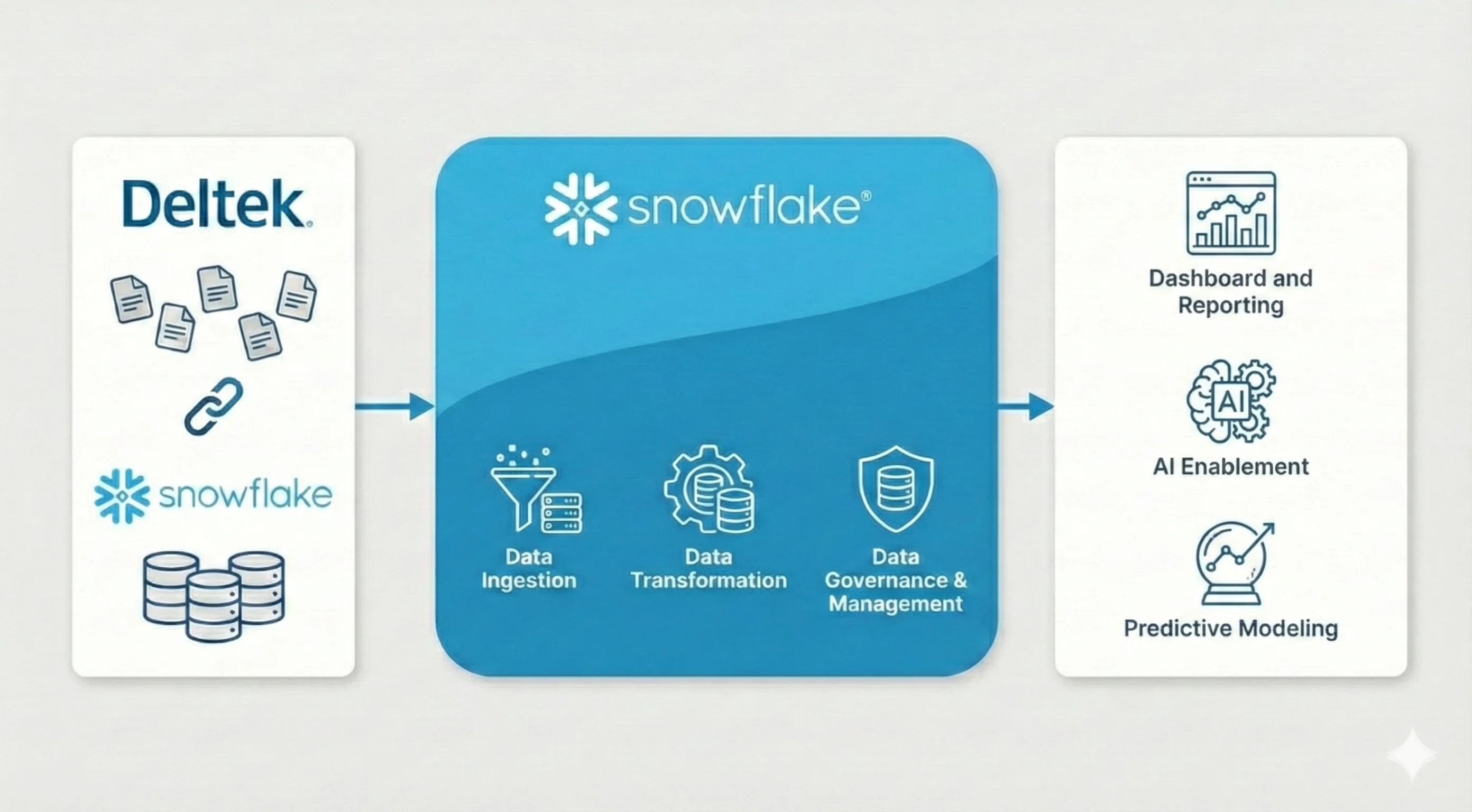
We migrated their legacy on-prem systems to a centralized Snowflake warehouse, unifying Procore APIs and Viewpoint databases into a single dimensional model.
Reconciliation time dropped from 18 days to 2 days.
Domain fluency is why the analytics gets adopted.
Commercial analytics for pharma launches & HCP models.
Read more →P&C underwriting dashboards & catastrophe modeling.
Read more →Product analytics, customer analytics, and churn-prevention models for subscription businesses.
Financial analytics including fraud detection, risk modeling, and regulatory reporting pipelines.
Retail analytics for supply chain forecasting, basket analysis, and marketing analytics attribution.
Operational analytics for IoT telemetry, predictive maintenance, and supply chain analytics.
Route optimization, dynamic pricing, and operational analytics for fleet and warehouse ops.
Healthcare data analytics for patient flow, revenue cycle tracking, and data analytics in healthcare compliance.
Fifteen minutes to hear your current stack and reporting bottlenecks. Fifteen minutes on a pointed diagnostic — what to fix first, what to leave alone, what a 90-day plan looks like.
Migrations fail for reasons that are entirely predictable, entirely avoidable, and almost never listed in the vendor's migration guide. Migrations go wrong in four specific places — here is how we avoid them.
You start with a lift-and-shift plan. Six weeks in, someone wants to fix the dimensional model, someone wants to add real-time streaming, and the migration turns into a two-year re-architecture. We enforce strict lift-and-shift first, optimize second.
The new warehouse is populated, but the finance team refuses to switch over because "the numbers don't tie out." We implement automated shadow-testing tools (like Datafold) to mathematically prove the new pipeline matches the old one.
A migration isn't done until the dashboards point to the new warehouse. Many teams migrate the data but forget they have 400 Tableau dashboards with hardcoded SQL pointing to the legacy database. We migrate end-to-end.
Cloud warehouses separate storage from compute, which means bad queries that used to just run slowly on-prem will now run quickly and rack up $10,000 in Snowflake credits. We set up Resource Monitors and cost alerts on day one.
The storage decision that anchors everything. Here is how to choose the right architecture for your workloads.
| Architecture | Data Format | Primary Workloads | Market Leaders |
|---|---|---|---|
| Data Warehouse | Structured, tabular data (relational) | BI dashboards, financial reporting, executive KPIs | Snowflake, Redshift, Azure Synapse |
| Data Lake | Raw, unstructured, and structured data (JSON, Parquet, images) | Data science, exploratory analysis, cheap archival storage | AWS S3, Azure Data Lake (ADLS), Google Cloud Storage |
| Lakehouse | Structured data with warehouse-like ACID transactions built on top of a data lake | Unified BI and ML workloads, high-volume streaming | Databricks (Delta Lake), Snowflake (Iceberg) |
The standard method for structuring warehouse data into Fact tables (transactions) and Dimension tables (descriptive attributes). Coined by Ralph Kimball, it remains the gold standard for BI performance.
A technique to track the historical state of dimensional data. E.g., when a customer moves to a new state, an SCD Type 2 table keeps the old record so historical sales reports don't rewrite history.
A warehouse built specifically for the cloud that decouples storage and compute, allowing them to scale independently. Snowflake and BigQuery are prime examples.
A subset of a data warehouse focused on a specific business unit (e.g., a Sales Data Mart or HR Data Mart). Built to simplify querying for specific teams.
A method where the database stores data by columns rather than by rows. This makes aggregations (like SUM or AVG) exponentially faster, which is why all modern warehouses use it.
A Snowflake feature that allows you to instantly clone a terabyte-scale database for QA or testing without physically duplicating the storage data, saving immense time and money.
| Criterion | Average Firm | Perceptive Analytics Standard |
|---|---|---|
| Migration Strategy | "We might as well fix it now" re-architecture | Lift-and-shift first, optimize second. Zero downtime. |
| Validation | Manual spot-checking in Excel | Automated shadow-testing and diffing (Datafold) |
| End-to-End Scope | Leaves BI dashboards broken downstream | Full migration including downstream Tableau/Power BI reports |
Check what our clients say